

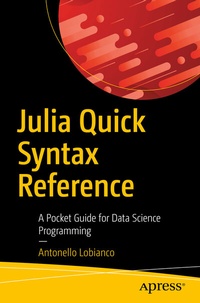
Julia Quick Syntax Reference
A Pocket Guide for Data Science Programming
Published on 12. November 2019
Book
Paperback/Softback
XVII, 216 pages
978-1-4842-5189-8 (ISBN)
Description
This quick Julia programming language guide is a condensed code and syntax reference to the Julia 1.x programming language, updated with the latest features of the Julia APIs, libraries, and packages. It presents the essential Julia syntax in a well-organized format that can be used as a handy reference.
This book provides an introduction that reveals basic Julia structures and syntax; discusses data types, control flow, functions, input/output, exceptions, metaprogramming, performance, and more. Additionally, you'll learn to interface Julia with other programming languages such as R for statistics or Python. You will learn how to use Julia packages for data analysis, numerical optimization and symbolic computation, and how to disseminate your results in dynamic documents or interactive web pages.
In this book, the focus is on providing important information as quickly as possible. It is packed with useful information and is a must-have for any Julia programmer.
What You Will Learn
Who This Book Is For
Experienced programmers new to Julia, as well as existing Julia coders new tothe now stable Julia version 1.0 release.
This book provides an introduction that reveals basic Julia structures and syntax; discusses data types, control flow, functions, input/output, exceptions, metaprogramming, performance, and more. Additionally, you'll learn to interface Julia with other programming languages such as R for statistics or Python. You will learn how to use Julia packages for data analysis, numerical optimization and symbolic computation, and how to disseminate your results in dynamic documents or interactive web pages.
In this book, the focus is on providing important information as quickly as possible. It is packed with useful information and is a must-have for any Julia programmer.
What You Will Learn
- Set up the software needed to run Julia and your first Hello World example
- Work with types and the different containers that Julia makes available for rapid application development
- Use vectorized, classical loop-based code, logical operators, and blocks
- Explore Julia functions by looking at arguments, return values, polymorphism, parameters, anonymous functions, and broadcasts
- Build custom structures in Julia
- Interface Julia with other languages such as C/C++, Python, and R
- Program a richer API, modifying the code before it is executed using expressions, symbols, macros, quote blocks, and more
- Maximize your code's performance
Who This Book Is For
Experienced programmers new to Julia, as well as existing Julia coders new tothe now stable Julia version 1.0 release.
More details
Edition
First Edition
Language
English
Place of publication
Berkeley
United States
Target group
Professional and scholarly
Illustrations
66 s/w Abbildungen
XVII, 216 p. 66 illus.
Dimensions
Height: 23.5 cm
Width: 15.5 cm
Weight
367 gr
ISBN-13
978-1-4842-5189-8 (9781484251898)
DOI
10.1007/978-1-4842-5190-4
Schweitzer Classification
Other editions
New editions
Book
01/2025
2nd Edition
APress
€58.84
Shipment within 10-15 days
Additional editions
E-Book
11/2019
APress
€56.99
Available for download
Person
Antonello Lobianco, PhD is a research engineer employed by a French grande école (polytechnic university). He works on the biophysical and economic modelling of the forest sector and is responsible for the lab models portfolio. He does programming in C++, Perl, PHP, Visual Basic, Python, and Julia. He teaches environmental and forest economics at undergraduate and graduate levels and modelling at PhD level. For a couple of years, he has followed the development of Julia as it fits his modelling needs. He is the author of a few Julia packages (search sylvaticus on GitHub).
Content
Part 1. Language Core.- 1. Getting Started.- 2. Data Types and Structures.- 3. Control Flow and Functions.- 4. Custom Types.- 5. Input - Output.- 6. Metaprogramming and Macros.- 7. Interfacing Julia with Other Languages.- 8. Efficiently Write Efficient Code.- Part 2. Packages Ecosystem.- 9. Working with Data.- 10. Mathematical Libraries.- 11. Utilities.