

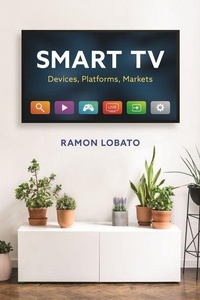
Smart TV
Devices, Platforms, Markets
Will be published approx. on 5. January 2027
Book
Hardback
248 pages
978-1-4798-3550-8 (ISBN)
Description
Charts the evolution of the TV from a broadcast-only receiver to the internet age
Smart TV provides an essential history of the smart TV as a media distribution technology. It explains how the smart TV was conceived, designed, and marketed; how its software and platforms were designed to facilitate certain kinds of interactivity (but not others); how it has reconfigured power relations between manufacturers, users, content providers, and platform operators; and how new advertising forms and practices have emerged in its wake. Ramon Lobato unpacks the heretofore unexplained specificities of smart TV distribution - including its dynamic and personalized platform environment, its elaborate choice architecture, and its distinctive market structure, which brings together technology giants (Google, Amazon, Apple, Baidu), global consumer electronics firms (Samsung, LG, Hisense, TCL, Sony) and dozens of specialist software and UI providers.
The book features a critical media-industries perspective. Building on recent work investigating the affordances, constraints, and policy challenges of "internet-distributed television," Lobato approaches the smart TV as the latest phase in a longer history of power struggles over television distribution. Unlike earlier media studies research on interactive television that emphasized consumer choice, agency, and participation, Lobato neither celebrates the smart TV as a site of user empowerment nor dismisses it out of hand as an instrument of capitalist extraction. Instead, the book critically investigates the actually-existing business arrangements and cultural practices that pave the way for the global adoption of the smart TV and explores what they mean for different kinds of audiences and users. Smart TV develops a multi-perspectival analysis of the smart TV as a media device, weaving together diverse sources that illuminate the impacts for industry and audiences.
Smart TV provides an essential history of the smart TV as a media distribution technology. It explains how the smart TV was conceived, designed, and marketed; how its software and platforms were designed to facilitate certain kinds of interactivity (but not others); how it has reconfigured power relations between manufacturers, users, content providers, and platform operators; and how new advertising forms and practices have emerged in its wake. Ramon Lobato unpacks the heretofore unexplained specificities of smart TV distribution - including its dynamic and personalized platform environment, its elaborate choice architecture, and its distinctive market structure, which brings together technology giants (Google, Amazon, Apple, Baidu), global consumer electronics firms (Samsung, LG, Hisense, TCL, Sony) and dozens of specialist software and UI providers.
The book features a critical media-industries perspective. Building on recent work investigating the affordances, constraints, and policy challenges of "internet-distributed television," Lobato approaches the smart TV as the latest phase in a longer history of power struggles over television distribution. Unlike earlier media studies research on interactive television that emphasized consumer choice, agency, and participation, Lobato neither celebrates the smart TV as a site of user empowerment nor dismisses it out of hand as an instrument of capitalist extraction. Instead, the book critically investigates the actually-existing business arrangements and cultural practices that pave the way for the global adoption of the smart TV and explores what they mean for different kinds of audiences and users. Smart TV develops a multi-perspectival analysis of the smart TV as a media device, weaving together diverse sources that illuminate the impacts for industry and audiences.
More details
Series
Language
English
Place of publication
New York
United States
Target group
Professional and scholarly
Product notice
Trade binding
Illustrations
25 b/w images; 6 tables
Dimensions
Height: 229 mm
Width: 152 mm
ISBN-13
978-1-4798-3550-8 (9781479835508)
Copyright in bibliographic data and cover images is held by Nielsen Book Services Limited or by the publishers or by their respective licensors: all rights reserved.
Schweitzer Classification
Person
Ramon Lobato is Associate Professor in the School of Media and Communication at RMIT University, Melbourne. He is the author of Netflix Nations: The Geography of Digital Distribution and Shadow Economies of Cinema: Mapping Informal Film Distribution.