

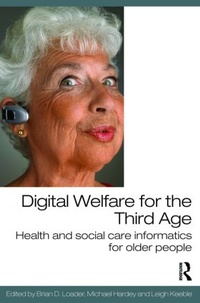
Digital Welfare for the Third Age
Health and social care informatics for older people
Published on 19. December 2008
Book
Paperback/Softback
192 pages
978-0-415-45409-4 (ISBN)
Description
This book is about the ways digital technology can contribute to the welfare of older people. The Internet, mobile phones and other technologies have changed how we live and work. Such technologies also shape how services for older people are organised in ways that potentially place carers and older people at the centre of service provision. Telecare can make homes 'smart' so that they are more comfortable and less risky for people who can take advantage of devices that help make them independent members of their community.
Digital Welfare is part of the broader project in Britain and elsewhere to adopt new information and communications technologies (ICTs) to organise and deliver health and social welfare services. This includes mundane technologies like an alarm to call for help to complex telecare 'smart homes' and electronic patient records. The intended and unintended consequences of such new technologies must be explored if we are to benefit from these innovations. Based on recent research this book seeks to highlight and examine the new opportunities and dilemmas that confront older people and all those concerned with their welfare in the network society.
This edited collection provides original contributions from leading academics and researchers in the field to access the evidence for improved professional integration and user-centred health and social care services for older people arising from health informatics. Digital Welfare for the Third Age will be of interest to all those working with older people.
Digital Welfare is part of the broader project in Britain and elsewhere to adopt new information and communications technologies (ICTs) to organise and deliver health and social welfare services. This includes mundane technologies like an alarm to call for help to complex telecare 'smart homes' and electronic patient records. The intended and unintended consequences of such new technologies must be explored if we are to benefit from these innovations. Based on recent research this book seeks to highlight and examine the new opportunities and dilemmas that confront older people and all those concerned with their welfare in the network society.
This edited collection provides original contributions from leading academics and researchers in the field to access the evidence for improved professional integration and user-centred health and social care services for older people arising from health informatics. Digital Welfare for the Third Age will be of interest to all those working with older people.
More details
Language
English
Place of publication
London
United Kingdom
Publishing group
Taylor & Francis Ltd
Target group
College/higher education
Professional and scholarly
Postgraduate and Professional
Illustrations
12 s/w Tabellen, 5 s/w Zeichnungen, 2 s/w Photographien bzw. Rasterbilder
12 Tables, black and white; 5 Line drawings, black and white; 2 Halftones, black and white
Dimensions
Height: 234 mm
Width: 156 mm
Weight
249 gr
ISBN-13
978-0-415-45409-4 (9780415454094)
Copyright in bibliographic data and cover images is held by Nielsen Book Services Limited or by the publishers or by their respective licensors: all rights reserved.
Schweitzer Classification
Other editions
Additional editions
Brian D. Loader | Michael Hardey | Leigh Keeble
Digital Welfare for the Third Age
Health and social care informatics for older people
E-Book
01/2009
Routledge
€36.99
Available for download
Brian D. Loader | Michael Hardey | Leigh Keeble
Digital Welfare for the Third Age
Health and social care informatics for older people
E-Book
01/2009
Routledge
€36.99
Available for download
Brian D. Loader | Michael Hardey | Leigh Keeble
Digital Welfare for the Third Age
Health and social care informatics for older people
Book
12/2008
Routledge
€133.69
Shipment within 15-20 days
Persons
Brian D. Loader is Co-Director of the Social Informatics Research Unit, Department of Sociology, University of York.
Michael Hardey is Reader in Sociology at the Hull/York Medical School and the Department of Social Sciences at the University of Hull.
Leigh Keeble is a Development Officer in local government, and previously a Research Fellow at the University of York.
Michael Hardey is Reader in Sociology at the Hull/York Medical School and the Department of Social Sciences at the University of Hull.
Leigh Keeble is a Development Officer in local government, and previously a Research Fellow at the University of York.
Content
1. Introduction Part 1: Towards Integrated Service Provision? 2. Are there Limits to the Integration of Care for Older People?3. Partnership in assessment? A case study of integrated information sharing Part 2: User-Centred Assessment and Autonomy 4. Perspectives on Telecare: Implications for Autonomy, Support and Social Inclusion 5. ICTs and Healthcare: User-Centred Devices and Patient Work 6. Networked carers: digital exclusion or digital empowerment? Part 3: Integrated User Design 7. Making sense of sensors: older people's and professional caregivers' attitudes towards telecare8. The performativity of a volunteer based telecare service 9. From have nots to watch dogs: understanding internet health communication behaviors of online senior citizens