

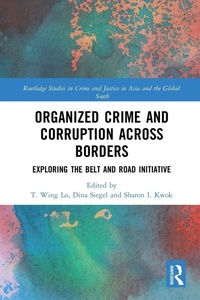
Organized Crime and Corruption Across Borders
Exploring the Belt and Road Initiative
1st Edition
Published on 1. April 2021
Book
Paperback/Softback
282 pages
978-0-367-77746-3 (ISBN)
Description
This book explores China's Belt and Road Initiative and the criminogenic potential for economic, financial, and socio-cultural cooperation across countries, where some are known for weak law enforcement and high levels of corruption. It examines whether these flows of capital are increasing the amount of organized crime in the newly linked regions and how law enforcement agencies are responding.
Bringing together experts across the Global South and Europe, this book considers transnational organized crime and corruption across One Belt One Road (OBOR). It examines crime and corruption in China and its international United Front tactic; analyzes various forms of transnational organized crime such as trafficking of illegal drugs, looted antiquities, and wildlife and counterfeit products; and presents studies on corruption and organized crime in selected OBOR countries including Russia, Kazakhstan, Lithuania, Czech Republic, Poland, and Bangladesh.
This book makes a significant contribution to the development of southern criminology and will also be of interest to those engaged with transnational organized crime, political economy, international relations, and Asian and Chinese studies.
Bringing together experts across the Global South and Europe, this book considers transnational organized crime and corruption across One Belt One Road (OBOR). It examines crime and corruption in China and its international United Front tactic; analyzes various forms of transnational organized crime such as trafficking of illegal drugs, looted antiquities, and wildlife and counterfeit products; and presents studies on corruption and organized crime in selected OBOR countries including Russia, Kazakhstan, Lithuania, Czech Republic, Poland, and Bangladesh.
This book makes a significant contribution to the development of southern criminology and will also be of interest to those engaged with transnational organized crime, political economy, international relations, and Asian and Chinese studies.
More details
Series
Language
English
Place of publication
London
United Kingdom
Publishing group
Taylor & Francis Ltd
Target group
College/higher education
Professional and scholarly
Postgraduate and Undergraduate
Dimensions
Height: 234 mm
Width: 156 mm
Thickness: 16 mm
Weight
453 gr
ISBN-13
978-0-367-77746-3 (9780367777463)
Copyright in bibliographic data and cover images is held by Nielsen Book Services Limited or by the publishers or by their respective licensors: all rights reserved.
Schweitzer Classification
Other editions
Additional editions
T. Wing Lo | Dina Siegel | Sharon Kwok
Organized Crime and Corruption Across Borders
Exploring the Belt and Road Initiative
Book
09/2019
1st Edition
Routledge
€179.51
Shipment within 15-20 days
T. Wing Lo | Dina Siegel | Sharon Kwok
Organized Crime and Corruption Across Borders
Exploring the Belt and Road Initiative
E-Book
09/2019
1st Edition
Routledge
€59.49
Available for download
T. Wing Lo | Dina Siegel | Sharon Kwok
Organized Crime and Corruption Across Borders
Exploring the Belt and Road Initiative
E-Book
09/2019
1st Edition
Routledge
€59.49
Available for download
Persons
T. Wing Lo is Head and Professor of the Department of Social and Behavioural Sciences at City University of Hong Kong. He received his PhD in criminology from the University of Cambridge (1991). He formerly worked with Chinese triad gangs and was invited to address the UN delegates attending the Palermo Convention Against Transnational Organized Crime (2010) and officials of the US Department of Defense (2015).
Dina Siegel is Professor of Criminology and Chair of the Willem Pompe Institute for Criminal Law and Criminology, Utrecht University. She has conducted research on transnational organized crime, human smuggling and trafficking, crimes of mobility, Russian mafia and other East European criminal organizations, crime in the diamond industry, and various activities of Asian organized crime in the European Union.
Sharon I. Kwok is Lecturer in the School of Social Sciences and Psychology, Western Sydney University, specializing in the study of triad society and Chinese organized crime. She received a BA, MSc, and PhD in criminology from the University of Hull (2001), London School of Economics (2004), and City University of Hong Kong (2017), respectively.
Dina Siegel is Professor of Criminology and Chair of the Willem Pompe Institute for Criminal Law and Criminology, Utrecht University. She has conducted research on transnational organized crime, human smuggling and trafficking, crimes of mobility, Russian mafia and other East European criminal organizations, crime in the diamond industry, and various activities of Asian organized crime in the European Union.
Sharon I. Kwok is Lecturer in the School of Social Sciences and Psychology, Western Sydney University, specializing in the study of triad society and Chinese organized crime. She received a BA, MSc, and PhD in criminology from the University of Hull (2001), London School of Economics (2004), and City University of Hong Kong (2017), respectively.
Content
Introduction; 1. One Belt, One Road and the Process of OBORization; Part A: China 1990 to 2018; 2. The Post-Tiananmen Decade: Prices Paid for China's Economic Growth; 3. Control of Grand Corruption and Triad Crime in China; 4. A Hardboiled Belt and Road: Backlash to the UN-Bribes-for-OBOR Scandals; Part B: Transnational Crime along the Belt and Road; 5. Transnational Crime in Asia: Illicit Markets and Innovation; 6. Crime, Corruption, and Collateral Damage: Large Infrastructure Projects as a Threat to Cultural Heritage; 7. Chinese Wildlife Trafficking Networks along the Silk Road; 8. Protected Wildlife on the One Belt, One Road: A Case Study of Illegal Tiger Skins Trade; Part C: Organized Crime and Corruption in OBOR Countries; 9. Organized Crime in Contemporary Russia; 10. Organized Crime in Kazakhstan; 11. Corruption and Anti-Corruption in Lithuania; 12. Organized Crime in the Czech Republic; 13. Organized Crime in Poland and its Control from a Central European Perspective; 14. Organized Crime and Corruption in Bangladesh; Conclusion; 15. The Possible Outcome of OBORization