

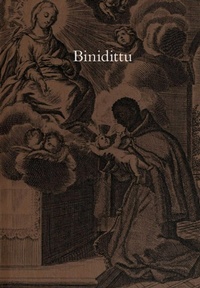
Binidittu
Published on 12. October 2021
Book
Hardback
160 pages
978-88-945155-3-4 (ISBN)
Description
Saint Benedict the Moor, or Binidittu as the Sicilians fondly rechristened him, was an Afro-Sicilian hermit friar, the son of African slaves born in Sicily in the 16th century. Canonized in 1807, he was the Catholic Church’s first Black saint and was made Patron Saint of Palermo. These photographs address the lives of African migrants in the Mediterranean today through the historical figure of Binidittu. This project retraces his improbable life, explores the historical sites of his hagiography, the worship of relics, and the religious and secular practices devoted to him in Sicily and elsewhere in the Mediterranean. This book is part of Lo Calzo's long-term photographic project, Cham, about the living memories of colonial slavery and anti-slavery struggles.
“Binidittu emerges in this work as an allegory of our time: an encounter between the Mare Nostrum and the world, between oblivion and memory, between racism made commonplace and our shared humanity, between the Sicilian people’s aspirations and African migrants’ hopes of freedom and dignity as they drift towards Europe’s shores.” Nicola lo Calzo
Text in English and Italian.
“Binidittu emerges in this work as an allegory of our time: an encounter between the Mare Nostrum and the world, between oblivion and memory, between racism made commonplace and our shared humanity, between the Sicilian people’s aspirations and African migrants’ hopes of freedom and dignity as they drift towards Europe’s shores.” Nicola lo Calzo
Text in English and Italian.
More details
Language
English
Place of publication
Italy
Product notice
sewn/stitched
Cloth over boards
Dimensions
Height: 244 mm
Width: 172 mm
Thickness: 18 mm
Weight
617 gr
ISBN-13
978-88-945155-3-4 (9788894515534)
Copyright in bibliographic data and cover images is held by Nielsen Book Services Limited or by the publishers or by their respective licensors: all rights reserved.
Schweitzer Classification
Person
Nicola Lo Calzo was born in Turin in 1979. He lives and works between Paris, West Africa and the Caribbean. He is represented by l’Agence à Paris.
After studying landscape architecture, he turned his gaze to photography. His photographic practice and research question notions of coloniality and identity. Imbued with profound empathy, Nicola Lo Calzo’s photographs show the ways in which minority groups interact with their environment and develop strategies of survival and resistance.
For almost seven years, he has been engaged in a long-term photographic research project on the memories of the slave trade and slavery. Cham, this ambitious and ongoing project has already taken him to Africa, the Caribbean and America. His photographs have been widely exhibited in museums, art centers and festivals, most notably the Macaal in Marrakesh, the Afriques Capitales in Lille, the Musée des Confluences in Lyon, the National Alinari Museum of Photography in Florence, and the Tropenmuseum in Amsterdam. His photography is present in many private and public collections including the Lightwork collection in Syracuse, Alinari Archives in Florence, the Pinacoteca Civica in Monza, the National Library of France in Paris, and Amsterdam’s Tropenmuseum.
After studying landscape architecture, he turned his gaze to photography. His photographic practice and research question notions of coloniality and identity. Imbued with profound empathy, Nicola Lo Calzo’s photographs show the ways in which minority groups interact with their environment and develop strategies of survival and resistance.
For almost seven years, he has been engaged in a long-term photographic research project on the memories of the slave trade and slavery. Cham, this ambitious and ongoing project has already taken him to Africa, the Caribbean and America. His photographs have been widely exhibited in museums, art centers and festivals, most notably the Macaal in Marrakesh, the Afriques Capitales in Lille, the Musée des Confluences in Lyon, the National Alinari Museum of Photography in Florence, and the Tropenmuseum in Amsterdam. His photography is present in many private and public collections including the Lightwork collection in Syracuse, Alinari Archives in Florence, the Pinacoteca Civica in Monza, the National Library of France in Paris, and Amsterdam’s Tropenmuseum.