

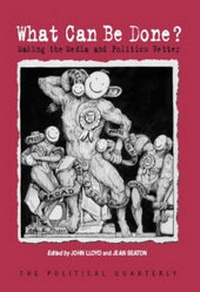
What Can Be Done?
Making the Media and Politics Better
Published on 21. June 2006
Book
Paperback/Softback
172 pages
978-1-4051-3693-8 (ISBN)
Description
This book proposes a series of reforms that could improve the media and politics, and the interaction of the two, in Britain.
This book makes an important contribution to public debate in Britain about the relationship between the media and politics.
Contributors include academics, journalists and political commentators.
Topical issues covered include regulation, public service broadcasting, managing the news, and training journalists.
The focus is on Britain, but key commentators from America and Europe put the British problems into perspective.
This book makes an important contribution to public debate in Britain about the relationship between the media and politics.
Contributors include academics, journalists and political commentators.
Topical issues covered include regulation, public service broadcasting, managing the news, and training journalists.
The focus is on Britain, but key commentators from America and Europe put the British problems into perspective.
More details
Series
Language
English
Place of publication
Hoboken
United Kingdom
Publishing group
John Wiley and Sons Ltd
Target group
Professional and scholarly
Dimensions
Height: 246 mm
Width: 170 mm
Thickness: 8 mm
Weight
290 gr
ISBN-13
978-1-4051-3693-8 (9781405136938)
Copyright in bibliographic data and cover images is held by Nielsen Book Services Limited or by the publishers or by their respective licensors: all rights reserved.
Schweitzer Classification
Persons
John Lloyd is a Contributing Editor to the Financial Times. He is a member of the editorial board of Prospect magazine, and of the Moscow School of Political Studies. He has won several top journalism awards and, in addition to TV and radio work, is a post editor of the New Statesmen and of Time Out. With others, he is creating the Reuters Institute for the Study of Journalism at Oxford University. His most recent book is What The Media Are Doing To Our Politics.
Jean Seaton is Professor of Media History at the University of Westminster and is on the board of Political Quarterly. She was official historian of the BBC for the 1980s, and is the author of Carnage and the Media (2005).
Jean Seaton is Professor of Media History at the University of Westminster and is on the board of Political Quarterly. She was official historian of the BBC for the 1980s, and is the author of Carnage and the Media (2005).
Content
Notes on Contributors. Introduction: Jean Seaton.
1. Hotting It Up: Jurgen Kronig.
2. The Virtues of an Unlovable Press: Michael Schudson.
3. The Epiphany of Joe Trippi: John Lloyd.
4. What's Good on Television?: Tim Gardam.
5. Can the BBC Invigorate our Political Culture?: Steven Barnett.
6. The Rise of the Ranters: Saving Political Journalism: Peter Riddell.
7. Morally Engaged: Reporters in Crises: Martin Woollacott.
8. Lacking a Clear Narrative: Foreign Reporting after the Cold War: Suzanne Franks.
9. Digitising Democracy: Georgina Born.
10. Little Citizens: Children, the Media and Politics: Jean Seaton.
11. On the Cusp: Finding New Visions for Social Gain from Broadcasting: Don Redding.
Index.
1. Hotting It Up: Jurgen Kronig.
2. The Virtues of an Unlovable Press: Michael Schudson.
3. The Epiphany of Joe Trippi: John Lloyd.
4. What's Good on Television?: Tim Gardam.
5. Can the BBC Invigorate our Political Culture?: Steven Barnett.
6. The Rise of the Ranters: Saving Political Journalism: Peter Riddell.
7. Morally Engaged: Reporters in Crises: Martin Woollacott.
8. Lacking a Clear Narrative: Foreign Reporting after the Cold War: Suzanne Franks.
9. Digitising Democracy: Georgina Born.
10. Little Citizens: Children, the Media and Politics: Jean Seaton.
11. On the Cusp: Finding New Visions for Social Gain from Broadcasting: Don Redding.
Index.