

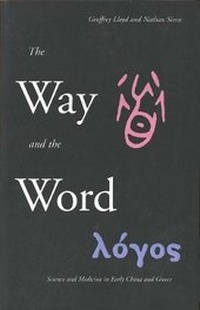
The Way and the Word
Science and Medicine in Early China and Greece
Published on 10. November 2003
Book
Paperback/Softback
368 pages
978-0-300-10160-7 (ISBN)
Description
The rich civilizations of ancient China and Greece built sciences of comparable sophistication-each based on different foundations of concept, method, and organization. In this engrossing book, two world-renowned scholars compare the cosmology, science, and medicine of China and Greece between 400 B.C. and A.D. 200, casting new light not only on the two civilizations but also on the evolving character of science.
Sir Geoffrey Lloyd and Nathan Sivin investigate the differences between the thinkers in the two civilizations: what motivated them, how they understood the cosmos and the human body, how they were educated, how they made a living, and whom they argued with and why. The authors' new method integrally compares social, political, and intellectual patterns and connections, demonstrating how all affected and were affected by ideas about cosmology and the physical world. They relate conceptual differences in China and Greece to the diverse ways that intellectuals in the two civilizations earned their living, interacted with fellow inquirers, and were involved with structures of authority.
By A.D. 200 the distinctive scientific strengths of both China and Greece showed equal potential for theory and practice. Lloyd and Sivin argue that modern science evolved not out of the Greek tradition alone but from the strengths of China, Greece, India, Islam, and other civilizations, which converged first in the Muslim world and then in Renaissance Europe.
Sir Geoffrey Lloyd and Nathan Sivin investigate the differences between the thinkers in the two civilizations: what motivated them, how they understood the cosmos and the human body, how they were educated, how they made a living, and whom they argued with and why. The authors' new method integrally compares social, political, and intellectual patterns and connections, demonstrating how all affected and were affected by ideas about cosmology and the physical world. They relate conceptual differences in China and Greece to the diverse ways that intellectuals in the two civilizations earned their living, interacted with fellow inquirers, and were involved with structures of authority.
By A.D. 200 the distinctive scientific strengths of both China and Greece showed equal potential for theory and practice. Lloyd and Sivin argue that modern science evolved not out of the Greek tradition alone but from the strengths of China, Greece, India, Islam, and other civilizations, which converged first in the Muslim world and then in Renaissance Europe.
Reviews / Votes
"A nuanced, sophisticated, and deeply learned reflection on ancient science... The book will be the foundation for thinking about the deep structures of the sociology of knowledge in antiquity." Thomas Laqueur, Times Literary SupplementMore details
Language
English
Place of publication
United States
Target group
College/higher education
Professional and scholarly
Product notice
Paperback (trade)
Dimensions
Height: 210 mm
Width: 140 mm
Weight
408 gr
ISBN-13
978-0-300-10160-7 (9780300101607)
Copyright in bibliographic data and cover images is held by Nielsen Book Services Limited or by the publishers or by their respective licensors: all rights reserved.
Schweitzer Classification
Persons
Sir Geoffrey Lloyd is emeritus professor of ancient philosophy and science at the University of Cambridge. Nathan Sivin is professor of Chinese culture and of the history of science at the University of Pennsylvania.