

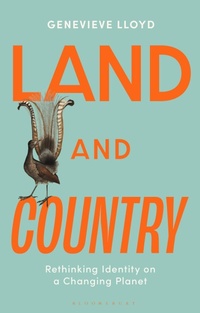
Land and Country
Rethinking Identity on a Changing Planet
Will be published approx. on 26. November 2026
Book
Hardback
192 pages
978-1-350-61042-2 (ISBN)
Description
Land and Country brings philosophical thought into direct engagement with Australia's contested debates on identity, sovereignty, and belonging.
Drawing on the author's family history of convict descent, and expounding on the thorny and variegated web of relations that determine the Australian past and present, this book traces the intersection of ancestral lives with the violence of settlement: land grants on stolen Country, frontier conflict, the Appin massacre, and the shifting cultural meanings of convict shame and pride. Beneath these stories lies a deeper inquiry: what does it mean to pursue family history as an act of truth-telling in a nation still struggling to reckon with its own past?
Interweaving political philosophy, feminist critique, and intellectual history, Lloyd examines the conceptual frameworks that continue to shape national debate - whiteness and multiculturalism; Enlightenment ideas of property and progress; the emotional dynamics of guilt, shame, pride, and responsibility; and the colonial mindset that persists in public discourse. She brings Locke, Kant and Spinoza into dialogue with Indigenous critiques of sovereignty, and explores how contemporary First Nations storytelling and visual practice unsettle colonial narratives and offer new imaginative "entry points" into shared truths about Country, climate change, and coexistence.
This intervention from one of Australia's most eminent contemporary philosophers is especially germane in the wake of the rejection of the 2023 referendum on a constitutionally enshrined indigenous 'Voice' to government: its principal objective is to make a philosophical contribution to the path towards indigenous recognition and national reconciliation. Part memoir, part philosophy, part cultural criticism, this book offers a compelling contribution to ongoing truth-telling, and to the still-unfinished task of imagining a just future between First Nations and non-Indigenous Australians.
Drawing on the author's family history of convict descent, and expounding on the thorny and variegated web of relations that determine the Australian past and present, this book traces the intersection of ancestral lives with the violence of settlement: land grants on stolen Country, frontier conflict, the Appin massacre, and the shifting cultural meanings of convict shame and pride. Beneath these stories lies a deeper inquiry: what does it mean to pursue family history as an act of truth-telling in a nation still struggling to reckon with its own past?
Interweaving political philosophy, feminist critique, and intellectual history, Lloyd examines the conceptual frameworks that continue to shape national debate - whiteness and multiculturalism; Enlightenment ideas of property and progress; the emotional dynamics of guilt, shame, pride, and responsibility; and the colonial mindset that persists in public discourse. She brings Locke, Kant and Spinoza into dialogue with Indigenous critiques of sovereignty, and explores how contemporary First Nations storytelling and visual practice unsettle colonial narratives and offer new imaginative "entry points" into shared truths about Country, climate change, and coexistence.
This intervention from one of Australia's most eminent contemporary philosophers is especially germane in the wake of the rejection of the 2023 referendum on a constitutionally enshrined indigenous 'Voice' to government: its principal objective is to make a philosophical contribution to the path towards indigenous recognition and national reconciliation. Part memoir, part philosophy, part cultural criticism, this book offers a compelling contribution to ongoing truth-telling, and to the still-unfinished task of imagining a just future between First Nations and non-Indigenous Australians.
Reviews / Votes
Land and Country is a decolonial tour de force by one of Australia's most respected Continental philosophers. Embarking on a painful autoethnography informed by the genocidal actions of her forebears, Genevieve Lloyd undertakes a reflexive interrogation of the collective imaginings and conceptual formations that structure how our colonial legacy is lived in present-day Australia. Into the dark history of the colonial dispossession of Indigenous Peoples, Land and Country shines an unwavering light to reveal conceptual genealogies of issues currently under contested political deliberation and public debate. The outcome is a powerful social critique of the present, laying bare the persistent recalcitrance of non-Indigenous Australia's refusal to engage with contemporary Indigenous demands for justice in the form of truth-telling, treaty and a representative voice within the postcolonial political system.~ Simone Bignall, author of Postcolonial Agency: Critique and Constructivism and Research Professor in Jumbunna Institute at the University of Technology Sydney. * Simone Bignall, author of Postcolonial Agency: Critique and Constructivism and Research Professor in Jumbunna Institute, University of Technology Sydney, Australia *
More details
Series
Language
English
Place of publication
London
United Kingdom
Publishing group
Bloomsbury Publishing PLC
Target group
College/higher education
Dimensions
Height: 234 mm
Width: 156 mm
Thickness: 25 mm
Weight
454 gr
ISBN-13
978-1-350-61042-2 (9781350610422)
Copyright in bibliographic data and cover images is held by Nielsen Book Services Limited or by the publishers or by their respective licensors: all rights reserved.
Schweitzer Classification
Person
Genevieve Lloyd is Professor Emerita at the Australian Academy of the Humanities, and was the first female Professor of Philosophy appointed in Australia. Her latest book is Reading Spinoza in the Anthropocene (2024).
Content
Acknowledgements
Introduction: Being Australian
1. Land and Country
2. Boats and Borders
3. Gender Disparity and 'White' Feminist Theory
4. 'Colonialist' Assumptions
5. Australia and The Enlightenment
6. Re-Imagining Being Australian
Conclusion: Thinking Back Through Ancestors
Appendix: The Uluru Statement From The Heart
Bibliography
Acknowledgements
Introduction: Being Australian
1. Land and Country
2. Boats and Borders
3. Gender Disparity and 'White' Feminist Theory
4. 'Colonialist' Assumptions
5. Australia and The Enlightenment
6. Re-Imagining Being Australian
Conclusion: Thinking Back Through Ancestors
Appendix: The Uluru Statement From The Heart
Bibliography
Acknowledgements