

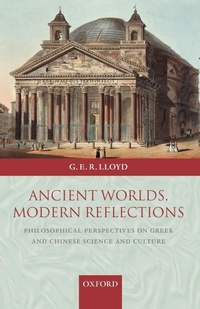
Ancient Worlds, Modern Reflections
Philosophical Perspectives on Greek and Chinese Science and Culture
Published on 2. February 2006
Book
Paperback/Softback
236 pages
978-0-19-928870-0 (ISBN)
Description
Geoffrey Lloyd engages in a wide-ranging exploration of what we can learn from the study of ancient civilisations that is relevant to fundamental problems, both intellectual and moral, that we still face today.
How far is it possible to arrive at an understanding of alien systems of belief? Is it possible to talk meaningfully of 'science' and of its various constituent disciplines, 'astronomy', 'geography', 'anatomy', and so on, in the ancient world? Are logic and its laws universal? Is there one ontology - a single world - to which all attempts at understanding must be considered to be directed? When we encounter apparently very different views of reality, how far can that be put down to a difference in conceptions of what needs explaining, or of what counts as an explanation, or to different preferred modes of reasoning or styles of inquiry? Do the notions of truth and belief represent reliable cross-cultural universals?
In another area, what can ancient history teach us about today's social and political problems? Are the discourses of human nature and of human rights universally applicable? What political institutions do we need to help secure equity and justice within nation states and between them?
Lloyd sets out to answer all these questions, and to convince us that the science and culture of ancient Greece and China provide precious resources to advance modern debates.
How far is it possible to arrive at an understanding of alien systems of belief? Is it possible to talk meaningfully of 'science' and of its various constituent disciplines, 'astronomy', 'geography', 'anatomy', and so on, in the ancient world? Are logic and its laws universal? Is there one ontology - a single world - to which all attempts at understanding must be considered to be directed? When we encounter apparently very different views of reality, how far can that be put down to a difference in conceptions of what needs explaining, or of what counts as an explanation, or to different preferred modes of reasoning or styles of inquiry? Do the notions of truth and belief represent reliable cross-cultural universals?
In another area, what can ancient history teach us about today's social and political problems? Are the discourses of human nature and of human rights universally applicable? What political institutions do we need to help secure equity and justice within nation states and between them?
Lloyd sets out to answer all these questions, and to convince us that the science and culture of ancient Greece and China provide precious resources to advance modern debates.
Reviews / Votes
Review from previous edition Lloyd's work is one of those rare studies that brings together the various debates of the East-West dialogue without favouring one side. * Quadrant *More details
Language
English
Place of publication
Oxford
United Kingdom
Publishing group
Oxford University Press
Target group
Professional and scholarly
Scholars and students of philosophy and the history of ideas
Dimensions
Height: 216 mm
Width: 140 mm
Thickness: 14 mm
Weight
339 gr
ISBN-13
978-0-19-928870-0 (9780199288700)
Copyright in bibliographic data and cover images is held by Nielsen Book Services Limited or by the publishers or by their respective licensors: all rights reserved.
Schweitzer Classification
Other editions
Additional editions
Geoffrey Lloyd
Ancient Worlds, Modern Reflections
Philosophical Perspectives on Greek and Chinese Science and Culture
E-Book
02/2006
OUP eBook
€37.99
Available for download
Geoffrey Lloyd
Ancient Worlds, Modern Reflections
Philosophical Perspectives on Greek and Chinese Science and Culture
Book
02/2004
Oxford University Press
€164.60
Shipment within 15-20 days
Person
Geoffrey Lloyd is Emeritus Professor of Ancient Philosophy and Science at the University of Cambridge.
Content
1. Understanding Ancient Societies ; 2. Science in Ancient Civilizations? ; 3. Carving out Territories ; 4. A Common Logic ; 5. Searching for Truth ; 6. The Questionability of Belief ; 7. Styles of Inquiry and the Question of a Common Ontology ; 8. The Use and Abuse of Classification ; 9. For Example and Against ; 10. Universities: their Histories and Responsibilities ; 11. Human Nature and Human Rights ; 12. A Critique of Democracy ; Conclusion ; Glossary of Chinese and Greek Terms