

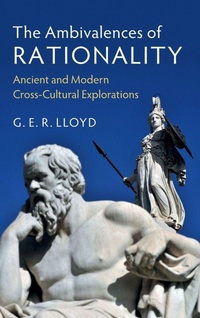
The Ambivalences of Rationality
Ancient and Modern Cross-Cultural Explorations
Published on 21. December 2017
Book
Hardback
132 pages
978-1-108-42004-4 (ISBN)
Description
Is rationality a well-defined human universal such that ideas and behaviour can everywhere be judged by a single set of criteria? Or are the rational and the irrational simply cultural constructs? This study provides an alternative to both options. The universalist thesis underestimates the variety found in sound human reasonings exemplified across time and space and often displays a marked Eurocentric bias. The extreme relativist faces the danger of concluding that we are all locked into mutually unintelligible universes. These problems are worse when certain concepts, often inherited from ancient Greek thought, especially binaries such as nature and culture, or the literal and the metaphorical, are not examined critically. Drawing on a variety of disciplines, from philosophy to cognitive science, this book explores what both ancient societies (Greece and China especially) and modern ones (as revealed by ethnography) can teach us concerning the heterogeneity of what can be called rational.
More details
Language
English
Place of publication
Cambridge
United Kingdom
Target group
Professional and scholarly
Product notice
sewn/stitched
Cloth over boards
Illustrations
Worked examples or Exercises
Dimensions
Height: 243 mm
Width: 164 mm
Thickness: 13 mm
Weight
313 gr
ISBN-13
978-1-108-42004-4 (9781108420044)
Copyright in bibliographic data and cover images is held by Nielsen Book Services Limited or by the publishers or by their respective licensors: all rights reserved.
Schweitzer Classification
Other editions
Additional editions
E-Book
01/2018
Cambridge University Press
€44.49
Available for download
E-Book
12/2017
Cambridge University Press
€36.99
Available for download
Person
G. E. R. Lloyd is Emeritus Professor of Ancient Philosophy and Science at the University of Cambridge, former Master of Darwin College Cambridge and Senior Scholar in Residence at the Needham Research Institute, Cambridge. He has held Visiting Professorships in Europe, North America, the Far East and Australasia. He is the author of twenty-three books and editor of a further five. He won the Sarton Medal for History of Science in 1987, the Kenyon Medal for Classical Studies in 2007, the Dan David prize in 2013, the Fyssen prize in 2014, and he was knighted for services to the history of thought in 1997.
Content
1. Aims and methods; 2. Rationality reviewed; 3. Cosmology without nature; 4. Seeming and being; 5. Language, literacy and cognition; 6. Gods, spirits, demons, ghosts, mysticism, miracles, magic, myth; 7. Conclusions: the ambivalences of rationality.