

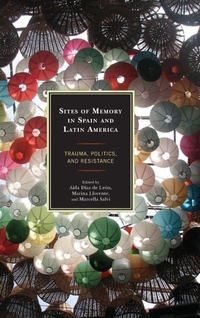
Sites of Memory in Spain and Latin America
Trauma, Politics, and Resistance
Published on 3. September 2015
Book
Hardback
186 pages
978-1-4985-0778-3 (ISBN)
Description
Sites of Memory in Spain and Latin America is a collection of essays that explores historical memory at the intersection of political, cultural, social, and economic forces in the contexts of Spain and Latin America. The essays here focus on a variety of forms of memory-from the most concrete to the performative-that resist forgetting and unite individuals against hegemonic memory. The volume comprises four thematic sections that focus on Chile, Spain, Argentina, Venezuela, Mexico, Peru, and the Dominican Republic. Keeping in line with the concept informing this collection, that the past returns politically to haunt the present, the four sections move from the contemporary context to the colonial and pre-Columbian eras in Latin America. For all its diversity, the researchers' interdisciplinary methodology displayed in this collection brings to light processes that would otherwise have remained illegible under a more narrow interpretative approach to historical memory.
This volume focuses on the processes of remembering in geographies that have been transformed by violence and conflict in Spain and Latin America. In the cases investigated witnessing, trauma, and testimony speak to the urgency of truth and justice; historical memory, therefore, is ultimately a political act.
This volume focuses on the processes of remembering in geographies that have been transformed by violence and conflict in Spain and Latin America. In the cases investigated witnessing, trauma, and testimony speak to the urgency of truth and justice; historical memory, therefore, is ultimately a political act.
Reviews / Votes
This excellent collection of essays reveals new and meaningful connections between the ways in which Spain and Latin America have been coming to terms with recent and not-so-recent violent pasts. The book not only makes the case for a Trans-Atlantic approach to memory studies in the Spanish-speaking world, but is also evidence of the specific contribution that literature, culture, and cultural criticism can make to the complex social processes that define individual and collective relationships with the past. -- Sebastiaan Faber, Oberlin CollegeMore details
Language
English
Place of publication
United States
Publishing group
Bloomsbury Publishing Plc
Target group
Professional and scholarly
Product notice
sewn/stitched
Cloth over boards
With dust jacket
Illustrations
Illustrations; Halftones, Black & White including Black & White Photographs
Dimensions
Height: 235 mm
Width: 157 mm
Thickness: 15 mm
Weight
429 gr
ISBN-13
978-1-4985-0778-3 (9781498507783)
Copyright in bibliographic data and cover images is held by Nielsen Book Services Limited or by the publishers or by their respective licensors: all rights reserved.
Schweitzer Classification
Other editions
Additional editions
Sites of Memory in Spain and Latin America
Trauma, Politics, and Resistance
E-Book
09/2015
1st Edition
Lexington Books
€38.49
Available for download
Persons
Aida Diaz de Leon is visiting professor of Spanish in the Department of Modern Languages and Literatures at St. Lawrence University.
Marina Llorente is professor of modern languages and literatures at St. Lawrence University.
Marcella Salvi is associate professor of Italian and Spanish at St. Lawrence University.
Marina Llorente is professor of modern languages and literatures at St. Lawrence University.
Marcella Salvi is associate professor of Italian and Spanish at St. Lawrence University.
Content
Part I: Introduction
The Politics of the Past and the Fragmentary Present: Locating Memory in Spain and Latin America, by Aida Diaz de Leon
Part II: From the Repertoire to the Archive: Memory in Chile after Pinochet
Chapter 1: Performing Memory and Democracy in Chile, by Liliana Trevizan
Chapter 2: Memory in Chile: A Conversation on Democracy. Interview to Ricardo Brodsky Baudet, Executive Director of the Museum of Memory and Human Rights in Chile (December 3, 2013), by Oscar D. Sarmiento and Liliana Trevizan
Part III: Literature as Media of Memory in Spain and Latin America
Chapter 3: Everything Is Coming to Light: Re-appearance of Lost History in Carmen Martin-Gaite's El cuarto de atras, by Marcella Salvi
Chapter 4: Exile and Erasure: A Poetic Reconstruction of the Spanish Past in Antonio Crespo Massieu's Elegia en Portbou, by Marina Llorente
Chapter 5: Translation as a Means of Preserving Historical Memory in Spain, Nicaragua, and Chile, by Steven F. White
Chapter 6: Narrativa e ilusion: Argentine Historical Memory in Una sombra ya pronto seras by Osvaldo Soriano, by Mallory N. Craig-Kuhn
Part IV: The Struggles of Memory in the Global Market: Venezuela and Mexico
Chapter 7: The Children of 1989: Resurrecting the Venezuelan Dead, by George Ciccariello-Maher
Chapter 8: Depoliticization, Historical Memory, and Resistance to Obliviousness: The Case of Feminicide and the Cotton Field Memorial in Ciudad Juarez, Mexico, by Martha I. Chew Sanchez and Alfredo Limas Hernandez
Part V: The Palimpsest of Memory: Reconstructing Race, Culture, and Religion from Colonial Times to the Present in Peru, Mexico, and the Dominican Republic
Chapter 9: Mystic Ringing of Stone Bells: A Case of Annihilation of Cultural Memory in Peru, by Beatriz Carolina Pena
Chapter 10: The Memory of Black Womanhood in Mexico: La Mulata de Cordoba, by Selfa A. Chew
Chapter 11: Casting Traitors and Villains: The Historiographical Memory of the 1605 Depopulations of Hispaniola, by Juan Jose Ponce-Vazquez
The Politics of the Past and the Fragmentary Present: Locating Memory in Spain and Latin America, by Aida Diaz de Leon
Part II: From the Repertoire to the Archive: Memory in Chile after Pinochet
Chapter 1: Performing Memory and Democracy in Chile, by Liliana Trevizan
Chapter 2: Memory in Chile: A Conversation on Democracy. Interview to Ricardo Brodsky Baudet, Executive Director of the Museum of Memory and Human Rights in Chile (December 3, 2013), by Oscar D. Sarmiento and Liliana Trevizan
Part III: Literature as Media of Memory in Spain and Latin America
Chapter 3: Everything Is Coming to Light: Re-appearance of Lost History in Carmen Martin-Gaite's El cuarto de atras, by Marcella Salvi
Chapter 4: Exile and Erasure: A Poetic Reconstruction of the Spanish Past in Antonio Crespo Massieu's Elegia en Portbou, by Marina Llorente
Chapter 5: Translation as a Means of Preserving Historical Memory in Spain, Nicaragua, and Chile, by Steven F. White
Chapter 6: Narrativa e ilusion: Argentine Historical Memory in Una sombra ya pronto seras by Osvaldo Soriano, by Mallory N. Craig-Kuhn
Part IV: The Struggles of Memory in the Global Market: Venezuela and Mexico
Chapter 7: The Children of 1989: Resurrecting the Venezuelan Dead, by George Ciccariello-Maher
Chapter 8: Depoliticization, Historical Memory, and Resistance to Obliviousness: The Case of Feminicide and the Cotton Field Memorial in Ciudad Juarez, Mexico, by Martha I. Chew Sanchez and Alfredo Limas Hernandez
Part V: The Palimpsest of Memory: Reconstructing Race, Culture, and Religion from Colonial Times to the Present in Peru, Mexico, and the Dominican Republic
Chapter 9: Mystic Ringing of Stone Bells: A Case of Annihilation of Cultural Memory in Peru, by Beatriz Carolina Pena
Chapter 10: The Memory of Black Womanhood in Mexico: La Mulata de Cordoba, by Selfa A. Chew
Chapter 11: Casting Traitors and Villains: The Historiographical Memory of the 1605 Depopulations of Hispaniola, by Juan Jose Ponce-Vazquez