

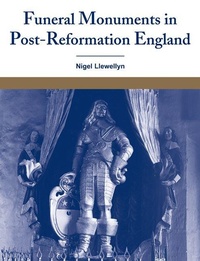
Funeral Monuments in Post-Reformation England
Published on 2. April 2009
Book
Paperback/Softback
500 pages
978-0-521-10752-5 (ISBN)
Description
This book takes as its subject the most important kind of surviving post-Reformation church art and the most important genre of English Renaissance sculpture, the carved stone funeral monument. These complex constructions, comprising not just sculpted figures but also architectural framing, heraldic decoration and inscribed text, were set up in huge numbers during the years around 1600 and still survive in their thousands in parish churches across England. This is a comprehensive account of the subject, Llewellyn examines the place of the tomb in the historiography of English art, issues of patronage and the business of erecting a monument, the tomb-makers, their world and the materials, and Reformist iconoclasm in England and its impact on the tombs. The volume is lavishly illustrated with rare photographs of tombs and monuments and offers a valuable and informative record of one of England's greatest treasures.
Reviews / Votes
Review of the hardback: 'This is essential reading for art historians, social historians and even students of the politics and economics of the period.' The Art Newspaper Review of the hardback: 'Dr Llewellyn is to be commended for establishing a new area of inquiry: the visual culture of churches and the practice of commemoration in early modern England.' Journal of Ecclesiastical History Review of the hardback: 'This is undoubtedly an important work which will remain the standard text for the foreseeable future.' Renaissance Studies Review of the hardback: 'Llewelyn's study has much to inform the serious 'Reformation' theologian.' Laudetur Review of the hardback: 'Llewellyn's study explores the complexities and range of these ambitious works and persuasively argues for their importance as registers of shifting social attitudes and aspirations. this important book deserves the attention not merely of art historians, but of a far wider variety of scholars working on the material culture of post-medieval England.' Post-Medieval ArchaeologyMore details
Language
English
Place of publication
Cambridge
United Kingdom
Target group
College/higher education
Product notice
Paperback (trade)
Illustrations
6 Maps; 250 Halftones, unspecified
Dimensions
Height: 246 mm
Width: 189 mm
Thickness: 27 mm
Weight
957 gr
ISBN-13
978-0-521-10752-5 (9780521107525)
Copyright in bibliographic data and cover images is held by Nielsen Book Services Limited or by the publishers or by their respective licensors: all rights reserved.
Schweitzer Classification
Other editions
Additional editions
Nigel Llewellyn
Funeral Monuments in Post-Reformation England
Book
02/2001
Cambridge University Press
€159.97
Article exhausted; check different version
Person
Content
List of illustrations; Acknowledgements; Preface; Part I. Historiography and the Discourse of Art History: 1. The antiquaries and the rule of taste; 2. Art history - nation and place; 3. Art history - the period; 4. Art history - artists and the theory of art; 5. Alternatives; 6. In the presence of death; 6. Differentiation, replication and portrayal; 7. Continuity and separation; 8. The Reformation; 9. Emotion and mourning; 9. Monuments to living people; 10. Conclusion; Part II. Form and Design: 1. Regional variation; 2. Medieval precedents; 3. England and Europe; 4. Changes through time; 5. The components of design; 6. Recumbent figures; 7. Standing, kneeling and seated figures; 8. Other poses and types; 9. Traditional compositions; 10. Inscriptions; 11. Allegories and histories; 12. Decoration, surface and painted finishes; Part III. Building Monuments: 1. Securing and maintaining a place; 2. The business of erecting a monument; 3. Transportation; 4. The tomb-makers and their materials; 5. Materials; Part IV. Habits and Skills in Visual Culture: 1. Descriptions; 2. Aesthetic and visual categories; 3. Hierarchies and dangers; 4. Image theory and religious controversy; 5. Iconoclasm; 6. The defence of monuments; Part V. Exemplifications: 1. Patrons and society; 2. Monuments and the state; 3. The expression of virtue; Part VI. Conclusion. Four Discourses: 1. The four discourses; 2. The architectural frame; 3. The effigial body; 4. The heraldic sign; 5. The inscribed word; 6. English art and the exemplary tradition; Notes; Bibliography; Documents and manuscripts in original and published forms; Printed materials; Index.