

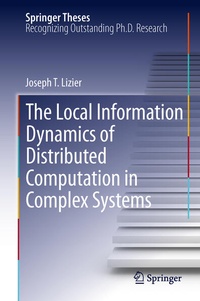
The Local Information Dynamics of Distributed Computation in Complex Systems
1st Edition
Published on 6. November 2012
Book
Hardback
XXIV, 236 pages
978-3-642-32951-7 (ISBN)
Description
The nature of distributed computation in complex systems has often been described in terms of memory, communication and processing. This thesis presents a complete information-theoretic framework to quantify these operations on information (i.e. information storage, transfer and modification), and in particular their dynamics in space and time. The framework is applied to cellular automata, and delivers important insights into the fundamental nature of distributed computation and the dynamics of complex systems (e.g. that gliders are dominant information transfer agents). Applications to several important network models, including random Boolean networks, suggest that the capability for information storage and coherent transfer are maximised near the critical regime in certain order-chaos phase transitions. Further applications to study and design information structure in the contexts of computational neuroscience and guided self-organisation underline the practical utility of the techniques presented here.
More details
Series
Language
English
Place of publication
Berlin
Germany
Publishing group
Springer Berlin
Target group
Professional and scholarly
Research
Illustrations
XXIV, 236 p.
Dimensions
Height: 241 mm
Width: 160 mm
Thickness: 19 mm
Weight
559 gr
ISBN-13
978-3-642-32951-7 (9783642329517)
DOI
10.1007/978-3-642-32952-4
Schweitzer Classification
Other editions
Additional editions
Book
12/2014
Springer
€160.49
Shipment within 7-9 days
E-Book
11/2012
1st Edition
Springer
€149.79
Available for download
Content
Introduction.- Computation in complex systems.-Information storage.-Information transfer.-Information modifications.- Information dynamics in networks and phase transitions.- Coherent information structure in complex computation.-Information transfer in biological and bio-inspired systems.-Conclusion.