

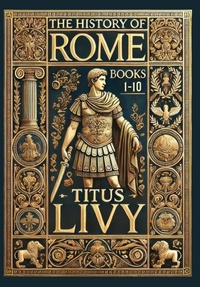
The History of Rome
Books 1-10 (Collector's Edition) (Laminated Hardback with Jacket)
Published on 11. February 2025
Book
Hardback
576 pages
978-1-998736-03-4 (ISBN)
Description
The History of Rome: Books 1-10 chronicles Rome's evolution from its founding to the early Republic. He begins with the myth of Aeneas's arrival in Italy and the city's establishment by Romulus in 753 BC.
More details
Language
English
Product notice
sewn/stitched
Cloth over boards
With dust jacket
Dimensions
Height: 229 mm
Width: 152 mm
Thickness: 37 mm
Weight
934 gr
ISBN-13
978-1-998736-03-4 (9781998736034)
Copyright in bibliographic data and cover images is held by Nielsen Book Services Limited or by the publishers or by their respective licensors: all rights reserved.
Schweitzer Classification
Person
Titus Livius, known as Livy, was born in 59 BCE in Patavium (modern-day Padua, Italy) and was educated in rhetoric and philosophy. He spent most of his life in Rome, where he became a respected historian under the patronage of prominent figures, including Emperor Augustus. Livy's writings focused on preserving Rome's history and values, which deeply influenced his approach to history and literature.Livy's most renowned work is Ab urbe condita (From the Founding of the City), a comprehensive history of Rome from its mythical foundation in 753 BCE to the reign of Augustus. Originally consisting of 142 books, only 35 have survived. In this work, Livy combined mythology with historical events, aiming to illustrate moral lessons through the virtues and vices of Rome's past, thus emphasizing how history could guide the future.Written during Augustus' reign, Livy's history reflected the political and social changes of the time, marking the shift from the Roman Republic to the Empire. Though not directly involved in politics, Livy's work celebrated Rome's greatness while stressing the importance of moral virtue and the dangers of corruption. Despite criticisms of its reliance on myth and lack of critical analysis, Livy's history remains a key source for understanding early Roman history and continues to influence Western historiography.