

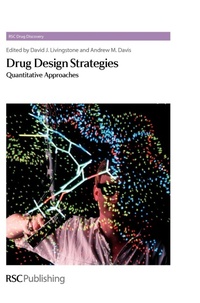
Drug Design Strategies
Quantitative Approaches
Published on 10. November 2011
Book
Hardback
516 pages
978-1-84973-166-9 (ISBN)
Description
This book brings together drug design practitioners, all leaders in their field, who are actively advancing the field of quantitative methods to guide drug discovery, from structure-based design to empirical statistical models - from rule-based approaches to toxicology to the fields of bioinformatics and systems biology. The aim of the book is to show how various facets of the drug discovery process can be addressed in a quantitative fashion (ie: numerical analysis to enable robust predictions to be made). Each chapter includes a brief review of the topic showing the historical development of quantitative approaches, a survey/summary of the current state-of-the-art, a selection of well chosen examples with some worked through and an appreciation of what problems remain to be overcome as well as an indication of how the field may develop. After an overview of quantitative approaches to drug design the book describes the development of concepts of "drug-like properties", of quantitative structure-activity relationships and molecular modelling, and in particular, structure-based design approaches to guide lead optimisation. How to manage and describe chemical structures, underpins all quantitative approaches to drug design and these are described in the following chapters. The next chapter covers the value of a quantitative approach, and also the challenge which is to describe the confidence in any prediction, and methods to assess predictive model quality. The later chapters describe the application of quantitative approaches to describing and optimising potency, selectivity, drug metabolism and pharmacokinetic properties and toxicology, and the design of chemical libraries to feed the screening approaches to lead generation that underpin modern drug discovery. Finally the book describes the impact of bioinformatics, current status of predicting ligand affinity direct from the protein structure, and the application of quantitative approaches to predicting environmental risk. The book provides a summary of the current state-of-the-art in quantitative approaches to drug design, and future opportunities, but it also provides inspiration to drug design practitioners to apply careful design, to make best use of the quantitative methods that are available, while continuing to improve them. Drug discovery still relies heavily on random screening and empirical screening cascades to identify leads and drugs and the process has many failures to deliver only a small handful of drugs. With the rapidly escalating costs of drug discovery and development together with spiralling delivery, quantitative approaches hold the promise of shifting the balance of success, to enable drug discovery to maintain its economic viability.
Reviews / Votes
"The Editors both with a long and recognised history in academic and industrial research, have managed to compile an impressive and fresh overview combining theoretical and application-oriented chapters.""The wealth of information, its good readability for the most part, and the appropriate selection of research topics make this reference book a recommended read for both graduate students and researchers in the field." * ChemMedChem, 2012, 7, 1295-1298, Dr Hans Matter *More details
Series
Language
English
Place of publication
Cambridge
United Kingdom
Target group
Professional and scholarly
Product notice
Unsewn / adhesive bound
Dimensions
Height: 241 mm
Width: 162 mm
Thickness: 39 mm
Weight
1012 gr
ISBN-13
978-1-84973-166-9 (9781849731669)
Copyright in bibliographic data and cover images is held by Nielsen Book Services Limited or by the publishers or by their respective licensors: all rights reserved.
Schweitzer Classification
Other editions
Additional editions
E-Book
11/2011
1st Edition
Royal Society of Chemistry
€199.99
Available for download
Complete work / Part of the work
Drug Discovery Series Set
2010-2014
Other
06/2015
Royal Society of Chemistry
€7,729.50
Article not available at the moment
Persons
David J Livingstone is now an independent consultant having previously spent 18 years carrying out research in the pharmaceutical industry. Following a PhD in drug design at the University of Dundee, he joined Wellcome in their department of Biophysics & Biochemistry on a search for compounds that would promote the release of oxygen from haemoglobin, and later he joined the computational chemistry group in physical chemistry. He then moved to SmithKline Beecham to run a small computational chemistry group and left to work for himself as a consultant and also became a visiting professor at the Centre for Molecular Design at the University of Portsmouth. While working in the pharmaceutical industry he has had a number of academic collaborations and successfully supervised 3 MSc students and 5 PhD students. He has published 80 peer reviewed papers, 11 book chapters, 1 book and also edited 3 books. He is a fellow of the Royal Society of Chemistry and a member of the editorial board of 3 journals. Andy Davis is a senior principal scientist in chemistry with the Respiratory and Inflammation Innovative Medicines division of AstraZeneca in Sweden. He read chemistry at Imperial College of Science and Technology and gained a PhD in Physical Organic Chemistry with Professor MI Page at the University of Huddersfield. He joined Fisons PLC Pharmaceuticals Division, which became part of the Swedish pharmaceutical company Astra AB who then merged with Zeneca PLC, to form AstraZeneca PLC. He has spent the last 23 years in drug discovery, in line management, project and portfolio management and senior science roles.
Content
Preface;
The Evolution of Quantitative Drug Design;
Drug-Like Physicochemical Properties Development of QSAR;
The Development of Molecular Modelling Programs: The Use and Limitations of Physical Models;
Contribution of Structure-based Drug Design to the Discovery of Marketed Drugs;
Representing Chemical Structures in Databases for Drug Design Modeling Chemical Structure-Log P;
Characterising Chemical Structure using Physicochemical Descriptors;
Assessing Quantitative Model Quality and Performance Application of Modelling Techniques;
Expert Systems: The Use of Expert Systems in Drug Design - Toxicity and Metabolism;
Ligand-Based Modeling of Toxicity;
Design of Chemical Libraries;
The Impact of Genomics, Systems Biology, and Bioinformatics on Drug and Target Discovery: Challenge and Opportunity;
Scoring Drug-Receptor Interactions;
Modelling Chemicals in the Environment.
The Evolution of Quantitative Drug Design;
Drug-Like Physicochemical Properties Development of QSAR;
The Development of Molecular Modelling Programs: The Use and Limitations of Physical Models;
Contribution of Structure-based Drug Design to the Discovery of Marketed Drugs;
Representing Chemical Structures in Databases for Drug Design Modeling Chemical Structure-Log P;
Characterising Chemical Structure using Physicochemical Descriptors;
Assessing Quantitative Model Quality and Performance Application of Modelling Techniques;
Expert Systems: The Use of Expert Systems in Drug Design - Toxicity and Metabolism;
Ligand-Based Modeling of Toxicity;
Design of Chemical Libraries;
The Impact of Genomics, Systems Biology, and Bioinformatics on Drug and Target Discovery: Challenge and Opportunity;
Scoring Drug-Receptor Interactions;
Modelling Chemicals in the Environment.