

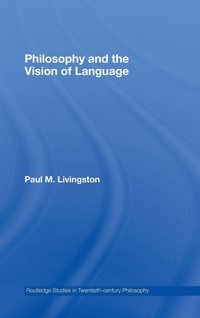
Philosophy and the Vision of Language
1st Edition
Published on 24. June 2008
Book
Hardback
290 pages
978-0-415-96114-1 (ISBN)
Description
Philosophy and the Vision of Language explores the history and enduring significance of the twentieth-century turn to language as a specific object of investigation and resource for philosophical reflection. It traces the implications of the access to language in some of the most prominent projects and results of the historical and contemporary tradition of analytic philosophy, including the projects of Frege, Wittgenstein, Sellars, Quine, Brandom, and Cavell. Additionally, it demonstrates the deep and enduring connections between the analytic tradition's inquiry into language and the parallel inquiries of phenomenology, critical theory, and deconstruction over the course of the twentieth century. Finally, it documents some of the enduring consequences of philosophy's inquiry into language for contemporary questions of social and political life. The book provides a clear, accessible and widely inclusive introduction to the relevance of language for analytic and continental philosophy in the twentieth century and is readable by non-specialist audiences. It should contribute to a growing historical sense of the location of the analytic tradition in a broader geography of social, political and critical thought. Furthermore, it contributes to building bridges between this tradition and the neighboring continental ones from which it has all too often been estranged.
More details
Series
Language
English
Place of publication
London
United Kingdom
Publishing group
Taylor & Francis Ltd
Target group
College/higher education
Dimensions
Height: 235 mm
Width: 157 mm
Thickness: 21 mm
Weight
594 gr
ISBN-13
978-0-415-96114-1 (9780415961141)
Copyright in bibliographic data and cover images is held by Nielsen Book Services Limited or by the publishers or by their respective licensors: all rights reserved.
Schweitzer Classification
Other editions
Additional editions
Paul M. Livingston
Philosophy and the Vision of Language
Book
06/2010
1st Edition
Routledge
€73.80
Shipment within 15-20 days
Paul M. Livingston
Philosophy and the Vision of Language
E-Book
06/2008
Routledge
€67.49
Available for download
Paul M. Livingston
Philosophy and the Vision of Language
E-Book
06/2008
1st Edition
Routledge
€67.49
Available for download
Person
Paul M. Livingston is Assistant Professor of Philosophy at Villanova University. He has published widely in the history of twentieth century philosophy. His first book was titled Philosophical History and the Problem of Consciousness (Cambridge University Press, 2004).
Content
Preface
Acknowledgments
Chapter 1: Introduction: Language and Structure
Section I: Early Analytic Philosophy
Chapter 2: Frege on the Context Principle and Psychologism
Chapter 3: 'Meaning is Use' in the Tractatus
Section II: Radical Translation and Intersubjective Practice
Introductory: From Syntax to Semantics (and Pragmatics)
Chapter 4: Ryle and Sellars on Inner-State Reports
Chapter 5: Quine's Appeal to Use and the Genealogy of Indeterminacy
Section III: Critical Outcome
Introductory: From the Aporia of Structure to the Critique of Practice
Chapter 6: Wittgenstein, Kant, and the Critique of Totality
Chapter 7: Thinking and Being: Heidegger and Wittgenstein on Machination and Lived-Experience
Chapter 8: Language, Norms, and the Force of Reason
Section IV: Conclusion
Chapter 9: The Question of Language
Notes
Bibliography
Index
Acknowledgments
Chapter 1: Introduction: Language and Structure
Section I: Early Analytic Philosophy
Chapter 2: Frege on the Context Principle and Psychologism
Chapter 3: 'Meaning is Use' in the Tractatus
Section II: Radical Translation and Intersubjective Practice
Introductory: From Syntax to Semantics (and Pragmatics)
Chapter 4: Ryle and Sellars on Inner-State Reports
Chapter 5: Quine's Appeal to Use and the Genealogy of Indeterminacy
Section III: Critical Outcome
Introductory: From the Aporia of Structure to the Critique of Practice
Chapter 6: Wittgenstein, Kant, and the Critique of Totality
Chapter 7: Thinking and Being: Heidegger and Wittgenstein on Machination and Lived-Experience
Chapter 8: Language, Norms, and the Force of Reason
Section IV: Conclusion
Chapter 9: The Question of Language
Notes
Bibliography
Index