

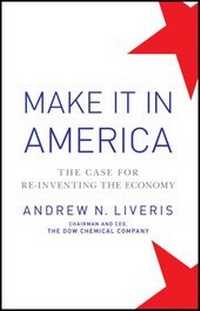
Make It In America
The Case for Re-Inventing the Economy
1st Edition
Published on 28. January 2011
Book
Hardback
240 pages
978-0-470-93022-9 (ISBN)
Description
America used to define itself by the things it built. We designed and produced the world's most important innovations, and in doing so, created a vibrant manufacturing sector that built the middle class. We manufactured our way to the top and became the undisputed economic leader among all nations. But over the last several decades, and especially in the last ten years, the sector that was America's great pride has eroded, costing millions of jobs and putting our long-term prosperity at risk. Now, as we struggle to recover from the worst recession in generations, our only chance to turn things around is to revive the American manufacturing sector--and to revolutionize it. In MAKE IT IN AMERICA: The Case for Reinventing the Economy, Andrew Liveris -- Chairman and CEO of The Dow Chemical Company--offers a thoughtful and passionate argument that America's future economic growth and prosperity depends on the strength of its manufacturing sector. The book
* Explains how a manufacturing sector creates economic value at a scale unmatched by any other, and how central the sector is to creating jobs both inside and outside the factory.
* Explores how other nations are building their manufacturing sectors to stay competitive in the global economy, and describes how America has failed to keep up.
* Provides an aggressive, practical and comprehensive agenda that will put the U.S. back on track to lead the world.
It's time to stop accepting as inevitable the shuttering of factories and staggering job losses that have come to define manufacturing. It's time to acknowledge the cost of inaction. There is no better company to make the case for reviving U.S. manufacturing than the Michigan-based The Dow Chemical Company, one of the world's largest manufacturers and one of its most global corporations. And there's no better book to show why it needs to be done and how to do it than MAKE IT IN AMERICA.
Andrew Liveris is Chairman and CEO of The Dow Chemical Company, one of the largest multinational corporations in the world and a leader in science and technology.
Reviews / Votes
"Andrew Liveris has produced a well-written and timely book that deserves wide circulation. Everyone concerned with America's economic difficulties should read it." (The Washington Examiner)"Perhaps because Liveris is Australian by birth, his economic patriotism comes across as genuine and heartfelt. The fact that he is chief executive of Dow Chemical gives the book added authority. What is most noteworthy about the book, however, is his unsparing critique of the business community for its blind faith in markets and globalization, and its stubborn refusal to accept a government role in managing the economy." (The Washington Post)"In uncertain economic times, it's inspiring to see that the top executive of a leading American company has written a book titled Make It in America. What can be more inclusive and 21st century-sounding than a pro-America argument being made by an Australian of Greek heritage such as Liveris? He may have written the book while relaxing in a melting pot.In Make It in America, Liveris spells out the challenges facing American manufacturing. He argues in favor of a national economic policy, one that will make it easier for manufacturing to thrive here as it once did. He stresses over and over again the importance of manufacturing because of the number of jobs it creates both on its own and in related sectors. This "multiplier effect" is much greater in manufacturing than it is in other industries. In his book, Liveris tackles many big-picture topics. He's asking a lot of important questions, questions that will need to be answered if America's manufacturing base wants to survive and thrive." (Plastics News)"Manufacturing still accounts for nearly one in 10 U.S. nonfarm jobs as measured by the government, and those jobs tend to pay much better than burger-flipping or barista gigs. Between 1997 and 2009, we lost six million U.S. manufacturing jobs, or around a third of the total. How much should we care? Plenty, says Andrew Liveris, chairman and chief executive of Dow Chemical. In Make It in America, he calls for a national strategy to revive manufacturing. We need manufacturing jobs, he says, if we are to keep a growing population busy and start paying off our debts to the rest of the world. Some Americans imagine that we can thrive by continuing to dream up gadgets like iPhones and Kindles while letting the Chinese do all the tedious work of making the products themselves. Mr. Liveris disagrees. Mr. Liveris doesn't shy away from proposing ideas that have defeated countless other reformers. For instance, he wants to overhaul our K-12 education system so that it will concentrate more on science, math and engineering. That promises to be a long struggle, he admits. 'I pushed science at the dinner table with my kids,' writes Mr. Liveris, who loved chemistry as a boy, 'but none of them ended up going into engineering.'"(The Wall Street Journal)"Is the U.S. manufacturing sector. becoming as obsolete as [a] typewriter? Andrew N. Liveris seems to think so. He has written a book, Make It in America: The Case for Re-Inventing the Economy.As chief executive officer of Dow Chemical, Liveris is in a unique position to understand the problem. Liveris points out that production hasn't kept pace with the increase in the U.S. population and that our share of global industrial output has been shrinking. The decline of the manufacturing sector is a real threat to the prosperity that Americans take for granted, Liveris says. We cannot hope to sustain our vast economy if we write off its greatest engine of job creation. Liveris cites a 2009 study by the Manufacturing Institute that says every $1.00 in sales by a manufacturer generates $1.40 in economic activity elsewhere in the economy. Liveris' key insight is that the U.S. isn't necessarily losing ground for the reason most people think: low wages in developing countries. High productivity in the U.S. makes up for much of that, he points out. Instead, countries such as China and Singapore are attracting companies with generous incentives. If you can't beat 'em, join 'em, Liveris says. The U.S. needs to offer incentives to attract more investment. He suggests reducing taxes for manufacturers and making the R&D tax credit permanent and more generous. The era when the federal government can offer nothing but gratitude in return for investment dollars is probably over. States and localities offer incentives to attract investment away from other communities all the time. Maybe the entire country should try to do the same to stem the manufacturing decline."(Chemical & Engineering News)"Mr. Liveris's argument is compelling and even novel. this book serves as a clarion call for rebuilding the United States' manufacturing base. He argues this can and must be done by a novel partnership between government and business. Further, this partnership must provide long term incentives and opportunities to increase innovation in the U.S. manufacturing sector that until recently was given up for a loss. This book is a must read for policy makers and forecasters of global economic trends." (New York Journal of Books)"The Perspective of a chief executive who is really making vital decisions about the location of manufacturing plants and research centres is well worth hearing.full of stimulation ideas, and remarkably well-written for a book by a chief executive."(Financial Times)"The case for a better understanding of how prosperity is actually won and sustained in a globalizing world is well argued in a timely new book 'Make It In America' by Andrew Liveris. His thesis is that innovation alone is not sufficient as a basis for a durable leading-edge economy and that the American economy cannot be lifted out of decline by innovation alone. Beyond the obvious truism that a country cannot increase exports if it does not make things to export, Liveris argues a less well-understood dimension of the challenge, explaining that a country that innovates products and then hands off the production to another country to manufacture will wind up seeing the next generation of innovation come from the country that does the manufacturing. Liveris makes an even more compelling case that the US cannot survive as a purely service industry economy. Services are important, but many result in transfer of money from one pocket to another without, as manufacturing does, actually adding value and increasing wealth. Certainly, Liveris' suggestions for revival sound worth trying in the light of his chilling crisis narrative. Of course, they are not the lead-pipe cinch Liveris tries to make them. Overall, in fact, Liveris' book, certainly unintentionally, makes a much more convincing case for the fact of crisis than for the ability to emerge from crisis. But a vital prerequisite for revival is a more widespread recognition of the problem, and Liveris make a signal contribution to that end."(European Affairs)"Mr. Liveris's argument is compelling and even novel. this book serves as a clarion call for rebuilding the United States' manufacturing base. He argues this can and must be done by a novel partnership between government and business. Further, this partnership must provide long term incentives and opportunities to increase innovation in the U.S. manufacturing sector that until recently was given up for a loss. This book is a must read for policy makers and forecasters of global economic trends."(New York Journal of Books) 'Make It In America is full of stimulating ideas, and remarkably well-written'. (FT, March 2011).More details
Other editions
New editions

Book
12/2012
Wiley
€33.00
Shipment within 15-20 days
Additional editions
Book
01/2012
Wiley
€18.50
Shipment within 15-20 days
E-Book
12/2011
Wiley
€12.99
Available for download
E-Book
12/2011
Wiley
€12.99
Available for download
Person
Andrew N. Liveris is Chairman and CEO of The Dow Chemical Company, a $45 billion global specialty chemical, advanced materials, agrosciences, and plastics company based in Midland, Michigan. Liveris's 34-year Dow career has spanned manufacturing, engineering, sales, and marketing since he began with the firm in Australia in 1976. Liveris was born in Darwin, Australia, and received a bachelor's degree in chemical engineering from the University of Queensland in Brisbane. Liveris serves on the boards of directors of IBM and Citigroup. He is President of the International Council of Chemical Associations; Vice Chairman of The Business Council; a member of the executive committee of the Business Roundtable; and a member of the U.S. President's Export Council, the U.S.-India CEO Forum, and the Peterson Institute for International Economics.
Content
Preface.
Acknowledgments.
Introduction.
Chapter 1: The Rise and Fall.
How We Fell Out of Love with Manufacturing.
The Multiplier Effect.
Manufacturing Tomorrow.
Surviving the Crisis.
A Tale of Two Nations.
Chapter 2: Separating What Can't Be Separated.
The Truth about the Manufacturing Crisis.
Adding Value the Only Way We Can.
Trying to Survive on Ideas Alone.
Where Manufacturing Goes, the Ideas Follow.
Chapter 3: Fighting Offshoring.
Should I Stay or Should I Go?
It Isn't What You Think.
Taxing Problems.
Funding the Future.
Regulating Our Way into a Muddle.
Trading Our Way to Prosperity.
Chapter 4: Energy Drives the World.
A Big Energy Bill, and Not Just for Power.
The New New.
Germany's Green Miracle.
China's Green Revolution.
America Can't Compete.
Chapter 5: Building Tomorrow.
Education: "A Permanent National Recession".
Developing the Right Skills for the New Workplace.
Preventing a Worker Shortage.
What America Doesn't Understand That Other Nations Do.
The Tortoise and the Hare.
A New Foundation of Infrastructure.
Funding the Future.
Chapter 6: Built to Compete.
An Ambitious Agenda.
Changing the Way We Tax.
National Incentive Strategy.
Regulatory Policy.
Everyone Needs Good Trading Partners.
Chapter 7: The Long Game.
The Human Element: Education and Immigration.
Innovation and Competitiveness.
Chapter 8: The Fork in the Road.
Bibliography.
About the Author.
About The Dow Chemical Company.
Index.