

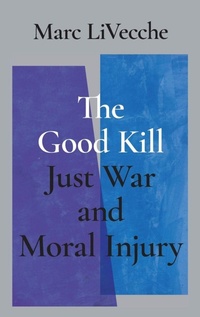
The Good Kill
Just War and Moral Injury
Published on 30. September 2021
Book
Hardback
254 pages
978-0-19-751580-8 (ISBN)
Description
War wounds the soul. It is not only the violence that warfighters suffer against them that harms, but also the violence that they do. These soul wounds have come to be known as moral injuries: psychic traumas that occur from having done or condoned that which goes against deeply held moral principles. It is not surprising that the committing of atrocities or the accidental killing of the innocent would hurt the soul of warfighters.
The problem is that many warfighters at least tacitly follow the commonplace belief that killing another human being is always wrong--it's just that sometimes, as in war, it is necessary. This paradoxical commitment makes the very business of warfighting morally injurious. This problem is also a crisis. Clinical research among combat veterans has established a link between killing in combat and moral injury and between moral injury and suicide. Our warfighters, even those who have served honorably and with the right intentions, are dying by their own hands at devastating rates--casualties not of the physical threats of war, but of the moral ones.
It does not have to be this way.
The just war tradition, a moral framework for thinking about war that flows out of our Greco-Roman and Hebraic intellectual traditions, is grounded in the basic truth that killing comes in different kinds. While some kinds of killing, like murder, are always wrong, there are other kinds of killing that are morally neutral, such as unavoidable accidents, and still other kinds that are morally permitted--even, sometimes, obligatory. The Good Kill embraces this tradition to argue for the morality of killing in justified wars. Marc LiVecche does not deny the morally bruising realities of combat, but offers potential remedies to help our warfighters manage the bruising without becoming irreparably morally injured.
The problem is that many warfighters at least tacitly follow the commonplace belief that killing another human being is always wrong--it's just that sometimes, as in war, it is necessary. This paradoxical commitment makes the very business of warfighting morally injurious. This problem is also a crisis. Clinical research among combat veterans has established a link between killing in combat and moral injury and between moral injury and suicide. Our warfighters, even those who have served honorably and with the right intentions, are dying by their own hands at devastating rates--casualties not of the physical threats of war, but of the moral ones.
It does not have to be this way.
The just war tradition, a moral framework for thinking about war that flows out of our Greco-Roman and Hebraic intellectual traditions, is grounded in the basic truth that killing comes in different kinds. While some kinds of killing, like murder, are always wrong, there are other kinds of killing that are morally neutral, such as unavoidable accidents, and still other kinds that are morally permitted--even, sometimes, obligatory. The Good Kill embraces this tradition to argue for the morality of killing in justified wars. Marc LiVecche does not deny the morally bruising realities of combat, but offers potential remedies to help our warfighters manage the bruising without becoming irreparably morally injured.
Reviews / Votes
LiVecche artfully links contemporary psychology with ancient philosophical and theological wisdom, mixed with the testimony of veterans and insights of military ethicists ... Highly recommended reading for soldiers and military instructors, as well as chaplains, veteran welfare workers and military ethicists. * Darren Cronshaw, Journal of Moral Theology * LiVecche provides an invaluable contribution... In addition to a rich accounting of leading psychological literature on moral injury, LiVecche provides graphic and moving first-hand battlefield accounts, testimonies of the lingering guilt that some soldiers feel about the violence that they saw or participated in. * Eric Patterson, Journal of Military Ethics * A well-written book. * Theodora Hawksley, Studies in Christian Ethics *More details
Language
English
Place of publication
New York
United States
Target group
Professional and scholarly
Dimensions
Height: 240 mm
Width: 161 mm
Thickness: 18 mm
Weight
549 gr
ISBN-13
978-0-19-751580-8 (9780197515808)
Copyright in bibliographic data and cover images is held by Nielsen Book Services Limited or by the publishers or by their respective licensors: all rights reserved.
Schweitzer Classification
Other editions
Additional editions
E-Book
06/2021
1st Edition
OUP eBook
€43.49
Available for download
E-Book
06/2021
1st Edition
OUP eBook
€43.49
Available for download
Persons
Marc LiVecche is the editor-at-large for Providence: A Journal of Christianity & American Foreign Policy. He was the McDonald Visiting Scholar at the McDonald Centre for Theology, Ethics, and Public Life at Oxford University.
Content
Acknowledgments
Forward by Rev. Timothy S. Mallard, Ph.D.
Introduction
War & the Soul
The Problem of Paradox
Neither Sin nor Paradox
Just War in the Midst of Combat (?)
The Mournful Warrior
Conclusion
Works Cited
Index
Forward by Rev. Timothy S. Mallard, Ph.D.
Introduction
War & the Soul
The Problem of Paradox
Neither Sin nor Paradox
Just War in the Midst of Combat (?)
The Mournful Warrior
Conclusion
Works Cited
Index