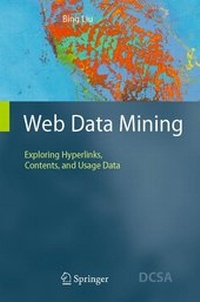
The rapid growth of the Web in the last decade makes it the largest p- licly accessible data source in the world. Web mining aims to discover u- ful information or knowledge from Web hyperlinks, page contents, and - age logs. Based on the primary kinds of data used in the mining process, Web mining tasks can be categorized into three main types: Web structure mining, Web content mining and Web usage mining. Web structure m- ing discovers knowledge from hyperlinks, which represent the structure of the Web. Web content mining extracts useful information/knowledge from Web page contents. Web usage mining mines user access patterns from usage logs, which record clicks made by every user. The goal of this book is to present these tasks, and their core mining - gorithms. The book is intended to be a text with a comprehensive cov- age, and yet, for each topic, sufficient details are given so that readers can gain a reasonably complete knowledge of its algorithms or techniques without referring to any external materials. Four of the chapters, structured data extraction, information integration, opinion mining, and Web usage mining, make this book unique. These topics are not covered by existing books, but yet they are essential to Web data mining. Traditional Web mining topics such as search, crawling and resource discovery, and link analysis are also covered in detail in this book.
Reviews / Votes
From the reviews:
"This is a textbook about data mining and its application to the Web. . Liu succeeds in helping readers appreciate the key role that data mining and machine learning play in Web applications. . It also motivates the student by adding immediacy and relevance to the concepts and algorithms described. I liked the way the concepts are introduced in a stepwise manner. . I also appreciated the bibliographical notes at the end of each chapter." (W. Hu, ACM Computing Reviews, January, 2009)
Series
Edition
Softcover reprint of hardcover 1st ed. 2007
Language
Place of publication
Publishing group
Target group
Professional and scholarly
Professional/practitioner
Illustrations
177 s/w Abbildungen
177 black & white illustrations
Dimensions
Height: 23.5 cm
Width: 15.5 cm
Weight
ISBN-13
978-3-642-07237-6 (9783642072376)
DOI
10.1007/978-3-540-37882-2
Schweitzer Classification
Bing Liu is an associate professor in Computer Science at the University of Illinois at Chicago (UIC). He received his PhD degree in Artificial Intelligence from the University of Edinburgh. Before joining UIC in 2002, he was with the National University of Singapore. His research interests include data mining, Web mining, text mining, and machine learning. He has published extensively in these areas in leading conferences and journals. He served (or serves) as a vice chair, deputy vice chair or program committee member of many conferences, including WWW, KDD, ICML, VLDB, ICDE, AAAI, SDM, CIKM and ICDM.
Data Mining Foundations.- Association Rules and Sequential Patterns.- Supervised Learning.- Unsupervised Learning.- Partially Supervised Learning.- Web Mining.- Information Retrieval and Web Search.- Link Analysis.- Web Crawling.- Structured Data Extraction: Wrapper Generation.- Information Integration.- Opinion Mining.- Web Usage Mining.