

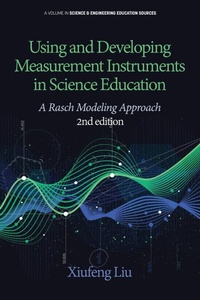
Using and Developing Measurement Instruments in Science Education
A Rasch Modeling Approach
2nd Edition
Published on 9. January 2020
Book
Paperback/Softback
356 pages
978-1-64113-934-2 (ISBN)
Description
This book meets a demand in the science education community for a comprehensive and introductory measurement book in science education. It describes measurement instruments reported in refereed science education research journals, and introduces the Rasch modeling approach to developing measurement instruments in common science assessment domains, i.e. conceptual understanding, affective variables, science inquiry, learning progression, and learning environments. This book can help readers develop a sound understanding of measurement theories and approaches, particularly Rasch modeling, to using and developing measurement instruments for science education research.
This book is for anyone who is interested in knowing what measurement instruments are available and how to develop measurement instruments for science education research. For example, this book can be a textbook for a graduate course in science education research methods; it helps graduate students develop competence in using and developing standardized measurement instruments for science education research. Science education researchers, both beginning and experienced, may use this book as a reference for locating available and developing new measurement instruments when conducting a research study.
This book is for anyone who is interested in knowing what measurement instruments are available and how to develop measurement instruments for science education research. For example, this book can be a textbook for a graduate course in science education research methods; it helps graduate students develop competence in using and developing standardized measurement instruments for science education research. Science education researchers, both beginning and experienced, may use this book as a reference for locating available and developing new measurement instruments when conducting a research study.
More details
Series
Edition
2nd Revised edition
Language
English
Place of publication
United States
Publishing group
Emerald Publishing Inc
Target group
Professional and scholarly
Edition type
Revised edition
Dimensions
Height: 234 mm
Width: 156 mm
Thickness: 19 mm
Weight
541 gr
ISBN-13
978-1-64113-934-2 (9781641139342)
Copyright in bibliographic data and cover images is held by Nielsen Book Services Limited or by the publishers or by their respective licensors: all rights reserved.
Schweitzer Classification
Other editions
Additional editions
Xiufeng Liu
Using and Developing Measurement Instruments in Science Education
A Rasch Modeling Approach 2nd Edition
E-Book
01/2020
1st Edition
Information Age Publishing
from
€62.33
Available for download
Previous edition
Xiufeng Liu
Using and Developing Measurement Instruments in Science Education
A Rasch Modeling Approach
Book
04/2010
Information Age Publishing
€75.71
Article exhausted; check for reprint
Person
Xiufeng Liu, State University of New York at Buffalo
Content
List of Tables.
List of Figures.
Preface.
Preface to the Second Edition.
Chapter 1. Essential Concepts and Skills for Using and Developing Measurement Instruments.
Chapter 2. Approaches to Developing Measurement Instruments.
Chapter 3. Using and Developing Instruments for Measuring Conceptual Understanding.
Chapter 4. Using and Developing Instruments for Measuring Affective Variables.
Chapter 5. Using and Developing Instruments for Measuring Science Inquiry and Practices.
Chapter 6. Using and Developing Instruments for Measuring Learning Progression.
Chapter 7. Using and Developing Instruments for Measuring Science Learning Environments.
List of Figures.
Preface.
Preface to the Second Edition.
Chapter 1. Essential Concepts and Skills for Using and Developing Measurement Instruments.
Chapter 2. Approaches to Developing Measurement Instruments.
Chapter 3. Using and Developing Instruments for Measuring Conceptual Understanding.
Chapter 4. Using and Developing Instruments for Measuring Affective Variables.
Chapter 5. Using and Developing Instruments for Measuring Science Inquiry and Practices.
Chapter 6. Using and Developing Instruments for Measuring Learning Progression.
Chapter 7. Using and Developing Instruments for Measuring Science Learning Environments.