

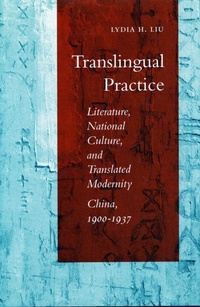
Translingual Practice
Literature, National Culture, and Translated Modernity-China, 1900-1937
Published on 1. January 1995
Book
Paperback/Softback
496 pages
978-0-8047-2535-4 (ISBN)
Description
Are languages incommensurate? If so, how do people establish and maintain hypothetical equivalences between words and their meanings? What does it mean to translate one culture into the language of another on the basis of commonly conceived equivalences?
This study-bridging contemporary theory, Chinese history, comparative literature, and culture studies-analyzes the historical interactions among China, Japan, and the West in terms of "translingual practice." By this term, the author refers to the process by which new words, meanings, discourses, and modes of representation arose, circulated, and acquired legitimacy in early modern China as it contacted/collided with European/Japanese languages and literatures. In reexamining the rise of modern Chinese literature in this context, the book asks three central questions: How did "modernity" and "the West" become legitimized in May fourth literary discourse? What happened to native agency in this complex process of legitimation? How did the Chinese national culture imagine and interpret its own moment of unfolding?
This study-bridging contemporary theory, Chinese history, comparative literature, and culture studies-analyzes the historical interactions among China, Japan, and the West in terms of "translingual practice." By this term, the author refers to the process by which new words, meanings, discourses, and modes of representation arose, circulated, and acquired legitimacy in early modern China as it contacted/collided with European/Japanese languages and literatures. In reexamining the rise of modern Chinese literature in this context, the book asks three central questions: How did "modernity" and "the West" become legitimized in May fourth literary discourse? What happened to native agency in this complex process of legitimation? How did the Chinese national culture imagine and interpret its own moment of unfolding?
Reviews / Votes
"This important book will be of great interest and immense use to anyone in modern Chinese cultural studies who would understand the process by which new words, meanings, discourses, and modes of representation arose, circulated, and acquired legitimacy in early modern China through contact with European and Japanese languages and literatures." -Choice "This book will be of interest to a wide audience and is must reading for those pursuing comparative studies."-Viren Murthy, University of HawaiiMore details
Edition
New edition
Language
English
Place of publication
Palo Alto
United States
Target group
College/higher education
Professional and scholarly
Edition type
New edition
Product notice
Paperback (trade)
Dimensions
Height: 230 mm
Width: 155 mm
Thickness: 31 mm
Weight
744 gr
ISBN-13
978-0-8047-2535-4 (9780804725354)
Copyright in bibliographic data and cover images is held by Nielsen Book Services Limited or by the publishers or by their respective licensors: all rights reserved.
Schweitzer Classification
Person
Lyida H. Liu is Associate Professor of Chinese and Comparative Literature at the University of California, Berkeley.
Content
Preface 1. Introduction: the problem of language in cross-cultural studies Part I. Between the Nation and the Individual: 2. Translating national character Lu Xun and Arthur Smith 3. The discourse of individualism Part II. Translingual modes of representation: 4. Homo Economicus and the question of novelistic realism 5. Narratives of desire: negotiating the real and the fantastic 6. The deixis of writing in the first person Part III. National Building and Culture Building: 7. Literary criticism as a discourse of legitimation 8. The making of the Compendium of Modern Chinese Literature 9. Rethinking culture and national essence Appendixes Notes Index.