

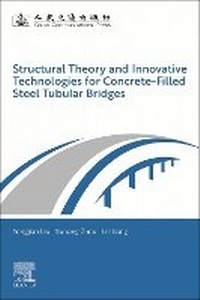
Structural Theory and Innovative Technologies for Concrete-Filled Steel Tubular Bridges
Will be published approx. on 1. February 2026
Book
Paperback/Softback
710 pages
978-0-443-33484-9 (ISBN)
Description
Structural Theory and Innovative Technologies for Concrete-Filled Steel Tubular Bridges examines concrete-filled steel tubular bridges, including arch bridges, truss bridges, piers and towers in cable stayed and suspension bridges. The book considers, in detail, foundational theoretical issues such as: research on the buckling performance of concrete-filled steel tube walls, the static and fatigue performance of joints, the effects of temperature, interface performance, and the confinement effects. The book also proposes design methods for concrete-filled steel tubular bridges and provides engineering design and application examples for concrete
More details
Language
English
Place of publication
Philadelphia
United States
Target group
Professional and scholarly
Dimensions
Height: 229 mm
Width: 152 mm
Weight
450 gr
ISBN-13
978-0-443-33484-9 (9780443334849)
Copyright in bibliographic data and cover images is held by Nielsen Book Services Limited or by the publishers or by their respective licensors: all rights reserved.
Schweitzer Classification
Other editions
Additional editions
Yongjian Liu | Xuhong Zhou | Lei Jiang
Structural Theory and Innovative Technologies for Concrete-Filled Steel Tubular Bridges
E-Book
02/2026
Elsevier
€286.99
Available for download
Persons
Yongjian Liu is a professor in the School of Civil Engineering, Chongqing University and School of Highways, Chang'an University, China. He is the Director of Large Structures Highway Safety Engineering Research Center at the Ministry of Education. He is an active researcher in the areas of steel and composite bridges, especially concrete-filled steel tubular bridges
Xuhong Zhou is a professor in the School of Civil Engineering, Chongqing University, China. He has been elected as the Academician of the Chinese Academy of Engineering and Foreign Fellow of the Engineering Academy of Japan. He has been severed as President of Chongqing University, Director of Research Center of Steel Structures in Chongqing University, Vice President of China Steel Construction Society, Director of Technical Committee of the National Engineering Research Center for Steel Construction and Chief Editor of Journal of Architecture and Civil Engineering. He is an active researcher in the areas of steel and composite structures
Dr Lei Jiang is an Associate Professor at Chang'an University in China. His research interests include: steel and composite bridges; high-performance bridge structures; accelerated bridge construction; and fatigue assessment of bridges
Xuhong Zhou is a professor in the School of Civil Engineering, Chongqing University, China. He has been elected as the Academician of the Chinese Academy of Engineering and Foreign Fellow of the Engineering Academy of Japan. He has been severed as President of Chongqing University, Director of Research Center of Steel Structures in Chongqing University, Vice President of China Steel Construction Society, Director of Technical Committee of the National Engineering Research Center for Steel Construction and Chief Editor of Journal of Architecture and Civil Engineering. He is an active researcher in the areas of steel and composite structures
Dr Lei Jiang is an Associate Professor at Chang'an University in China. His research interests include: steel and composite bridges; high-performance bridge structures; accelerated bridge construction; and fatigue assessment of bridges
Content
1. Introduction
2. Structural System
3. Buckling Behavior
4. Static Behavior of CFST Joints
5. Fatigue Behavior of CFST Joints
6. Temperature Action of CFST Bridges
7. Steel-Concrete Interfacial Behavior
8. Confinement Effect
9. Design Method of CFST Bridges
10. CFST Arch Bridges
11. CFST Composite Truss Bridges
12. CFST Bridge Piers
13. CFST Bridge Pylons
2. Structural System
3. Buckling Behavior
4. Static Behavior of CFST Joints
5. Fatigue Behavior of CFST Joints
6. Temperature Action of CFST Bridges
7. Steel-Concrete Interfacial Behavior
8. Confinement Effect
9. Design Method of CFST Bridges
10. CFST Arch Bridges
11. CFST Composite Truss Bridges
12. CFST Bridge Piers
13. CFST Bridge Pylons