

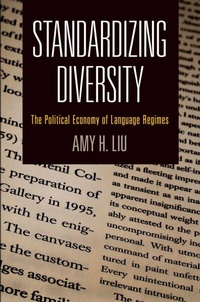
Standardizing Diversity
The Political Economy of Language Regimes
Published on 14. January 2015
Book
Hardback
264 pages
978-0-8122-4672-8 (ISBN)
Description
Languages have deep political significance beyond communication: a common language can strengthen cultural bonds and social trust, or it may exacerbate cultural differences and power imbalances. Language regimes that emerge from political bargains can centralize power by favoring the language of one ethnolinguistic group, share power by recognizing multiple mother tongues, or neutralize power through the use of a lingua franca. Cultural egoism, communicative efficiency, or collective equality determines the choice. As Amy H. Liu demonstrates, the conditions surrounding the choice of a language regime also have a number of implications for a nation's economy.
Standardizing Diversity examines the relationship between the distribution of linguistic power and economic growth. Using a newly assembled dataset of all language-in-education policies in Asia from 1945 to 2005 and drawing on fieldwork data from Malaysia and Singapore, Liu shows language regimes that recognize a lingua franca exclusively-or at least above all others-tend to develop social trust, attract foreign investment, and stimulate economic growth. Particularly at high levels of heterogeneity, the recognition of a lingua franca fosters equality and facilitates efficiency. Her findings challenge the prevailing belief that linguistic diversity inhibits economic growth, suggesting instead that governments in even the most ethnically heterogeneous countries have institutional tools to standardize their diversity and to thrive economically.
Standardizing Diversity examines the relationship between the distribution of linguistic power and economic growth. Using a newly assembled dataset of all language-in-education policies in Asia from 1945 to 2005 and drawing on fieldwork data from Malaysia and Singapore, Liu shows language regimes that recognize a lingua franca exclusively-or at least above all others-tend to develop social trust, attract foreign investment, and stimulate economic growth. Particularly at high levels of heterogeneity, the recognition of a lingua franca fosters equality and facilitates efficiency. Her findings challenge the prevailing belief that linguistic diversity inhibits economic growth, suggesting instead that governments in even the most ethnically heterogeneous countries have institutional tools to standardize their diversity and to thrive economically.
Reviews / Votes
"A superb book, providing a richly documented, carefully reasoned, and innovative analysis of the economic imperative in the choice of language regimes. Addressing criteria of stability, efficiency, and inclusivity, and focusing especially on Asia, Amy Liu makes a convincing case for the role of lingua francas in power sharing and power neutralizing in multiethnic societies. It is a major contribution to the comparative study of the politics of language." (William Safran, University of Colorado at Boulder)More details
Series
Language
English
Place of publication
Pennsylvania
United States
Target group
College/higher education
Product notice
Paper over boards
Illustrations
22 illus.
Dimensions
Height: 237 mm
Width: 161 mm
Thickness: 32 mm
Weight
590 gr
ISBN-13
978-0-8122-4672-8 (9780812246728)
Copyright in bibliographic data and cover images is held by Nielsen Book Services Limited or by the publishers or by their respective licensors: all rights reserved.
Schweitzer Classification
Other editions
Additional editions
E-Book
01/2015
1st Edition
University of Pennsylvania Press
€78.99
Available for download
Person
Amy H. Liu teaches government at the University of Texas at Austin.