

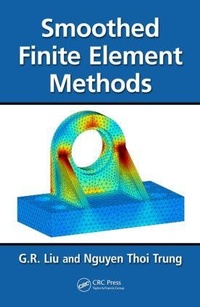
Smoothed Finite Element Methods
1st Edition
Published on 8. June 2010
Book
Hardback
692 pages
978-1-4398-2027-8 (ISBN)
Description
Generating a quality finite element mesh is difficult and often very time-consuming. Mesh-free methods operations can also be complicated and quite costly in terms of computational effort and resources. Developed by the authors and their colleagues, the smoothed finite element method (S-FEM) only requires a triangular/tetrahedral mesh to achieve more accurate results, a generally higher convergence rate in energy without increasing computational cost, and easier auto-meshing of the problem domain. Drawing on the authors' extensive research results, Smoothed Finite Element Methods presents the theoretical framework and development of various S-FEM models.
After introducing background material, basic equations, and an abstracted version of the FEM, the book discusses the overall modeling procedure, fundamental theories, error assessment matters, and necessary building blocks to construct useful S-FEM models. It then focuses on several specific S-FEM models, including cell-based (CS-FEM), node-based (NS-FEM), edge-based (ES-FEM), face-based (FS-FEM), and a combination of FEM and NS-FEM (?FEM). These models are then applied to a wide range of physical problems in solid mechanics, fracture mechanics, viscoelastoplasticity, plates, piezoelectric structures, heat transfer, and structural acoustics.
Requiring no previous knowledge of FEM, this book shows how computational methods and numerical techniques like the S-FEM help in the design and analysis of advanced engineering systems in rapid and cost-effective ways since the modeling and simulation can be performed automatically in a virtual environment without physically building the system. Readers can easily apply the methods presented in the text to their own engineering problems for reliable and certified solutions.
After introducing background material, basic equations, and an abstracted version of the FEM, the book discusses the overall modeling procedure, fundamental theories, error assessment matters, and necessary building blocks to construct useful S-FEM models. It then focuses on several specific S-FEM models, including cell-based (CS-FEM), node-based (NS-FEM), edge-based (ES-FEM), face-based (FS-FEM), and a combination of FEM and NS-FEM (?FEM). These models are then applied to a wide range of physical problems in solid mechanics, fracture mechanics, viscoelastoplasticity, plates, piezoelectric structures, heat transfer, and structural acoustics.
Requiring no previous knowledge of FEM, this book shows how computational methods and numerical techniques like the S-FEM help in the design and analysis of advanced engineering systems in rapid and cost-effective ways since the modeling and simulation can be performed automatically in a virtual environment without physically building the system. Readers can easily apply the methods presented in the text to their own engineering problems for reliable and certified solutions.
Reviews / Votes
Liu and Nguyen introduce newly developed S-FEM models that combine FEM and mesh-free techniques, and explain their application to fracture mechanics, plates, piezoelectrics, heat transfer, and acoustics problems. Intended for mechanical and structural engineers, the graduate textbook describes each step in the S-FEM method and analyzes the properties of S-FEM models using smoothing domains based on cells, nodes, edges, and faces. Numerical examples are provided for an interfacial crack, elastic strain on a hollow sphere, plate buckling, an engine pedestal, and acoustic pressure distribution in a car passenger compartment.-SciTech Book News, February 2011
More details
Language
English
Place of publication
Bosa Roca
United States
Publishing group
Taylor & Francis Inc
Target group
College/higher education
Mechanical, structural, civil, and aeronautical engineers; computer aided engineers/computer aided designers; mathematicians and computational scientists; senior undergraduate and graduate students in engineering.
Product notice
sewn/stitched
Paper over boards
Illustrations
361 s/w Abbildungen
361 Illustrations, black and white
Dimensions
Height: 237 mm
Width: 161 mm
Thickness: 40 mm
Weight
1071 gr
ISBN-13
978-1-4398-2027-8 (9781439820278)
Copyright in bibliographic data and cover images is held by Nielsen Book Services Limited or by the publishers or by their respective licensors: all rights reserved.
Schweitzer Classification
Other editions
Additional editions
G.R. Liu | Nguyen Trung
Smoothed Finite Element Methods
E-Book
04/2016
1st Edition
CRC Press
€264.99
Available for download
G.R. Liu | Nguyen Trung
Smoothed Finite Element Methods
E-Book
04/2016
CRC Press
€264.99
Available for download
Persons
G.R. Liu is the director of the Centre for Advanced Computations in Engineering Science (ACES) as well as a professor and deputy head of the Department of Mechanical Engineering at the National University of Singapore.
Nguyen Thoi Trung is a lecturer in the Department of Mechanics in the University of Science at Vietnam National University in Ho Chi Minh City. He is also the CEO of the Friends of Science and Technology (FOSAT) Group and a researcher in the Faculty of Civil Engineering at Ton Duc Thang University in Ho Chi Minh City.
Nguyen Thoi Trung is a lecturer in the Department of Mechanics in the University of Science at Vietnam National University in Ho Chi Minh City. He is also the CEO of the Friends of Science and Technology (FOSAT) Group and a researcher in the Faculty of Civil Engineering at Ton Duc Thang University in Ho Chi Minh City.
Content
Introduction. Basic Equations for Solid Mechanics. The Finite Element Method. Fundamental Theories for S-FEM. Cell-Based Smoothed FEM. Node-Based Smoothed FEM. Edge-Based Smoothed FEM. Face-Based Smoothed FEM. The ?FEM. S-FEM for Fracture Mechanics. S-FEM for Viscoelastoplasticity. ES-FEM for Plates. S-FEM for Piezoelectric Structures. S-FEM for Heat Transfer Problems. S-FEM for Acoustics Problems. Index.