

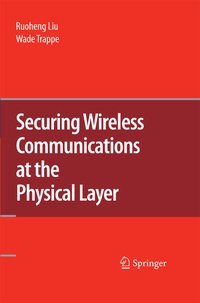
Securing Wireless Communications at the Physical Layer
Published on 7. September 2014
Book
Paperback/Softback
XVI, 396 pages
978-1-4899-8375-6 (ISBN)
Description
Securing communications is a challenging task. A ?rst attempt at security involves learning basic cryptography, and applying encryption algorithms to make messages unintelligible to adversaries. However, rarely is the task of securing a message - changesosimple.Whenonestepsbackandcontemplateshowtosecuretheexchange of communications, one realizes that the challenge is fundamentally one of bui- ing a complete solution. For example, one must ensure that all entities involved have proper and authenticated cryptographic material, or one must ensure that one veri?ably knows to whom one is communicating, or one must understand how the communication process takes place so as to make certain there are no vulnerabilities introduced by the communication process itself. Thislastissue, namelythatsecuritymethodsareoftenbuiltwithoutconsideration to how communication takes place, represents a fundamental gap where much of modern security research has fallen short.The security literature is ?lled with a mass of articles on cryptographic primitives and, although there are still many theoretical hurdlestobeovercomebythecryptographiccommunity,mostoftheseshortcomings areacademicandtherearenownumeroustextbooksoncryptographythatcanprovide thebasicintroductionneededtoemploycryptographicprimitives.
Ontheothersideof thecoin,thesecurityliteratureisalso?lledwithamassofarticlesdevotedtobuilding secure protocols and, similarly, there are now numerous textbooks on computer securitythatprovidetheinstructionneededtodesignsecureprotocols.Unfortunately, the issue of how communication takes place or, more speci?cally, whether there are any speci?c issues that might arise or be circumvented because message exchanges aretakingplaceononemediumversusanother(e.g., wirelesscommunicationversus wired communication), is generally neglected.
Ontheothersideof thecoin,thesecurityliteratureisalso?lledwithamassofarticlesdevotedtobuilding secure protocols and, similarly, there are now numerous textbooks on computer securitythatprovidetheinstructionneededtodesignsecureprotocols.Unfortunately, the issue of how communication takes place or, more speci?cally, whether there are any speci?c issues that might arise or be circumvented because message exchanges aretakingplaceononemediumversusanother(e.g., wirelesscommunicationversus wired communication), is generally neglected.
More details
Edition
2010 ed.
Language
English
Place of publication
New York
United States
Target group
Professional and scholarly
Research
Illustrations
XVI, 396 p.
Dimensions
Height: 235 mm
Width: 155 mm
Thickness: 23 mm
Weight
622 gr
ISBN-13
978-1-4899-8375-6 (9781489983756)
DOI
10.1007/978-1-4419-1385-2
Schweitzer Classification
Other editions
Additional editions
Ruoheng Liu | Wade Trappe
Securing Wireless Communications at the Physical Layer
Book
12/2009
Springer
€160.49
Shipment within 15-20 days
Ruoheng Liu | Wade Trappe
Securing Wireless Communications at the Physical Layer
E-Book
12/2009
1st Edition
Springer
€149.79
Available for download
Content
Secrecy Capacity of Independent Parallel Channels.- Obtaining Secrecy through Intentional Uncertainty.- Distributed Secret Sharing over the Gaussian Interference Wiretap Channel.- Cooperative Jamming: The Tale of Friendly Interference for Secrecy.- Hybrid-ARQ Schemes for Reliable and Secret Wireless Communications.- Secret Communication Under Channel Uncertainty.- Cooperative Secrecy in Wireless Communications.- Source Coding under Secrecy Constraints.- Secret Key Extraction from Level Crossings over Unauthenticated Wireless Channels.- Secret Key Generation Among Multiple Terminals with Applications to Wireless Systems.- Secret Key Agreement Techniques based on Multipath Propagation Characteristics.- Secret Communication over Fading Channels.- Fingerprints in the Ether: Channel-Based Authentication.- Message Authentication: Information Theoretic Bounds.- Trusted Cooperative Transmissions: Turning a Security Weakness into a Security Enhancement.- Modulation Forensics for Wireless Digital Communications in Frequency-Selective Fading Channels.