

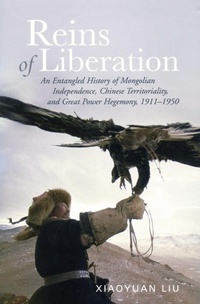
Reins of Liberation
An Entangled History of Mongolian Independence, Chinese Territoriality, and Great Power Hegemony, 1911-1950
Published on 15. September 2006
Book
Hardback
506 pages
978-0-8047-5426-2 (ISBN)
Description
The author's purpose in writing this book is to use the Mongolian question to illuminate much larger issues of twentieth-century Asian history: how war, revolution, and great-power rivalries induced or restrained the formation of nationhood and territoriality. He thus continues the argument he made in Frontier Passages that on its way to building a communist state, the CCP was confronted by a series of fundamental issues pertinent to China's transition to nation-statehood. The book's focus is on the Mongolian question, which ran through Chinese politics in the first half of the twentieth century. Between the Revolution of 1911 and the Communists' triumph in 1949, the course of the Mongolian question best illustrates the genesis, clashes, and convergence of Chinese and Mongolian national identities and geopolitical visions.
Reviews / Votes
"Liu Xiaoyuan's dense but thought-provoking volume... is an essential tome for contemporary Chinese historians as well as those who follow Mongolia, not only because it throws new light on the period, but also because it offers a new paradigm to analyze the Chinese communist drive for national sovereignty."-American Historical Review "This book is excellent. It is well written, with a personal touch that makes for interesting reading... It is a truly path-breaking study for our knowledge of Mongolian and Chinese histories, and ways of looking at them."-The China Journal "An extensive and often fascinating body of detail, which will interest historians of the Chinese civil war."-International History Review "Liu's work is especially important in providing new insight on the post-WWII struggle of various Mongol independence groups to assert themselves, and the impact this had on the ultimate creation of Inner Mongolia and other autonomous regions in China."-CHOICE "With the publication of this book, Mongolia and the Mongols will be central to any study of China's history of modern diplomacy, China's nationalism, communism, the Chinese Communist Party-Nationalist struggle for supremacy, and studies of ethnicity. A truly monumental piece of scholarship."-Uradyn E. Bulag, City University of New York "This book represents the second installment in a project to rethink the twentieth-century history of China and China's self-image in its 'ethnopolitical' context. As a product of the 'great-power-rivalry' approach to Inner Asia, Liu's work is indeed a success and offers much of interest to scholars of modern China." -Asian Studies ReviewMore details
Edition
New edition
Language
English
Place of publication
Palo Alto
United States
Target group
College/higher education
Professional and scholarly
Edition type
New edition
Product notice
Cloth
Dimensions
Height: 238 mm
Width: 161 mm
Thickness: 36 mm
Weight
957 gr
ISBN-13
978-0-8047-5426-2 (9780804754262)
Copyright in bibliographic data and cover images is held by Nielsen Book Services Limited or by the publishers or by their respective licensors: all rights reserved.
Schweitzer Classification
Person
Xiaoyuan Liu is Associate Professor of History at Iowa State University and a recent Fellow at the Woodrow Wilson Center in Washington. He is author of Frontier Passages: Ethnopolitics and the Rise of Chinese Communism, 1921-1945 (Stanford University Press and the Woodrow Wilson Center Press, 2004).
Content
List of Maps
Acknowledgments
Introduction
Part I Independence and Revolution, 1911-1945
1 China and Mongolia: From Empire to National States
Facets of the Mongolia Question
Independence for the Second Time
Ethnic Separation and National Revolution
Partisan, National, and Imperial Interests
2 "Red Protective Deity": World Revolution and Geopolitics
Bolsheviks and Mongolian Partisans
Eurasian Federation vs. Soviet Empire
Divided Nation and Split Revolution
3 Dialectics of Brotherhood: The Chinese Communist Party and the Mongolian People's Republic
Revolutionary Paradox
Rally toward Periphery
Return to Centrality
Part II Autonomy and Civil War, 1945-1950
4 "National Fever": The Genesis of an
Autonomous Movement
From Colonialism to National Fever
Liberation through Unification
Degrees of Self-Government
5 Ethnic Strategy: The Eastern Mongolian Experience
Chengde Concession
Xing'an Interval
Wangyemiao Finale
6 "Restoration": The Guomindang's Administrative Endeavor
Delusive "Frontier Administration
Abortive "Restoration
Elusive "Loyalists
7 "Liberation": The Chinese Communist Party's Interethnic Approach
Decide on a Strategy
Awake to Spontaneity
Secure "National Banner
Enact "Leftist Excessiveness
Part III Ethnicity and Hegemony, 1945-1950
8 "New Frontier":America's Encounter with Inner Mongolia
Partisan Mongols
Racial Mongols
Change of Climate
Princely Connection
9 The Range of "Wild Wind": Moscow's Inner Mongolia Stratagem
A Sense of Limits
Containing Nationalism
Hierarchy of Patronage
10 The Structure of Bloc Politics: Mao, Stalin, and Mongolian Independence
A Fractured Revolutionary Alliance
Resetting the Interstate Relationship
Between National and Bloc Interests
Mongolian Independence, Again
11 Epilogue: Territoriality, Power, and Legitimacy
A Note on Transliteration
Acronyms and Abbreviations
Bibliography
Index
Acknowledgments
Introduction
Part I Independence and Revolution, 1911-1945
1 China and Mongolia: From Empire to National States
Facets of the Mongolia Question
Independence for the Second Time
Ethnic Separation and National Revolution
Partisan, National, and Imperial Interests
2 "Red Protective Deity": World Revolution and Geopolitics
Bolsheviks and Mongolian Partisans
Eurasian Federation vs. Soviet Empire
Divided Nation and Split Revolution
3 Dialectics of Brotherhood: The Chinese Communist Party and the Mongolian People's Republic
Revolutionary Paradox
Rally toward Periphery
Return to Centrality
Part II Autonomy and Civil War, 1945-1950
4 "National Fever": The Genesis of an
Autonomous Movement
From Colonialism to National Fever
Liberation through Unification
Degrees of Self-Government
5 Ethnic Strategy: The Eastern Mongolian Experience
Chengde Concession
Xing'an Interval
Wangyemiao Finale
6 "Restoration": The Guomindang's Administrative Endeavor
Delusive "Frontier Administration
Abortive "Restoration
Elusive "Loyalists
7 "Liberation": The Chinese Communist Party's Interethnic Approach
Decide on a Strategy
Awake to Spontaneity
Secure "National Banner
Enact "Leftist Excessiveness
Part III Ethnicity and Hegemony, 1945-1950
8 "New Frontier":America's Encounter with Inner Mongolia
Partisan Mongols
Racial Mongols
Change of Climate
Princely Connection
9 The Range of "Wild Wind": Moscow's Inner Mongolia Stratagem
A Sense of Limits
Containing Nationalism
Hierarchy of Patronage
10 The Structure of Bloc Politics: Mao, Stalin, and Mongolian Independence
A Fractured Revolutionary Alliance
Resetting the Interstate Relationship
Between National and Bloc Interests
Mongolian Independence, Again
11 Epilogue: Territoriality, Power, and Legitimacy
A Note on Transliteration
Acronyms and Abbreviations
Bibliography
Index