

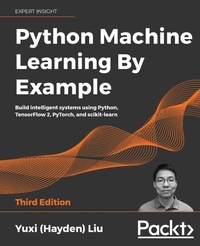
Python Machine Learning by Example
Build intelligent systems using Python, TensorFlow 2, PyTorch, and scikit-learn
3rd Edition
Published on 30. October 2020
Book
Paperback/Softback
526 pages
978-1-80020-971-8 (ISBN)
Description
A comprehensive guide to get you up to speed with the latest developments of practical machine learning with Python and upgrade your understanding of machine learning (ML) algorithms and techniques
Key Features
Dive into machine learning algorithms to solve the complex challenges faced by data scientists today
Explore cutting edge content reflecting deep learning and reinforcement learning developments
Use updated Python libraries such as TensorFlow, PyTorch, and scikit-learn to track machine learning projects end-to-end
Book DescriptionPython Machine Learning By Example, Third Edition serves as a comprehensive gateway into the world of machine learning (ML).
With six new chapters, on topics including movie recommendation engine development with Naive Bayes, recognizing faces with support vector machine, predicting stock prices with artificial neural networks, categorizing images of clothing with convolutional neural networks, predicting with sequences using recurring neural networks, and leveraging reinforcement learning for making decisions, the book has been considerably updated for the latest enterprise requirements.
At the same time, this book provides actionable insights on the key fundamentals of ML with Python programming. Hayden applies his expertise to demonstrate implementations of algorithms in Python, both from scratch and with libraries.
Each chapter walks through an industry-adopted application. With the help of realistic examples, you will gain an understanding of the mechanics of ML techniques in areas such as exploratory data analysis, feature engineering, classification, regression, clustering, and NLP.
By the end of this ML Python book, you will have gained a broad picture of the ML ecosystem and will be well-versed in the best practices of applying ML techniques to solve problems.What you will learn
Understand the important concepts in ML and data science
Use Python to explore the world of data mining and analytics
Scale up model training using varied data complexities with Apache Spark
Delve deep into text analysis and NLP using Python libraries such NLTK and Gensim
Select and build an ML model and evaluate and optimize its performance
Implement ML algorithms from scratch in Python, TensorFlow 2, PyTorch, and scikit-learn
Who this book is forIf you're a machine learning enthusiast, data analyst, or data engineer highly passionate about machine learning and want to begin working on machine learning assignments, this book is for you.
Prior knowledge of Python coding is assumed and basic familiarity with statistical concepts will be beneficial, although this is not necessary.
Key Features
Dive into machine learning algorithms to solve the complex challenges faced by data scientists today
Explore cutting edge content reflecting deep learning and reinforcement learning developments
Use updated Python libraries such as TensorFlow, PyTorch, and scikit-learn to track machine learning projects end-to-end
Book DescriptionPython Machine Learning By Example, Third Edition serves as a comprehensive gateway into the world of machine learning (ML).
With six new chapters, on topics including movie recommendation engine development with Naive Bayes, recognizing faces with support vector machine, predicting stock prices with artificial neural networks, categorizing images of clothing with convolutional neural networks, predicting with sequences using recurring neural networks, and leveraging reinforcement learning for making decisions, the book has been considerably updated for the latest enterprise requirements.
At the same time, this book provides actionable insights on the key fundamentals of ML with Python programming. Hayden applies his expertise to demonstrate implementations of algorithms in Python, both from scratch and with libraries.
Each chapter walks through an industry-adopted application. With the help of realistic examples, you will gain an understanding of the mechanics of ML techniques in areas such as exploratory data analysis, feature engineering, classification, regression, clustering, and NLP.
By the end of this ML Python book, you will have gained a broad picture of the ML ecosystem and will be well-versed in the best practices of applying ML techniques to solve problems.What you will learn
Understand the important concepts in ML and data science
Use Python to explore the world of data mining and analytics
Scale up model training using varied data complexities with Apache Spark
Delve deep into text analysis and NLP using Python libraries such NLTK and Gensim
Select and build an ML model and evaluate and optimize its performance
Implement ML algorithms from scratch in Python, TensorFlow 2, PyTorch, and scikit-learn
Who this book is forIf you're a machine learning enthusiast, data analyst, or data engineer highly passionate about machine learning and want to begin working on machine learning assignments, this book is for you.
Prior knowledge of Python coding is assumed and basic familiarity with statistical concepts will be beneficial, although this is not necessary.
More details
Edition
3rd Revised edition
Language
English
Place of publication
Birmingham
United Kingdom
Target group
Professional and scholarly
US School Grade: College Graduate Student
Edition type
Revised edition
Dimensions
Height: 235 mm
Width: 191 mm
Thickness: 29 mm
Weight
971 gr
ISBN-13
978-1-80020-971-8 (9781800209718)
Copyright in bibliographic data and cover images is held by Nielsen Book Services Limited or by the publishers or by their respective licensors: all rights reserved.
Schweitzer Classification
Other editions
Additional editions
Yuxi (Hayden) Liu
Python Machine Learning by Example
Build intelligent systems using Python, TensorFlow 2, PyTorch, and scikit-learn
E-Book
09/2024
3rd Edition
Packt Publishing
€23.49
Available for download
Person
Yuxi (Hayden) Liu was a Machine Learning Software Engineer at Google. With a wealth of experience from his tenure as a machine learning scientist, he has applied his expertise across data-driven domains and applied his ML expertise in computational advertising, cybersecurity, and information retrieval.
He is the author of a series of influential machine learning books and an education enthusiast. His debut book, also the first edition of Python Machine Learning by Example, ranked the #1 bestseller in Amazon and has been translated into many different languages.
He is the author of a series of influential machine learning books and an education enthusiast. His debut book, also the first edition of Python Machine Learning by Example, ranked the #1 bestseller in Amazon and has been translated into many different languages.
Content
Table of Contents
Getting Started with Machine Learning and Python
Building a Movie Recommendation Engine with Na
Recognizing Faces with Support Vector Machine
Predicting Online Ad Click-Through with Tree-Based Algorithms
Predicting Online Ad Click-Through with Logistic Regression
Scaling Up Prediction to Terabyte Click Logs
Predicting Stock Prices with Regression Algorithms
Predicting Stock Prices with Artificial Neural Networks
Mining the 20 Newsgroups Dataset with Text Analysis Techniques
Discovering Underlying Topics in the Newsgroups Dataset with Clustering and Topic Modeling
Machine Learning Best Practices
Categorizing Images of Clothing with Convolutional Neural Networks
Making Predictions with Sequences Using Recurrent Neural Networks
Making Decisions in Complex Environments with Reinforcement Learning
Getting Started with Machine Learning and Python
Building a Movie Recommendation Engine with Na
Recognizing Faces with Support Vector Machine
Predicting Online Ad Click-Through with Tree-Based Algorithms
Predicting Online Ad Click-Through with Logistic Regression
Scaling Up Prediction to Terabyte Click Logs
Predicting Stock Prices with Regression Algorithms
Predicting Stock Prices with Artificial Neural Networks
Mining the 20 Newsgroups Dataset with Text Analysis Techniques
Discovering Underlying Topics in the Newsgroups Dataset with Clustering and Topic Modeling
Machine Learning Best Practices
Categorizing Images of Clothing with Convolutional Neural Networks
Making Predictions with Sequences Using Recurrent Neural Networks
Making Decisions in Complex Environments with Reinforcement Learning