

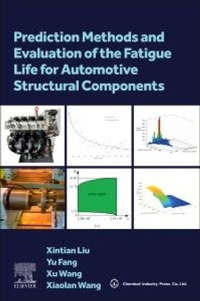
Prediction Methods and Evaluation of the Fatigue Life for Automotive Structural Components
Published on 1. June 2025
Book
Paperback/Softback
400 pages
978-0-443-30235-0 (ISBN)
Description
Automotive structural components are an important component that affects the performance of the entire vehicle. The light weight of automotive structural components is one of the sustainable solutions to energy and environmental issues, and the development technology of its core components and vehicle performance evaluation technology are its key development directions. To gradually replace traditional cars on a large scale, electric vehicles need to address the durability and reliability issues of the entire vehicle and key components. Prediction Methods and Evaluation of the Fatigue Life for Automotive Structural Components helps readers understand how they can do this
More details
Language
English
Place of publication
Philadelphia
United States
Target group
Professional and scholarly
Product notice
Paperback (trade)
Unsewn / adhesive bound
Dimensions
Height: 234 mm
Width: 191 mm
Thickness: 20 mm
Weight
816 gr
ISBN-13
978-0-443-30235-0 (9780443302350)
Copyright in bibliographic data and cover images is held by Nielsen Book Services Limited or by the publishers or by their respective licensors: all rights reserved.
Schweitzer Classification
Other editions
Additional editions
Xintian Liu | Yu Fang | Xu Wang
Prediction Methods and Evaluation of the Fatigue Life for Automotive Structural Components
E-Book
06/2025
Elsevier
€214.99
Available for download
Persons
Dr Xintian Liu is the Vice Dean of the School of Mechanical and Automotive Engineering at Shanghai University of Engineering Science, China, and also serves as a member of the Modern Management Branch of the China Society of Automotive Engineering and the Automotive Reliability Professional Committee of Shanghai Society of Automotive Engineering. Currently, he is mainly engaged in research in automotive reliability engineering, fatigue life prediction and evaluation, structural system uncertainty, and functional safety of intelligent vehicle systems. He has published more than 100 papers as the first or corresponding author Professor Yu Fang is currently a Professor at the School of Mechanical and Automotive Engineering, Shanghai University of Engineering Science, China. He received his PhD from Harbin Institute of Technology, China, in 2008 Dr Xu Wang received her PhD degree in pattern recognition and intelligent system in 2013 from Donghua University, China. She is currently a lecturer at the school of mechanical and automotive engineering, Shanghai University of Engineering Science, China. Her research interests include prediction methods, evolutionary computation, optimization methods, deep learning and their applications Dr Xiaolan Wang received her M.S. and Ph.D. degrees in vehicle application engineering from Jilin University, Changchun, China, in 2009 and 2012, respectively. She is currently a lecturer with the School of Mechanical and Automotive Engineering, Shanghai University of Engineering Science, Shanghai, China. Her active research interests include intelligent vehicles, driving assistance systems, and driver behaviour
Content
1. Classification and characteristics of automotive structural components
2. The characteristics of metals and non-metallic materials
3. The strength properties of structural components
4. The principles and characteristic of load
5. Fatigue life prediction methods
6. Theoretical and experimental standardization of fatigue life
7. Fatigue reliability analysis and evaluation
8. The correlation between quality characteristics and fatigue life
9. Conclusions and future outlook
2. The characteristics of metals and non-metallic materials
3. The strength properties of structural components
4. The principles and characteristic of load
5. Fatigue life prediction methods
6. Theoretical and experimental standardization of fatigue life
7. Fatigue reliability analysis and evaluation
8. The correlation between quality characteristics and fatigue life
9. Conclusions and future outlook