

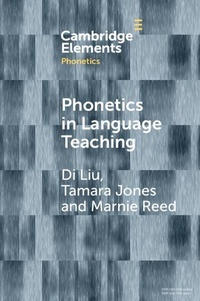
Phonetics in Language Teaching
Published on 19. January 2023
Book
Paperback/Softback
90 pages
978-1-108-99435-4 (ISBN)
Description
This Element explores ways in which language teachers, especially teachers of English, can benefit from knowledge of phonetics. It also offers recommendations for introducing and improving pronunciation teaching in the classroom. While hoping that this Element is useful to instructors of all languages, the majority of the examples comes from North American English (NAE) and the English language classroom. At the same time, the Element acknowledges that English language teaching is rather different from the teaching of other languages, since nowadays, most interactions around the world in English do not involve a native speaker, and use of English as a lingua franca (ELF) has become widespread. Teachers of English should be aware that their students may not want to mimic all aspects of native-speaker pronunciation; since some native-speaker patterns of speech, such as the extensive simplification and omission of sounds may not be helpful in enhancing intelligibility.
More details
Series
Language
English
Place of publication
Cambridge
United Kingdom
Product notice
Paperback (trade)
Illustrations
Worked examples or Exercises
Dimensions
Height: 182 mm
Width: 129 mm
Thickness: 16 mm
Weight
264 gr
ISBN-13
978-1-108-99435-4 (9781108994354)
Copyright in bibliographic data and cover images is held by Nielsen Book Services Limited or by the publishers or by their respective licensors: all rights reserved.
Schweitzer Classification
Other editions
Additional editions
Di Liu | Tamara Jones | Marnie Reed
Phonetics in Language Teaching
E-Book
01/2023
Cambridge University Press
€22.49
Available for download
Tamara Jones | Di Liu | Marnie Reed
Phonetics in Language Teaching
E-Book
12/2022
Cambridge University Press
€22.49
Available for download
Persons
Content
1. Introduction; 2. Phonetic transcription; 3. Articulation of segments; 4. Coarticulation and connected speech processes; 5. Prosody; 6. Advances, issues, and technology; Conclusion; Glossary; References.