

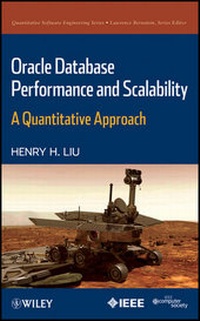
Oracle Database Performance and Scalability
A Quantitative Approach
Will be published approx. on 23. December 2011
Book
Hardback
728 pages
978-1-118-05699-8 (ISBN)
Description
A data-driven, fact-based, quantitative text on Oracle performance and scalability
With database concepts and theories clearly explained in Oracle's context, readers quickly learn how to fully leverage Oracle's performance and scalability capabilities at every stage of designing and developing an Oracle-based enterprise application. The book is based on the author's more than ten years of experience working with Oracle, and is filled with dependable, tested, and proven performance optimization techniques.
Oracle Database Performance and Scalability is divided into four parts that enable readers to progressively learn and apply new skills:
* Part 1, Getting Started with Oracle, describes how to set up a working Oracle environment, offering a quick tour to illustrate major database concepts
* Part 2, Oracle Architecture from Performance and Scalability Perspectives, explains all the major database concepts and architectural features that readers need to know to optimize Oracle performance and scalability
* Part 3, Optimizing Oracle Performance and Scalability, offers hands-on instructions to optimize and fine-tune performance and scalability for all database applications
* Part 4, Case Studies: Oracle Meeting Real-World Performance and Scalability Challenges, sets forth quantitative case studies based on the author's first-hand experience that demonstrate how readers can apply proven techniques to dramatically improve the performance and scalability of actual database products
In addition to case studies, this book offers a detailed secure online banking application as an example, making it possible for readers to fully explore Oracle's performance and scalability features on their own. Oracle Database Performance and Scalability is an ideal text for pre-conditioning college students and training software developers.
More details
Product info
gebunden
Series
Edition
1. Auflage
Language
English
Place of publication
New York
United States
Target group
College/higher education
Professional and scholarly
Product notice
Unsewn / adhesive bound
Paper over boards
Dimensions
Height: 240 mm
Width: 161 mm
Thickness: 43 mm
Weight
1249 gr
ISBN-13
978-1-118-05699-8 (9781118056998)
Schweitzer Classification
Other editions
Additional editions

E-Book
10/2011
Wiley
€96.99
Available for download
E-Book
10/2011
Wiley-IEEE Computer Society Press
€98.99
Available for download
Person
Henry H. Liu, PhD, is a Software Developer at BMC Software, Inc., with a physicist background from his prior career. His primary responsibilities at BMC include helping build performance and scalability into BMC's cloud computing and enterprise service management software products. Dr. Liu is the author of the highly acclaimed Software Performance and Scalability: A Quantitative Approach (Wiley).
Content
PREFACE xxv
ACKNOWLEDGMENTS xxxiii
INTRODUCTION 1
PART 1 GETTING STARTED WITH ORACLE 7
1 Basic Concepts 9
2 Installing Oracle Software 14
3 Options for Accessing an Oracle Server 34
4 A Quick Tour of an Oracle Server 52
PART 2 ORACLE ARCHITECTURE FROM PERFORMANCE AND SCALABILITY PERSPECTIVES 75
5 Understanding Oracle Architecture 79
6 Oracle 10g Memory Management 101
7 Oracle 11g Memory Management 111
8 Oracle Storage Structure 116
9 Oracle Wait Interface (OWI) 127
10 Oracle Data Consistency and Concurrency 139
11 Anatomy of an Oracle Automatic Workload Repository (AWR) Report 161
12 Oracle Advanced Features and Options 227
13 Top 10 Oracle Performance and Scalability Features 257
14 Oracle-Based Application Performance and Scalability by Design 266
15 Project: Soba--A Secure Online Banking Application on Oracle 326
PART 3 OPTIMIZING ORACLE PERFORMANCE AND SCALABILITY 415
16 Logistics of the Oracle Cost-Based Optimizer (CBO) 417
17 Oracle SQL Tuning 431
18 Oracle Indexing 449
19 Auto_Tune Features 459
PART 4 CASE STUDIES: ORACLE MEETING REAL WORLD PERFORMANCE AND SCALABILITY CHALLENGES 473
20 Case Study: Achieving High Throughput with Array Processing 477
21 Case Study: Performance Comparison of Heap-Organized versus Index-Organized Tables 485
22 Case Study: SQL Tuning: "IN" versus "OR" versus Global Temporary Table 492
23 Case Study: Data Access Paths (Double Buffering) 504
24 Case Study: Covering Index 531
25 Case Study: CURSOR_SHARING 547
26 Case Study: Bulk Transactions 571
27 Case Study: Missing Statistics 594
28 Case Study: Misconfigured SAN Storage 620
Recommended Reading 630
Exercises 630
APPENDIX A ORACLE PRODUCT DOCUMENTATIONS 633
A.1 Oracle Database Concepts 633
A.2 Oracle Database Administrator's Guide 633
A.3 Oracle Database Reference 634
A.4 Oracle Database Performance Tuning Guide 634
A.5 Oracle Database 2 Day Performance Tuning Guide 634
A.6 Oracle Database 2 Day DBA 634
A.7 Oracle Database SQL Language Reference 634
A.8 Oracle Database Sample Schemas 635
A.9 Oracle Database PL/SQL Packages and Types Reference 635
A.10 Oracle Database PL/SQL Language Reference 635
A.11 Oracle Database JDBC Developer's Guide and References 635
APPENDIX B USING SQLPLUS WITH ORACLE 636
B.1 Installation 636
B.2 SQLPlus and tnsnames.ora File 637
B.3 Basics of SQLPlus 638
B.4 Common SQLPlus Commands 638
B.5 Using SQLPlus to Execute SQL Statements 639
B.6 Using SQLPlus to Execute PL/SQL Blocks 640
B.7 Using SQLPlus Autotrace to Obtain EXECUTION PLANs and Optimizer Statistics 640
B.8 Using SQLPlus Timing Command 641
B.9 Exporting/Importing Oracle Databases with SQLPlus 642
B.10 Creating AWR Reports with SQLPlus 643
B.11 Checking Tablespace Usage with SQLPlus 644
B.12 Creating EM DBConsole with SQLPlus 646
APPENDIX C A COMPLETE LIST OF ALL WAIT EVENTS IN ORACLE 11g 648
APPENDIX D A COMPLETE LIST OF ALL METRICS WITH THE V$STATNAME VIEW 656
APPENDIX E A COMPLETE LIST OF ALL STATISTICS WITH THE V$SYSSTAT VIEW 667
INDEX 681