

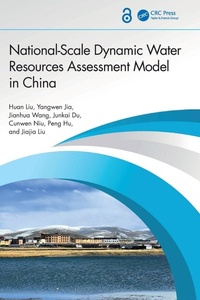
National-Scale Dynamic Water Resources Assessment Model in China
1st Edition
Published on 10. September 2025
Book
Hardback
158 pages
978-1-041-08697-0 (ISBN)
Description
This detailed book introduces China's national dynamic water resources assessment model, presenting its construction, application scenarios, and modern modeling approach to replace traditional statistics-based methods.
The book thoroughly explores the applications of distributed hydrological modeling techniques in national water resources assessment. It presents the successful development of the China Water Assessment Model (CWAM), which is based on the WEP-L hydrological model. CWAM demonstrates broad potential in supporting national water information acquisition, uniquely covering both surveyed and un-surveyed regions. The work highlights the model's ability to account for China's diverse climatic and geological characteristics, while improving the efficiency of water resources assessment and providing solutions to dynamic assessment challenges, especially under climate change and human impacts.
This work will serve as an essential reference for scholars and students in hydrology and water resources, as well as policy makers and engineers involved in water resources management and assessment.
Chapter 1 of this book is freely available as a downloadable Open Access PDF at http://www.taylorfrancis.com under a Creative Commons Attribution-Non Commercial-No Derivatives (CC BY-NC-ND) 4.0 license.
The book thoroughly explores the applications of distributed hydrological modeling techniques in national water resources assessment. It presents the successful development of the China Water Assessment Model (CWAM), which is based on the WEP-L hydrological model. CWAM demonstrates broad potential in supporting national water information acquisition, uniquely covering both surveyed and un-surveyed regions. The work highlights the model's ability to account for China's diverse climatic and geological characteristics, while improving the efficiency of water resources assessment and providing solutions to dynamic assessment challenges, especially under climate change and human impacts.
This work will serve as an essential reference for scholars and students in hydrology and water resources, as well as policy makers and engineers involved in water resources management and assessment.
Chapter 1 of this book is freely available as a downloadable Open Access PDF at http://www.taylorfrancis.com under a Creative Commons Attribution-Non Commercial-No Derivatives (CC BY-NC-ND) 4.0 license.
More details
Language
English
Place of publication
London
United Kingdom
Publishing group
Taylor & Francis Ltd
Target group
College/higher education
Professional and scholarly
Academic, Postgraduate, Professional Practice & Development, Professional Reference, Undergraduate Advanced, and Undergraduate Core
Illustrations
54 s/w Abbildungen, 17 farbige Abbildungen, 54 s/w Zeichnungen, 17 farbige Zeichnungen, 43 s/w Tabellen
43 Tables, black and white; 17 Line drawings, color; 54 Line drawings, black and white; 17 Illustrations, color; 54 Illustrations, black and white
Dimensions
Height: 260 mm
Width: 183 mm
Thickness: 14 mm
Weight
545 gr
ISBN-13
978-1-041-08697-0 (9781041086970)
Copyright in bibliographic data and cover images is held by Nielsen Book Services Limited or by the publishers or by their respective licensors: all rights reserved.
Schweitzer Classification
Other editions
Additional editions
Huan Liu | Yangwen Jia | Jianhua Wang
National-Scale Dynamic Water Resources Assessment Model in China
E-Book
09/2025
CRC Press
€92.49
Available for download
Huan Liu | Yangwen Jia | Jianhua Wang
National-Scale Dynamic Water Resources Assessment Model in China
E-Book
09/2025
CRC Press
€92.49
Available for download
Persons
Huan Liu is Senior Engineer at China Institute of Water Resources and Hydropower Research, mainly engaged in water cycle simulation and water resources assessment.
Yangwen Jia is Senior Engineer at China Institute of Water Resources and Hydropower Research, mainly engaged in water cycle simulation.
Jianhua Wang is Senior Engineer at China Institute of Water Resources and Hydropower Research, mainly engaged in water resources assessment and utilization.
Junkai Du is Senior Engineer at China Institute of Water Resources and Hydropower Research, mainly engaged in water information monitoring and application.
Cunwen Niu is Senior Engineer at China Institute of Water Resources and Hydropower Research, mainly engaged in water resources management.
Peng Hu is Senior Engineer at China Institute of Water Resources and Hydropower Research, mainly engaged in protection and restoration of rivers and lakes.
Jiajia Liu is Senior Engineer at China Institute of Water Resources and Hydropower Research, mainly engaged in hydrological model development.
Yangwen Jia is Senior Engineer at China Institute of Water Resources and Hydropower Research, mainly engaged in water cycle simulation.
Jianhua Wang is Senior Engineer at China Institute of Water Resources and Hydropower Research, mainly engaged in water resources assessment and utilization.
Junkai Du is Senior Engineer at China Institute of Water Resources and Hydropower Research, mainly engaged in water information monitoring and application.
Cunwen Niu is Senior Engineer at China Institute of Water Resources and Hydropower Research, mainly engaged in water resources management.
Peng Hu is Senior Engineer at China Institute of Water Resources and Hydropower Research, mainly engaged in protection and restoration of rivers and lakes.
Jiajia Liu is Senior Engineer at China Institute of Water Resources and Hydropower Research, mainly engaged in hydrological model development.
Content
1. Model architecture design and implementation program of the CWAM model 2. New sub-basin division method for large-scale regions and its application in China 3. Infiltration-runoff modeling for swelling soil under unsteady rainfall condition 4. Hydrological modeling for karst structure and its application in the karst mountain region 5. Hydrothermal coupling modeling for the cold region and its application in the source area of the Yangtze River 6. Development and validation of national-scale dynamic water resources assessment model in China 7. Spatiotemporal patterns of hydrological and water resources variables in China 8. Detection and attribution of streamflow changes in different climatic and geomorphic regions of China 9. Conclusions