

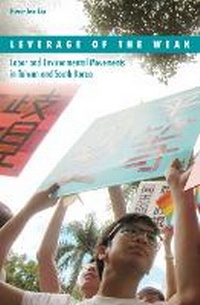
Leverage of the Weak
Labor and Environmental Movements in Taiwan and South Korea
Published on 21. July 2015
Book
Paperback/Softback
248 pages
978-0-8166-8952-1 (ISBN)
Description
Comparing Taiwan and South Korea strategically, Hwa-Jen Liu seeks an answer to a deceptively simple question: Why do social movements appear at different times in a nation's development?
Despite their apparent resemblance-a colonial heritage, authoritarian rule, rapid industrialization, and structural similarities-Taiwan and South Korea were opposites in their experiences with two key social movements. South Korea followed a conventional capitalist route: labor movements challenged the system long before environmental movements did. In Taiwan, pro-environment struggles gained strength before labor activism. Liu argues that part of the explanation lies in an analysis of how movements advance their causes by utilizing different types of power. Whereas labor movements have the power of economic leverage, environmental movements depend on the power of ideology. Therefore, examining material factors versus ideational factors is crucial to understanding the successes (or failures) of social movements.
Leverage of the Weak is a significant contribution to the literature on social movements, to the study of East Asian political economies, and to the progress of the comparative-historical method. It enhances knowledge of movement emergence, investigates the possibilities and obstacles involved in forging labor-environment alliances, and offers the first systematic, multilayered comparisons across movements and nations in East Asia.
Despite their apparent resemblance-a colonial heritage, authoritarian rule, rapid industrialization, and structural similarities-Taiwan and South Korea were opposites in their experiences with two key social movements. South Korea followed a conventional capitalist route: labor movements challenged the system long before environmental movements did. In Taiwan, pro-environment struggles gained strength before labor activism. Liu argues that part of the explanation lies in an analysis of how movements advance their causes by utilizing different types of power. Whereas labor movements have the power of economic leverage, environmental movements depend on the power of ideology. Therefore, examining material factors versus ideational factors is crucial to understanding the successes (or failures) of social movements.
Leverage of the Weak is a significant contribution to the literature on social movements, to the study of East Asian political economies, and to the progress of the comparative-historical method. It enhances knowledge of movement emergence, investigates the possibilities and obstacles involved in forging labor-environment alliances, and offers the first systematic, multilayered comparisons across movements and nations in East Asia.
Reviews / Votes
"Theoretically sophisticated and methodologically meticulous, Hwa-Jen Liu's book presents a fascinating comparative analysis of the labor and environmental movements in Taiwan and South Korea. Leverage of the Weak is one of the most interesting and significant books on East Asian development."-Hagen Koo, University of Hawai?i at Manoa"A sober yet hopeful account of the struggle to humanize capitalism, this comparative study is a valuable resource for those interested in social movements and labor, sociology, and economic development."-CHOICE
"Because of its rich conceptual development, strong case study analysis and the generalisability of its findings, Leverage of the Weak is likely to appeal to a diverse academic audience."-Asian Studies Review
"Essential reading for anyone interested in the historical development of Taiwan and South Korea."-American Journal of Sociology
"Theoretically innovative, well-grounded in in-depth empirical research, and well written. Students who want to understand the rise social movements in East Asia, the relationship between labor and environmental activism, and the interactions between state actors and collective actors will learn a lot from this comparative study."-Mobilization
"Liu's rigorous, provocative, and ground-breaking analysis of the mutually constitutive relationship between movement power and capitalist transformation should be required reading for anyone interested in the political possibilities and challenges of social movements in today's global political economy."-Labour/Le Travail
"This is a detailed study on why and how social movements rise up during a nation's development. Author Liu takes a comparative examination of two Northeast Asian countries, similar in many ways of political and economic development; modern industrialized Taiwan and South Korea."-Korean Quarterly
More details
Series
Language
English
Place of publication
Minnesota
United States
Target group
Professional and scholarly
Illustrations
18
Dimensions
Height: 229 mm
Width: 152 mm
Thickness: 25 mm
ISBN-13
978-0-8166-8952-1 (9780816689521)
Copyright in bibliographic data and cover images is held by Nielsen Book Services Limited or by the publishers or by their respective licensors: all rights reserved.
Schweitzer Classification
Person
Hwa-Jen Liu teaches sociology at the National Taiwan University.
Content
Contents
Acknowledgments
Note to Readers
Abbreviations
Introduction: Strategic Comparison of Two Movements and Two Late Industrializers
1. The Power Bases of Labor and Environmental Movements
2. The Tangles of Movement Histories
3. The Emergence of Early-Riser Movements
4. Movement Legacy and Latecomer Movements
5. Labor and Environmental Trajectories
Conclusion: What Now?
Appendix: Notes on Methodology
Notes
Bibliography
Index
Acknowledgments
Note to Readers
Abbreviations
Introduction: Strategic Comparison of Two Movements and Two Late Industrializers
1. The Power Bases of Labor and Environmental Movements
2. The Tangles of Movement Histories
3. The Emergence of Early-Riser Movements
4. Movement Legacy and Latecomer Movements
5. Labor and Environmental Trajectories
Conclusion: What Now?
Appendix: Notes on Methodology
Notes
Bibliography
Index