

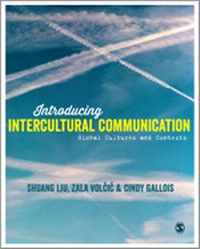
Introducing Intercultural Communication
Global Cultures and Contexts
2nd Edition
Published on 19. November 2014
Book
Hardback
384 pages
978-1-4462-8590-9 (ISBN)
Description
Introducing Intercultural Communication uses examples and case studies from around the world to situate communication theory in a truly global perspective. Covering the essentials from international conflict to migration and social networking, this book shows students how to master the skills and concepts at work in how we communicate and understand each other across cultural boundaries.
Each chapter brings to life the links between theory and practice, and between the global and local, showing you how to understand the influence of your culture on how you view yourself and others. In this book:
Theory boxes show you how to use key ideas in work contexts.
Case studies from European, Chinese, Australian and American contexts give you a truly global perspective.
Critical questions help you to challenge yourself.
A full chapter gives practical tips on how to become an effective intercultural communicator.
Annotated lists of further reading and free access to online SAGE journal articles assist you in your research.
A companion website (https://study.sagepub.com/liu2e) provides you with exercise questions, as well as extended reading lists.
This book will guide you to success in your studies and will teach you to become a more critical consumer of information.
Each chapter brings to life the links between theory and practice, and between the global and local, showing you how to understand the influence of your culture on how you view yourself and others. In this book:
Theory boxes show you how to use key ideas in work contexts.
Case studies from European, Chinese, Australian and American contexts give you a truly global perspective.
Critical questions help you to challenge yourself.
A full chapter gives practical tips on how to become an effective intercultural communicator.
Annotated lists of further reading and free access to online SAGE journal articles assist you in your research.
A companion website (https://study.sagepub.com/liu2e) provides you with exercise questions, as well as extended reading lists.
This book will guide you to success in your studies and will teach you to become a more critical consumer of information.
Reviews / Votes
This new edition provides a very comprehensive and most up-to-date account of the key concepts and current issues in intercultural communication to accommodate the changing practice in an increasingly digitalized age. Theoretical discussions are complemented with case studies and stimulating questions for critical thinking and group discussion. -- Dr Richard Xiao This second edition has continued its mission to stimulate students' critical thinking on intercultural communication across continents, using highly accessible language and vivid examples from various parts of the world. Theoretical concepts and cases have been enriched and updated. The "Theory Corner" equips students with more cultural and related theories and resources which enable them to self-learn and explore further. Digital/mobile communication and its impact on cultural exchange is discussed to keep students abreast of the fast-changing cultural contexts in which they live and act. -- Justina Cheang The second edition of Introducing Intercultural Communication strikes a balance between theory and practice that I found really valuable. The global examples used throughout the book show an application of theories that otherwise can feel quite abstract. The whole book flows in a logical manner, however each chapter stands alone in providing a glimpse into global cultures and the theories we use to communicate within them.Particularly notable is the chapter on Mass Media, Technology and Cultural Change, which highlights the influence of technology in everything we do. The book doesn't simply speak about this change, but caters to it with a companion website that allows readers to access the content in an interactive capacity. The content is accessible and introduces key concepts that will provide a foundation in the communication field, whether that is in further studies or the workplace. -- Natassja Bertram Introducing Intercultural Communication was published in 2011 and written by a 'multinational team of authors' (book cover) from the University of Queensland, Australia. Though not officially presented as a textbook, it can obviously serve as one. The book is composed of 13 chapters and a very useful glossary. The chapters cover various aspects of intercultural communication and the Global: e.g. the influence of culture on perception, (non-) verbal communication, categorizations, subgroups and identities, intercultural conflicts, etc. Each chapter contains theory corners, case illustrations, and further reading -- Fred Dervin, University of Turku, Finland
More details
Edition
2nd Revised edition
Language
English
Place of publication
London
United Kingdom
Target group
College/higher education
Edition type
Revised edition
Dimensions
Height: 232 mm
Width: 186 mm
Weight
836 gr
ISBN-13
978-1-4462-8590-9 (9781446285909)
Copyright in bibliographic data and cover images is held by Nielsen Book Services Limited or by the publishers or by their respective licensors: all rights reserved.
Schweitzer Classification
Other editions
New editions
Shuang Liu | Zala Volcic | Cindy Gallois
Introducing Intercultural Communication
Global Cultures and Contexts
Book
12/2018
3rd Edition
SAGE Publications Ltd
€224.33
Article exhausted; check for reprint
Persons
Shuang Liu is Associate Professor in the School of Communication and Arts at the University of Queensland, Australia. She is an internationally recognised intercultural communication expert, specialising in the areas of immigration, acculturation, identity negotiation, particularly in relation to older migrants ageing in a foreign land.
Zala Volcic is Senior Lecturer in the School of Media, Film and Journalism at Monash University, Australia. She is an expert in researching in media, digital cultures, nationalism, class, and gender. She has taught at different universities around the world, including Franklin University, Switzerland and Pomona College, USA.
Cindy Gallo is is Emeritus Professor in the School of Psychology at The University of Queensland, Australia. She is an internationally renowned senior researcher in intercultural communication, with a special focus on intergroup communication in health context, impact of communication on quality of care, health service delivery, and health promotion.
Zala Volcic is Senior Lecturer in the School of Media, Film and Journalism at Monash University, Australia. She is an expert in researching in media, digital cultures, nationalism, class, and gender. She has taught at different universities around the world, including Franklin University, Switzerland and Pomona College, USA.
Cindy Gallo is is Emeritus Professor in the School of Psychology at The University of Queensland, Australia. She is an internationally renowned senior researcher in intercultural communication, with a special focus on intergroup communication in health context, impact of communication on quality of care, health service delivery, and health promotion.
Content
Introduction: Communicating in a Culturally Diverse Society
Part 1: Challenges of Living in a Global Society
Contributors to cultural diversity
Necessity and benefits of intercultural communication
Join the debate: Will globalization result in the disappearance of local cultures?
Case study: Migration and diversity in Australia
Part 2: Understanding Communication
The multifaceted nature of communication
Models of communication
Current issues theorizing communication
Communication and culture
Join the debate: Universal or culture-specific theories of communication?
Case study: hanging out in the public square
Part 3: Understanding Culture
Definitions and components of culture
Characteristics of culture
Subcultures
Join the debate: Are we what we eat?
Case study: mobile banking in rural Papua New Guinea
Part 4: The Influence of Culture on Perception
Stages of the perception process
The influence of culture on perception
Perception and intercultural communication
Join the debate: Is ageism the fear of our future self?
Case study: How are eastern Europeans perceived by the West?
Part 5: Cultural and Value Orientations
Hofstede's cultural dimensions
Hall's high-and-low-context cultural dimension
Kluckhohn and Strodtbeck's value orientations
Schwartz's cultural value theory
Intercultural communication ethics
Join the debate: Should same-sex marriage be accepted across the world?
Case study: Museums as a site of culture
Part 6: Categorization, Subgroups and Identities
Social categorization and identities
Subgroup memberships and identities
Identities and intercultural communication
Join the debate: Is identity what we have or what we perform?
Case stuy: South African identity and apartheid in South Africa
Part 7: Verbal Communication and Culture
The components and characteristics of verbal codes
Language, culture, and discourse
Cultural variations in verbal communication
Language and identity
Join the debate: 'Do the limits of my language mean the limits of my world?'
Case study: How is politeness expressed across cultures
Part 8: Nonverbal Communication and Culture
Characteristics and functions of nonverbal codes
Types of nonverbal communication
Influence of culture on nonverbal communication
Join the debate: How can we lie with our body language?
Case study: Nonverbal expressions in politcis - the case of Vladimir Putin
Part 9: Immigration and Acculturation
Migration and cultural diversity
Diversity and multiculturalism
Culture shock and acculturation orientations
Cross-cultural adaptation
Join the debate: to what extent should migrants be encouraged to maintain their heritage culture?
Case study: the cronulla riots
Part 10: Developing Relationships with Culturally Different Others
Dimensions and characteristics of human relationships
Stages of human relationship development
Culture and human relationship development
Developing intercultural relationships
Join the debate: Does communication technology bring us closer or set us further apart?
Case study: Love by arrangement in India
Part 11: Managing Intercultural Conflicts
Potential sources of intercultural conflict
Conflict stages and conflict management approaches and styles
Influence of culture on conflict management
Join the debate: When can conflict lead to productive and positive outcomes in workplaces?
Case study: Hollywood celebrity activism in war-torn societies
Part 12: Mass Media, Technology, and Cultural Change
Globalization, technology, and mass media
Mass media and symbolic social reality
Mass media and cultural change
Join the debate: Will the print media still maintain a place in the digital age?
Case study: OhmyNews in South Korea
Part 13: Becoming an Effective Intercultural Communicator
Homogenization and fragmentation
Globalization and localization
Developing intercultural competence
Join the debate: Will our attitudes become more 'provincial' in the global economy?
Case study: Doctors without borders
Part 1: Challenges of Living in a Global Society
Contributors to cultural diversity
Necessity and benefits of intercultural communication
Join the debate: Will globalization result in the disappearance of local cultures?
Case study: Migration and diversity in Australia
Part 2: Understanding Communication
The multifaceted nature of communication
Models of communication
Current issues theorizing communication
Communication and culture
Join the debate: Universal or culture-specific theories of communication?
Case study: hanging out in the public square
Part 3: Understanding Culture
Definitions and components of culture
Characteristics of culture
Subcultures
Join the debate: Are we what we eat?
Case study: mobile banking in rural Papua New Guinea
Part 4: The Influence of Culture on Perception
Stages of the perception process
The influence of culture on perception
Perception and intercultural communication
Join the debate: Is ageism the fear of our future self?
Case study: How are eastern Europeans perceived by the West?
Part 5: Cultural and Value Orientations
Hofstede's cultural dimensions
Hall's high-and-low-context cultural dimension
Kluckhohn and Strodtbeck's value orientations
Schwartz's cultural value theory
Intercultural communication ethics
Join the debate: Should same-sex marriage be accepted across the world?
Case study: Museums as a site of culture
Part 6: Categorization, Subgroups and Identities
Social categorization and identities
Subgroup memberships and identities
Identities and intercultural communication
Join the debate: Is identity what we have or what we perform?
Case stuy: South African identity and apartheid in South Africa
Part 7: Verbal Communication and Culture
The components and characteristics of verbal codes
Language, culture, and discourse
Cultural variations in verbal communication
Language and identity
Join the debate: 'Do the limits of my language mean the limits of my world?'
Case study: How is politeness expressed across cultures
Part 8: Nonverbal Communication and Culture
Characteristics and functions of nonverbal codes
Types of nonverbal communication
Influence of culture on nonverbal communication
Join the debate: How can we lie with our body language?
Case study: Nonverbal expressions in politcis - the case of Vladimir Putin
Part 9: Immigration and Acculturation
Migration and cultural diversity
Diversity and multiculturalism
Culture shock and acculturation orientations
Cross-cultural adaptation
Join the debate: to what extent should migrants be encouraged to maintain their heritage culture?
Case study: the cronulla riots
Part 10: Developing Relationships with Culturally Different Others
Dimensions and characteristics of human relationships
Stages of human relationship development
Culture and human relationship development
Developing intercultural relationships
Join the debate: Does communication technology bring us closer or set us further apart?
Case study: Love by arrangement in India
Part 11: Managing Intercultural Conflicts
Potential sources of intercultural conflict
Conflict stages and conflict management approaches and styles
Influence of culture on conflict management
Join the debate: When can conflict lead to productive and positive outcomes in workplaces?
Case study: Hollywood celebrity activism in war-torn societies
Part 12: Mass Media, Technology, and Cultural Change
Globalization, technology, and mass media
Mass media and symbolic social reality
Mass media and cultural change
Join the debate: Will the print media still maintain a place in the digital age?
Case study: OhmyNews in South Korea
Part 13: Becoming an Effective Intercultural Communicator
Homogenization and fragmentation
Globalization and localization
Developing intercultural competence
Join the debate: Will our attitudes become more 'provincial' in the global economy?
Case study: Doctors without borders