

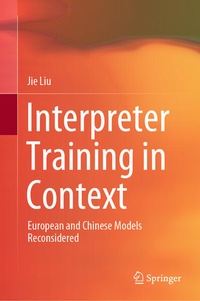
Interpreter Training in Context
European and Chinese Models Reconsidered
Published on 8. October 2020
Book
Hardback
XIII, 155 pages
978-981-15-8593-7 (ISBN)
Description
This book addresses an important, yet under-researched domain in interpreting education: how theoretical training models should be responsive to context. To do so, it applies the linguistic concept of 'context' to interpreting studies by investigating practices in representative (conference) interpreting training programmes in Europe and China. After presenting an overview of interpreter training programmes, the author describes the need to reassess the applicability of the well-established and widely accepted model of interpreting from the Paris School (ESIT/AIIC model) to the Chinese interpreting training scene.
Building on the theoretical study of context in foreign language classrooms suggested by linguists like Halliday and Hasan (1993); Kramsch (1993) and others, the author subsequently constructs a new curriculum, comprising a four-step approach to consecutive interpreting courses in the Chinese context. The rationale for such an approach is justified in accordance with the overall design of context, taking into account the four dimensions in a teaching-learning environment.
This book is intended for scholars and graduate students who are interested in translation and interpreting, applied linguistics as well as foreign language education. It also serves as a practical guide for developing (university-level) translation and interpreting programmes.
Building on the theoretical study of context in foreign language classrooms suggested by linguists like Halliday and Hasan (1993); Kramsch (1993) and others, the author subsequently constructs a new curriculum, comprising a four-step approach to consecutive interpreting courses in the Chinese context. The rationale for such an approach is justified in accordance with the overall design of context, taking into account the four dimensions in a teaching-learning environment.
This book is intended for scholars and graduate students who are interested in translation and interpreting, applied linguistics as well as foreign language education. It also serves as a practical guide for developing (university-level) translation and interpreting programmes.
Reviews / Votes
"Interpreter Training in Context: European and Chinese Models Reconsidered is a worthy addition to an important and highly relevant topic. Given its focus, a key part of the work's audience will naturally be interpreter trainers working in China and/or with Mandarin Chinese . . the volume successfully blends theoretical and practical aspects in an insightful manner, with the clear potential to play an influential role in interpreter training in the Chinese context." (Antony Hoyte-West, Studies in Comparative Education, Vol. 43 (1), 2022)More details
Edition
2020 ed.
Language
English
Place of publication
Singapore
Singapore
Target group
Professional and scholarly
Illustrations
9 s/w Abbildungen, 6 farbige Abbildungen
XIII, 155 p. 15 illus., 6 illus. in color.
Dimensions
Height: 241 mm
Width: 160 mm
Thickness: 16 mm
Weight
430 gr
ISBN-13
978-981-15-8593-7 (9789811585937)
DOI
10.1007/978-981-15-8594-4
Schweitzer Classification
Other editions
Additional editions
Book
10/2021
Springer
€117.69
Shipment within 3-4 weeks
E-Book
10/2020
1st Edition
Springer
€106.99
Available for download
Person
Jie Liu is currently a Postdoctoral Fellow under the "Postdoctoral International Exchange Program" at Central China Normal University (CCNU) in Wuhan, China. He received his Ph.D. from Utrecht University (2015) and has been a Research Scholar at the University of Florida. Previously, he held an Associate Professorship at the National Huaqiao University, where he also served as Lead Interpreter. His work has been published in several international interpretation and translation journals. Over the past decade or so, Jie Liu has been an active conference interpreter and member of the Translators' Association of China (TAC), and the European Society of Translation Studies (EST).
Content
Chapter 1 Introducing Basic Concepts of Interpreting and InterpreterTraining.- Chapter 2 Contemporary Interpreter Training Practices in Europe and China.- Chapter 3 Acquiring Interpreting Competence through Training: European and Chinese Training Models Explored.- Chapter 4 Didactic Approaches to Interpreter Training: Contexts, Approaches and Coping Tactics.- Chapter 5 Optimizing Interpreting Education in the Chinese Context: Principles, Curriculum and Pedagogy.- Chapter 6 Towards a Contextual Model for Interpreter Education.