

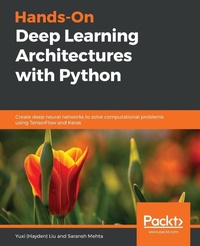
Hands-On Deep Learning Architectures with Python
Create deep neural networks to solve computational problems using TensorFlow and Keras
Published on 30. April 2019
Book
Paperback/Softback
316 pages
978-1-78899-808-6 (ISBN)
Description
Concepts, tools, and techniques to explore deep learning architectures and methodologies
Key Features
Explore advanced deep learning architectures using various datasets and frameworks
Implement deep architectures for neural network models such as CNN, RNN, GAN, and many more
Discover design patterns and different challenges for various deep learning architectures
Book DescriptionDeep learning architectures are composed of multilevel nonlinear operations that represent high-level abstractions; this allows you to learn useful feature representations from the data. This book will help you learn and implement deep learning architectures to resolve various deep learning research problems.
Hands-On Deep Learning Architectures with Python explains the essential learning algorithms used for deep and shallow architectures. Packed with practical implementations and ideas to help you build efficient artificial intelligence systems (AI), this book will help you learn how neural networks play a major role in building deep architectures. You will understand various deep learning architectures (such as AlexNet, VGG Net, GoogleNet) with easy-to-follow code and diagrams. In addition to this, the book will also guide you in building and training various deep architectures such as the Boltzmann mechanism, autoencoders, convolutional neural networks (CNNs), recurrent neural networks (RNNs), natural language processing (NLP), GAN, and more-all with practical implementations.
By the end of this book, you will be able to construct deep models using popular frameworks and datasets with the required design patterns for each architecture. You will be ready to explore the potential of deep architectures in today's world.What you will learn
Implement CNNs, RNNs, and other commonly used architectures with Python
Explore architectures such as VGGNet, AlexNet, and GoogLeNet
Build deep learning architectures for AI applications such as face and image recognition, fraud detection, and many more
Understand the architectures and applications of Boltzmann machines and autoencoders with concrete examples
Master artificial intelligence and neural network concepts and apply them to your architecture
Understand deep learning architectures for mobile and embedded systems
Who this book is forIf you're a data scientist, machine learning developer/engineer, or deep learning practitioner, or are curious about AI and want to upgrade your knowledge of various deep learning architectures, this book will appeal to you. You are expected to have some knowledge of statistics and machine learning algorithms to get the best out of this book
Key Features
Explore advanced deep learning architectures using various datasets and frameworks
Implement deep architectures for neural network models such as CNN, RNN, GAN, and many more
Discover design patterns and different challenges for various deep learning architectures
Book DescriptionDeep learning architectures are composed of multilevel nonlinear operations that represent high-level abstractions; this allows you to learn useful feature representations from the data. This book will help you learn and implement deep learning architectures to resolve various deep learning research problems.
Hands-On Deep Learning Architectures with Python explains the essential learning algorithms used for deep and shallow architectures. Packed with practical implementations and ideas to help you build efficient artificial intelligence systems (AI), this book will help you learn how neural networks play a major role in building deep architectures. You will understand various deep learning architectures (such as AlexNet, VGG Net, GoogleNet) with easy-to-follow code and diagrams. In addition to this, the book will also guide you in building and training various deep architectures such as the Boltzmann mechanism, autoencoders, convolutional neural networks (CNNs), recurrent neural networks (RNNs), natural language processing (NLP), GAN, and more-all with practical implementations.
By the end of this book, you will be able to construct deep models using popular frameworks and datasets with the required design patterns for each architecture. You will be ready to explore the potential of deep architectures in today's world.What you will learn
Implement CNNs, RNNs, and other commonly used architectures with Python
Explore architectures such as VGGNet, AlexNet, and GoogLeNet
Build deep learning architectures for AI applications such as face and image recognition, fraud detection, and many more
Understand the architectures and applications of Boltzmann machines and autoencoders with concrete examples
Master artificial intelligence and neural network concepts and apply them to your architecture
Understand deep learning architectures for mobile and embedded systems
Who this book is forIf you're a data scientist, machine learning developer/engineer, or deep learning practitioner, or are curious about AI and want to upgrade your knowledge of various deep learning architectures, this book will appeal to you. You are expected to have some knowledge of statistics and machine learning algorithms to get the best out of this book
More details
Language
English
Place of publication
Birmingham
United Kingdom
Target group
Professional and scholarly
US School Grade: College Graduate Student
Dimensions
Height: 235 mm
Width: 191 mm
Thickness: 18 mm
Weight
593 gr
ISBN-13
978-1-78899-808-6 (9781788998086)
Copyright in bibliographic data and cover images is held by Nielsen Book Services Limited or by the publishers or by their respective licensors: all rights reserved.
Schweitzer Classification
Other editions
Additional editions
Yuxi (Hayden) Liu | Saransh Mehta
Hands-On Deep Learning Architectures with Python
Create deep neural networks to solve computational problems using TensorFlow and Keras
E-Book
09/2024
Packt Publishing
€22.99
Available for download
Persons
Yuxi (Hayden) Liu was a Machine Learning Software Engineer at Google. With a wealth of experience from his tenure as a machine learning scientist, he has applied his expertise across data-driven domains and applied his ML expertise in computational advertising, cybersecurity, and information retrieval.
He is the author of a series of influential machine learning books and an education enthusiast. His debut book, also the first edition of Python Machine Learning by Example, ranked the #1 bestseller in Amazon and has been translated into many different languages. Saransh Mehta has cross-domain experience of working with texts, images, and audio using deep learning. He has been building artificial, intelligence-based solutions, including a generative chatbot, an attendee-matching recommendation system, and audio keyword recognition systems for multiple start-ups. He is very familiar with the Python language, and has extensive knowledge of deep learning libraries such as TensorFlow and Keras. He has been in the top 10% of entrants to deep learning challenges hosted by Microsoft and Kaggle.
He is the author of a series of influential machine learning books and an education enthusiast. His debut book, also the first edition of Python Machine Learning by Example, ranked the #1 bestseller in Amazon and has been translated into many different languages. Saransh Mehta has cross-domain experience of working with texts, images, and audio using deep learning. He has been building artificial, intelligence-based solutions, including a generative chatbot, an attendee-matching recommendation system, and audio keyword recognition systems for multiple start-ups. He is very familiar with the Python language, and has extensive knowledge of deep learning libraries such as TensorFlow and Keras. He has been in the top 10% of entrants to deep learning challenges hosted by Microsoft and Kaggle.
Content
Table of Contents
Getting Started with Deep Learning
Deep Feedforward Networks
Restricted Boltzmann Machines and Autoencoders
CNN Architecture
Mobile Neural Networks and CNNs
Recurrent Neural Networks
Generative Adversarial Networks
New Trends of Deep Learning
Getting Started with Deep Learning
Deep Feedforward Networks
Restricted Boltzmann Machines and Autoencoders
CNN Architecture
Mobile Neural Networks and CNNs
Recurrent Neural Networks
Generative Adversarial Networks
New Trends of Deep Learning