

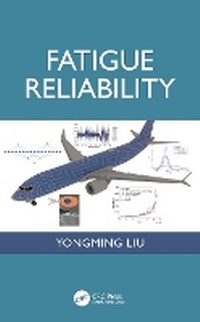
Fatigue Reliability
1st Edition
Will be published approx. on 17. November 2026
Book
Hardback
448 pages
978-1-032-39694-1 (ISBN)
Description
Fatigue Reliability revolutionizes how we predict and prevent the invisible threats posed by fatigue failure - the silent, progressive weakening of materials under repeated stress which threatens everything from aircraft and bridges to wind turbines and medical devices. The book transforms fatigue reliability into a dynamic, adaptive science that evolves with real-world data
Presenting a unified framework, this volume integrates classical fatigue theories with probabilistic methods, structural health monitoring, and AI/ML techniques. At its core is a closed-loop approach connecting physics-based modeling, real-time data collection, and intelligent decision-making algorithms. This system-level methodology addresses complex interactions among materials, loading conditions, and environmental uncertainties while tackling nonlinear and data-limited scenarios that challenge conventional approaches. What distinguishes this work is its transformation of fatigue reliability from static prediction to continuous adaptation. By bridging rigorous theoretical foundations with practical engineering tools, it enables reliability assessments that update dynamically as new information emerges from operating systems.
Designed for researchers, engineers, and graduate students, it advances fatigue reliability from a static prediction problem to a dynamic, adaptive discipline.
Presenting a unified framework, this volume integrates classical fatigue theories with probabilistic methods, structural health monitoring, and AI/ML techniques. At its core is a closed-loop approach connecting physics-based modeling, real-time data collection, and intelligent decision-making algorithms. This system-level methodology addresses complex interactions among materials, loading conditions, and environmental uncertainties while tackling nonlinear and data-limited scenarios that challenge conventional approaches. What distinguishes this work is its transformation of fatigue reliability from static prediction to continuous adaptation. By bridging rigorous theoretical foundations with practical engineering tools, it enables reliability assessments that update dynamically as new information emerges from operating systems.
Designed for researchers, engineers, and graduate students, it advances fatigue reliability from a static prediction problem to a dynamic, adaptive discipline.
More details
Language
English
Place of publication
London
United Kingdom
Publishing group
Taylor & Francis Ltd
Target group
General
Illustrations
40 s/w Tabellen, 191 s/w Zeichnungen, 20 s/w Photographien bzw. Rasterbilder, 211 s/w Abbildungen
40 Tables, black and white; 191 Line drawings, black and white; 20 Halftones, black and white; 211 Illustrations, black and white
Dimensions
Height: 234 mm
Width: 156 mm
ISBN-13
978-1-032-39694-1 (9781032396941)
Copyright in bibliographic data and cover images is held by Nielsen Book Services Limited or by the publishers or by their respective licensors: all rights reserved.
Schweitzer Classification
Person
Yongming Liu, Ph.D., is Professor of Mechanical and Aerospace Engineering at Arizona State University, USA. He is also a Founding Director of the Center for Complex System Safety, a state-supported multi-university initiative advancing safety science across materials, structures, and complex engineering systems. He received his Ph.D. in Civil Engineering from Vanderbilt University, focusing on stochastic multiaxial fatigue and fracture modeling. Dr. Liu's research lies at the intersection of fatigue and fracture mechanics, uncertainty quantification, and data-driven modeling, emphasizing unified frameworks that integrate physics-based approaches with probabilistic methods and artificial intelligence techniques. His work spans aerospace systems, civil infrastructure, energy systems, and air transportation safety, focusing on reliability, safety, and lifecycle performance under uncertainty. Dr. Liu is an ASME Fellow and Fellow of the Prognostics and Health Management Society. He has authored more than 200 journal publications and several book chapters, and his work continues to advance the integration of physics-based modeling and data-driven approaches for next-generation fatigue reliability and risk-informed engineering design.
Content
Preface
1. Introduction and Overview
2. Safe-Life Approach for Fatigue Analysis and Prognosis
3. Classical Crack Growth Approach for Fatigue Analysis and Prognosis
4. Subcycle Crack Growth Formulation for Fatigue Analysis and Prognosis
5. Fatigue Reliability and Uncertainty Quantification
6. Prognosis With Health and Usage Monitoring
7. Information Fusion and Fatigue Reliability Updating
8. Fatigue Analysis with Artificial Intelligence and Machine Learning
1. Introduction and Overview
2. Safe-Life Approach for Fatigue Analysis and Prognosis
3. Classical Crack Growth Approach for Fatigue Analysis and Prognosis
4. Subcycle Crack Growth Formulation for Fatigue Analysis and Prognosis
5. Fatigue Reliability and Uncertainty Quantification
6. Prognosis With Health and Usage Monitoring
7. Information Fusion and Fatigue Reliability Updating
8. Fatigue Analysis with Artificial Intelligence and Machine Learning