

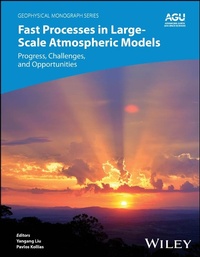
Fast Processes in Large-Scale Atmospheric Models
Description
Many atmospheric processes that influence Earth's weather and climate occur at spatiotemporal scales that are too small to be resolved in large scale models. They must be parameterized, which means approximately representing them by variables that can be resolved by model grids.
Fast Processes in Large Scale Atmospheric Models: Progress, Challenges and Opportunities explores ways to better investigate and represent multiple parameterized processes in models and thus improve their ability to make accurate climate and weather predictions.
Volume highlights include:
Historical development of the parameterization of fast processes in numerical models
Different types of major sub-grid processes and their parameterizations
Efforts to unify the treatment of individual processes and their interactions
Top-down versus bottom-up approaches across multiple scales
Measurement techniques, observational studies, and frameworks for model evaluation
Emerging challenges, new opportunities, and future research directions
The American Geophysical Union promotes discovery in Earth and space science for the benefit of humanity. Its publications disseminate scientific knowledge and provide resources for researchers, students, and professionals.
<b>Improving weather and climate prediction with better representation of fast processes in atmospheric models</b>
Many atmospheric processes that influence Earth's weather and climate occur at spatiotemporal scales that are too small to be resolved in large scale models. They must be parameterized, which means approximately representing them by variables that can be resolved by model grids.
<i>Fast Processes in Large Scale Atmospheric Models: Progress, Challenges and Opportunities</i> explores ways to better investigate and represent multiple parameterized processes in models and thus improve their ability to make accurate climate and weather predictions.
Volume highlights include:
<ul><li>Historical development of the parameterization of fast processes in numerical models</li><li>Different types of major sub-grid processes and their parameterizations</li><li>Efforts to unify the treatment of individual processes and their interactions</li><li>Top-down versus bottom-up approaches across multiple scales</li><li>Measurement techniques, observational studies, and frameworks for model evaluation</li><li>Emerging challenges, new opportunities, and future research directions</li></ul><i>The American Geophysical Union promotes discovery in Earth and space science for the benefit of humanity. Its publications disseminate scientific knowledge and provide resources for researchers, students, and professionals.</i>
More details
Other editions
Additional editions
Persons
<b>Yangang Liu</b>, Brookhaven National Laboratory, USA. <b>Pavlos Kollias</b>, Brookhaven National Laboratory and Stony Brook University, USA.
Content
<b>Section I: General </b>
Chapter 1. Introduction to Large Scale Models, Fast Physics and Challenges
By Yangang Liu, Leo Donner and Pavlos Kollias
<b>Section II: Processes and Parameterizations</b>
Chapter 2: Radiative transfer and atmospheric interactions
By Kuo-Nan Liou
Chapter 3. Aerosols and aerosol direct effects
By Susanna Bauer
Chapter 4 Aerosol-cloud Interactions and their effects on climate
By Ming Yi
Chapter 5. Cloud Microphysics and Interactions with turbulence
By Hugh Morrison
Chapter 6. Turbulent entrainment-mixing processes
By Chunsong Lu
Chapter 7. Shallow convection and convective clouds
By Minghua Zhang
Chapter 8. Deep convection and convective clouds
By Leo Donner
Chapter 9 Stratus and stratocumulus clouds
By Robert Wood
Chapter 10. Planetary Boundary Layer and processes
By Adrian Locke
Chapter 11. Land Surface and Interactions with atmosphere
By Fei Chen
Chapter 12. Gravity wave drags in the atmosphere
By Yaga Richter
<b>Section III: Unifying Efforts</b>
Chapter 13. Cloud-Resolving Models as Parameterization-Super-parameterization
By David Randall
Chapter 14. Parameterizations based on assumed Probability Density Function
By Vince Larson
Chapter 15. Eddy Diffusivity and Mass Flux (EDMF) approach
By Joao Teixeira
Chapter 16. Subgrid variability and scale-aware parameterizations
By Robin Hogan
Chapter 17. Application of machine learning approach in parameterization development
By Mike Pritchard
Chapter 18. Top-down view of subgrid processes and parameterization development
By Grahm Feingold
<b>Section IV: Measurements, Model Evaluation and Model-Measurement Integration</b>
Chapter 19: Surface-based remote sensing of key properties
By Pavlos Kollias
Chapter 20: Satellite remote sensing of key properties
By Anthony Davis
Chapter 21: In-situ and laboratory measurements of key properties
By Raymond Shaw
Chapter 22. Frameworks for evaluating climate and weather forecasting models
By Roel Neggers
Chapter 23. Use of data assimilation for model evaluation
By Zhijin Li