

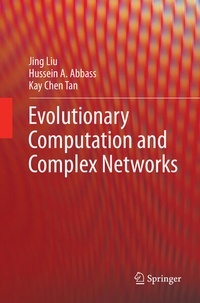
Evolutionary Computation and Complex Networks
Published on 11. February 2019
Book
Paperback/Softback
XIX, 148 pages
978-3-030-09649-6 (ISBN)
Description
This book introduces the linkage between evolutionary computation and complex networks and the advantages of cross-fertilising ideas from both fields. Instead of introducing each field individually, the authors focus on the research that sits at the interface of both fields. The book is structured to address two questions: (1) how complex networks are used to analyze and improve the performance of evolutionary computation methods? (2) how evolutionary computation methods are used to solve problems in complex networks? The authors interweave complex networks and evolutionary computing, using evolutionary computation to discover community structure, while also using network analysis techniques to analyze the performance of evolutionary algorithms. The book is suitable for both beginners and senior researchers in the fields of evolutionary computation and complex networks.
More details
Edition
Softcover Reprint of the Original 1st 2019 ed.
Language
English
Place of publication
Cham
Switzerland
Publishing group
Springer International Publishing
Target group
Professional and scholarly
Illustrations
20 s/w Abbildungen, 29 farbige Abbildungen
XIX, 148 p. 49 illus., 29 illus. in color.
Dimensions
Height: 235 mm
Width: 155 mm
Thickness: 10 mm
Weight
265 gr
ISBN-13
978-3-030-09649-6 (9783030096496)
DOI
10.1007/978-3-319-60000-0
Schweitzer Classification
Other editions
Additional editions
Jing Liu | Hussein A. Abbass | Kay CHen Tan
Evolutionary Computation and Complex Networks
Book
10/2018
Springer
€106.99
Shipment within 10-15 days
Persons
Dr. Jing Liu is a JSPS (Japan Society for the Promotion of Science) Postdoctoral Fellow at the University of Tokyo's Graduate School of Education. Before joining the University of Tokyo, Dr. Liu received his Doctoral Degree in International Development from the Graduate School of International Development, Nagoya University, Japan in 2013, where he subsequently served as an Assistant Professor from 2013 to 2017. His dissertation, titled "The Development of Inequality in Public School Admission: Public Discourses on Zexiao and Practices in Urban China" received the Best Dissertation Award from the Institute for International Studies in Education, School of Education, University of Pittsburgh, the US and the Asia Pacific Research Prize (Commendation) from the Asia Pacific Forum, Awaji Conference Japan in 2013.
His research areas include sociology of education, international and comparative education, and education policy studies. He began his studies on education in 2007, and since then has accumulated considerable experience in researching educational development in China, East, and South-East Asia. His current research project examines education reform to promote resource sharing and school-to-school collaboration in urban China. In the past five years, Dr. Liu has published in leading international journals and chapters of book series. His latest article, titled "Constructing resource sharing collaboration for quality public education in urban China: Case study of school alliance in Beijing" will be published by The International Journal of Educational Development in March 2018.
Content
Part 1: Background .- Evolutionary Computation.- Complex Networks.- Part 2: Using Complex Networks to Analyze Evolutionary Algorithms.- Evolutionary Dynamics on Complex Networks.- Problem Difficulty Prediction based on Complex Networks.- Network-based Problem Difficulty Prediction Measures.- Part 3: Using Evolutionary Algorithms to Solve Problems in Complex Networks.- Evolutionary Community Detection Algorithms.- Evolving Robust Networks using Evolutionary Algorithms.- Other Optimization Problems in Complex Networks.