

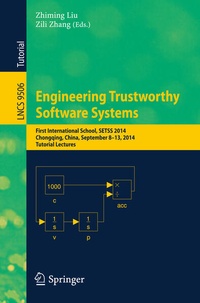
Engineering Trustworthy Software Systems
First International School, SETSS 2014, Chongqing, China, September 8-13, 2014. Tutorial Lectures
Published on 1. March 2016
Book
Paperback/Softback
XI, 325 pages
978-3-319-29627-2 (ISBN)
Description
This volume contains the lecture notes of the five courses
and one seminar given at the School on Engineering Trustworthy Software Systems
(SETSS 2014), held in September 2014 at Southwest University in Chongqing,
China.
The material is useful for postgraduate students,
researchers, academics and industrial engineers who are interested in the
theory and practice of methods and tools for the design and programming of
trustworthy software systems. The common themes of the courses include the
design and use of theories, techniques and tools for software specification and
modeling, analysis and verification. The courses cover sequential programming,
component- and object software, hybrid systems and cyber-physical systems with
challenges of termination, security, safety, security, fault-tolerance and
real-time requirements. The techniques include model checking, correctness by
construction through refinement and model transformations, synthesis and
computer algebra.
More details
Series
Edition
2016 ed.
Language
English
Place of publication
Cham
Switzerland
Publishing group
Springer International Publishing
Target group
Professional and scholarly
Illustrations
141 farbige Abbildungen
XI, 325 p. 141 illus. in color.
Dimensions
Height: 235 mm
Width: 155 mm
Thickness: 19 mm
Weight
517 gr
ISBN-13
978-3-319-29627-2 (9783319296272)
DOI
10.1007/978-3-319-29628-9
Schweitzer Classification
Other editions
Additional editions
Zhiming Liu | Zili Zhang
Engineering Trustworthy Software Systems
First International School, SETSS 2014, Chongqing, China, September 8-13, 2014. Tutorial Lectures
E-Book
02/2016
Springer
€53.49
Available for download
Content
(In-)formal methods: The Lost Art.- Program refinement, perfect secrecy and information flow.- The Z Notation: Whence the Cause and Whither the Course?.- Model-Driven Design of Object and Component Systems.- Cyber-Physical Systems Engineering.- Combining Formal and Informal Methods in the Design of Spacecrafts.