

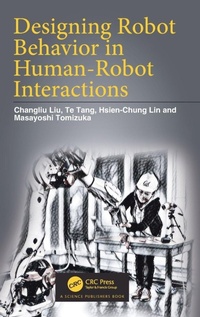
Designing Robot Behavior in Human-Robot Interactions
1st Edition
Published on 25. September 2019
Book
Hardback
256 pages
978-0-367-17969-4 (ISBN)
Description
In this book, we have set up a unified analytical framework for various human-robot systems, which involve peer-peer interactions (either space-sharing or time-sharing) or hierarchical interactions. A methodology in designing the robot behavior through control, planning, decision and learning is proposed. In particular, the following topics are discussed in-depth: safety during human-robot interactions, efficiency in real-time robot motion planning, imitation of human behaviors from demonstration, dexterity of robots to adapt to different environments and tasks, cooperation among robots and humans with conflict resolution. These methods are applied in various scenarios, such as human-robot collaborative assembly, robot skill learning from human demonstration, interaction between autonomous and human-driven vehicles, etc.
Key Features:
Proposes a unified framework to model and analyze human-robot interactions under different modes of interactions.
Systematically discusses the control, decision and learning algorithms to enable robots to interact safely with humans in a variety of applications.
Presents numerous experimental studies with both industrial collaborative robot arms and autonomous vehicles.
Key Features:
Proposes a unified framework to model and analyze human-robot interactions under different modes of interactions.
Systematically discusses the control, decision and learning algorithms to enable robots to interact safely with humans in a variety of applications.
Presents numerous experimental studies with both industrial collaborative robot arms and autonomous vehicles.
More details
Language
English
Place of publication
London
United Kingdom
Publishing group
Taylor & Francis Ltd
Target group
College/higher education
Professional and scholarly
Illustrations
104 s/w Abbildungen, 9 farbige Abbildungen, 9 s/w Tabellen
9 Tables, black and white; 9 Illustrations, color; 104 Illustrations, black and white
Dimensions
Height: 240 mm
Width: 161 mm
Thickness: 18 mm
Weight
552 gr
ISBN-13
978-0-367-17969-4 (9780367179694)
Copyright in bibliographic data and cover images is held by Nielsen Book Services Limited or by the publishers or by their respective licensors: all rights reserved.
Schweitzer Classification
Other editions
Additional editions
Changliu Liu | Te Tang | Hsien-Chung Lin
Designing Robot Behavior in Human-Robot Interactions
Book
04/2021
1st Edition
CRC Press
€68.08
Shipment within 15-20 days
Changliu Liu | Te Tang | Hsien-Chung Lin
Designing Robot Behavior in Human-Robot Interactions
E-Book
09/2019
1st Edition
CRC Press
€72.49
Available for download
Changliu Liu | Te Tang | Hsien-Chung Lin
Designing Robot Behavior in Human-Robot Interactions
E-Book
09/2019
1st Edition
CRC Press
€72.49
Available for download
Persons
Changliu Liu is an assistant professor in the Robotics Institute at Carnegie Mellon University, where she leads the Intelligent Control Lab. She received her PhD degree from University of California at Berkeley in 2017. Her research interests include: robotics and human-robot interactions, control and motion planning, optimization and optimal control, multi-agent system and game theory, design and verification of safe intelligent systems.
Te Tang received his PhD degree from University of California at Berkeley in 2018. He joined FANUC America Corporation in 2018, and he is currently a researcher at FANUC Advanced Research Laboratory. His research interests include robotics, learning from demonstration, computer vision and their industrial applications.
Hsien-Chung Lin is a research engineer in FANUC Advanced Research Laboratory at FANUC America Corporation. Prior to joining FANUC, he received his Ph.D. degree from University of California at Berkeley in 2018. His research interests cover robotics, optimal control, human-robot interaction, learning from demonstration and motion planning.
Masayoshi Tomizuka received his PhD degree from MIT in 1974. In 1974, he joined the Mechanical Engineering Department of the University of California, Berkeley, where he currently is Cheryl and John Neerhout, Jr., Distinguished Professor. His research interests are control theory and its applications to mechatronic systems such as robots. He is a Life Fellow of ASME and IEEE, and a Fellow of IFAC. He was awarded the Rufus Oldenburger Medal (2002) and the Richard Bellman Control Heritage Award (2018).
Te Tang received his PhD degree from University of California at Berkeley in 2018. He joined FANUC America Corporation in 2018, and he is currently a researcher at FANUC Advanced Research Laboratory. His research interests include robotics, learning from demonstration, computer vision and their industrial applications.
Hsien-Chung Lin is a research engineer in FANUC Advanced Research Laboratory at FANUC America Corporation. Prior to joining FANUC, he received his Ph.D. degree from University of California at Berkeley in 2018. His research interests cover robotics, optimal control, human-robot interaction, learning from demonstration and motion planning.
Masayoshi Tomizuka received his PhD degree from MIT in 1974. In 1974, he joined the Mechanical Engineering Department of the University of California, Berkeley, where he currently is Cheryl and John Neerhout, Jr., Distinguished Professor. His research interests are control theory and its applications to mechatronic systems such as robots. He is a Life Fellow of ASME and IEEE, and a Fellow of IFAC. He was awarded the Rufus Oldenburger Medal (2002) and the Richard Bellman Control Heritage Award (2018).
Content
SECTION I INTRODUCTION. Introduction. Framework. SECTION II THEORY. Safety during Human-Robot Interactions. Efficiency in Real-Time Motion Planning. Imitation: Mimicking Human Behavior. Dexterity: Analogy Learning to Expand Robot Skill Sets. Cooperation: Conflict Resolution during Interactions. SECTION III APPLICATIONS. Human-Robot Co-existence: Space-Sharing Interactions. Robot Learning from Human: Hierarchical Interactions. Human-Robot Collaboration: Time-Sharing Interactions. SECTION IV CONCLUSION. Vision for Future Robotics and Human-Robot Interactions. References. Index