

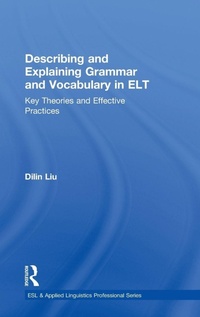
Describing and Explaining Grammar and Vocabulary in ELT
Key Theories and Effective Practices
1st Edition
Published on 15. August 2013
Book
Hardback
272 pages
978-0-415-63608-7 (ISBN)
Description
Language description plays an important role in language learning/teaching because it often determines what specific language forms, features, and usages are taught and how. A good understanding of language description is vital for language teachers and material writers and should constitute an important part of their knowledge. This book provides a balanced treatment of both theory and practice. It focuses on some of the most important and challenging grammar and vocabulary usage questions. Using these questions as examples, it shows how theory can inform practice and how grammar and vocabulary description and explanation can be made more effective and engaging.
Part I describes and evaluates the key linguistic theories on language description and teaching. Part II discusses and gives specific examples of how challenging grammar and vocabulary issues can be more effectively described and explained; each chapter focuses on one or more specific grammar and vocabulary. An annotated list of useful free online resources (online corpora and websites) for grammar and vocabulary learning and teaching, and a glossary provide helpful information.
Part I describes and evaluates the key linguistic theories on language description and teaching. Part II discusses and gives specific examples of how challenging grammar and vocabulary issues can be more effectively described and explained; each chapter focuses on one or more specific grammar and vocabulary. An annotated list of useful free online resources (online corpora and websites) for grammar and vocabulary learning and teaching, and a glossary provide helpful information.
Reviews / Votes
"The book, while packed with information about grammar and vocabulary, has useful examples throughout, which makes it both interesting to read and enlightening. It is likely that all of us, language teachers, will want to have it on our bookshelves." - tesolanz newsMore details
Series
Language
English
Place of publication
London
United Kingdom
Publishing group
Taylor & Francis Ltd
Target group
College/higher education
Illustrations
7 s/w Abbildungen, 10 s/w Tabellen
10 Tables, black and white; 7 Illustrations, black and white
Dimensions
Height: 240 mm
Width: 161 mm
Thickness: 19 mm
Weight
578 gr
ISBN-13
978-0-415-63608-7 (9780415636087)
Copyright in bibliographic data and cover images is held by Nielsen Book Services Limited or by the publishers or by their respective licensors: all rights reserved.
Schweitzer Classification
Other editions
Additional editions
Dilin Liu
Describing and Explaining Grammar and Vocabulary in ELT
Key Theories and Effective Practices
E-Book
08/2013
1st Edition
Routledge
€69.99
Available for download
Dilin Liu
Describing and Explaining Grammar and Vocabulary in ELT
Key Theories and Effective Practices
E-Book
08/2013
1st Edition
Routledge
€69.99
Available for download
Dilin Liu
Describing and Explaining Grammar and Vocabulary in ELT
Key Theories and Effective Practices
Book
07/2013
1st Edition
Routledge
€77.10
Shipment within 15-20 days
Person
Dilin Liu is Professor of Applied Linguistics/TESOL, Department of English, The University of Alabama, USA.
Content
Contents
Preface
Chapter 1 Language Description: Purview, Importance, and Principles
1.1 Introduction
1.2 The purview of language description
1.3 The importance of language description
1.4 Principles for language description
Part I: Foundations: Key theories and approaches to language description
Chapter 2. . Prescriptive, Structural, and Generative Linguistics
2.1 Prescriptivism
2.2 Structuralism
2.3 Generativism
Chapter 3. Sociolinguistics and Systemic Functional Linguistics
3.1 Sociolinguistics: An overview of Communicative Competence and Speech
3.2 Systemic functional linguistics: An overview
3.3 The impacts of sociolinguistics and SFL on language teaching
Chapter 4. . . Cognitive Linguistics
4.1 Theoretical underpinnings and important basic concepts
4.2 Cognitive Linguistics-inspired language description
Chapter 5. . . Corpus Linguistics
5.1 Overview
5.2 Significant contributions of corpus linguistics to the study of language
5.3 Impact of corpus linguistics on language teaching
Part II: Putting Theory to Practice: Striving for Enhanced Language
Description and Explanation
Chapter 6. . . Vocabulary Description: Basics, Parts of Speech, and Other
Challenging Issues
6.1 What information should be covered in teaching a word?
6.2 Describing/teaching spelling, pronunciation, and morphological rules
6.3 Defining/teaching parts of speech
6.4 Collocations/semantics/register: Other key issues to be addressed
6.5 Explaining/teaching challenging issues with new insights
Chapter 7. . . Sentence Structure Description: Basics, Verb Structure/
Subcategorization, and Other Challenging Structural Issues
7.1 Sentence structural analysis: Tasks and processes
7.2 Established practices for describing/analyzing sentence structures
7.3 Explaining/teaching challenging issues with new insight
Chapter 8. . . Tense and Aspect
8.1 English tense and aspect system: An overview
8.2 Established useful practices for describing/teaching prepositions
8.3 Explaining/teaching challenging issues with new insights
Chapter 9. . . Articles
9.1 The English article system: An overview
9.2 Established useful practices in describing/teaching English articles
9.3 Explaining/teaching challenging issues with new insights
Chapter 10. . Prepositions, Prepositional Adjectives/Adverbs, and Particles
10.1 Overview: Basic information, importance, and difficulties
10.2 Established useful practices for describing and teaching prepositions 10.3 Explaining/teaching challenging issues with new insights
Chapter 11. . Structural Alternation: English Object Placement, Subject/Object
Deletion, and the Passive voice
11.1 Explaining/teaching object placement with new insights
11.2 Explaining/teaching subject/object deletion with new insights
11.3 Explaining/teaching the passive voice with new insights
Chapter 12. . Word Meaning and Usage: Polysemy, Synonymy, Culturally-
Loaded Words, and Register
12.1 Polysemy: An overview
12.2 Synonymy
12.3 Established useful practices for teaching polysemes and synonyms
12.4 Explaining/teaching challenging issues with new insights
Chapter 13. . Word Collocations
13.1 Overview of collocations
13.2 Established useful practices in collocation teaching
13.3 Explaining/teaching collocations and collostructions with new insights
Chapter 14. . Multi-Word Expressions: Idioms, Phrasal Verbs, and Formulae/
Lexical Bundles
14.1 Describing idioms/phrasal verbs/formulae and their functions
14.2 Explaining/teaching idioms and phrasal verbs with new insights
14.3 Explaining and teaching formulae/lexical bundles with new insights
Annotated List of Free Online Resources for Grammar/Vocabulary Learning/ Teaching
Glossary
Preface
Chapter 1 Language Description: Purview, Importance, and Principles
1.1 Introduction
1.2 The purview of language description
1.3 The importance of language description
1.4 Principles for language description
Part I: Foundations: Key theories and approaches to language description
Chapter 2. . Prescriptive, Structural, and Generative Linguistics
2.1 Prescriptivism
2.2 Structuralism
2.3 Generativism
Chapter 3. Sociolinguistics and Systemic Functional Linguistics
3.1 Sociolinguistics: An overview of Communicative Competence and Speech
3.2 Systemic functional linguistics: An overview
3.3 The impacts of sociolinguistics and SFL on language teaching
Chapter 4. . . Cognitive Linguistics
4.1 Theoretical underpinnings and important basic concepts
4.2 Cognitive Linguistics-inspired language description
Chapter 5. . . Corpus Linguistics
5.1 Overview
5.2 Significant contributions of corpus linguistics to the study of language
5.3 Impact of corpus linguistics on language teaching
Part II: Putting Theory to Practice: Striving for Enhanced Language
Description and Explanation
Chapter 6. . . Vocabulary Description: Basics, Parts of Speech, and Other
Challenging Issues
6.1 What information should be covered in teaching a word?
6.2 Describing/teaching spelling, pronunciation, and morphological rules
6.3 Defining/teaching parts of speech
6.4 Collocations/semantics/register: Other key issues to be addressed
6.5 Explaining/teaching challenging issues with new insights
Chapter 7. . . Sentence Structure Description: Basics, Verb Structure/
Subcategorization, and Other Challenging Structural Issues
7.1 Sentence structural analysis: Tasks and processes
7.2 Established practices for describing/analyzing sentence structures
7.3 Explaining/teaching challenging issues with new insight
Chapter 8. . . Tense and Aspect
8.1 English tense and aspect system: An overview
8.2 Established useful practices for describing/teaching prepositions
8.3 Explaining/teaching challenging issues with new insights
Chapter 9. . . Articles
9.1 The English article system: An overview
9.2 Established useful practices in describing/teaching English articles
9.3 Explaining/teaching challenging issues with new insights
Chapter 10. . Prepositions, Prepositional Adjectives/Adverbs, and Particles
10.1 Overview: Basic information, importance, and difficulties
10.2 Established useful practices for describing and teaching prepositions 10.3 Explaining/teaching challenging issues with new insights
Chapter 11. . Structural Alternation: English Object Placement, Subject/Object
Deletion, and the Passive voice
11.1 Explaining/teaching object placement with new insights
11.2 Explaining/teaching subject/object deletion with new insights
11.3 Explaining/teaching the passive voice with new insights
Chapter 12. . Word Meaning and Usage: Polysemy, Synonymy, Culturally-
Loaded Words, and Register
12.1 Polysemy: An overview
12.2 Synonymy
12.3 Established useful practices for teaching polysemes and synonyms
12.4 Explaining/teaching challenging issues with new insights
Chapter 13. . Word Collocations
13.1 Overview of collocations
13.2 Established useful practices in collocation teaching
13.3 Explaining/teaching collocations and collostructions with new insights
Chapter 14. . Multi-Word Expressions: Idioms, Phrasal Verbs, and Formulae/
Lexical Bundles
14.1 Describing idioms/phrasal verbs/formulae and their functions
14.2 Explaining/teaching idioms and phrasal verbs with new insights
14.3 Explaining and teaching formulae/lexical bundles with new insights
Annotated List of Free Online Resources for Grammar/Vocabulary Learning/ Teaching
Glossary