

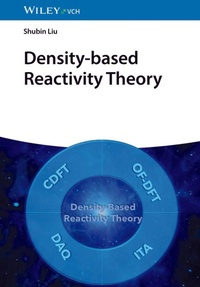
Density-Based Reactivity Theory
1st Edition
Will be published approx. on 19. August 2026
Book
Hardback
400 pages
978-3-527-35544-0 (ISBN)
Description
This book fills an essential knowledge gap by systematically demonstrating that one can use density-based ideas to appreciate physicochemical properties such as bonding, stability, reactivity, and others in chemical reactivity. Additionally, helps the reader gain an understanding on using electron density to analyze interactions and predict reactivity of systems. It also discusses the recent developments and applications in photochemistry, catalysis, material science and quantum computing, giving practical implications of the Density-based Reactivity Theory.
More details
Person
Dr. Shubin Liu is a Senior Computational Scientist in the Research Computing Center and an AdjunctProfessor in the Department of Chemistry, University of North Carolina at Chapel Hill (UNC). He received Ph.D. degree with the late Robert G. Parr of UNC as his adviser in 1996 and finished postdoctoral trainingwith Weitao Yang of Duke University. He has been an independent researcher at UNC since 2000, focusingon developing a chemical reactivity theory using density functional theory language. Dr. Liu has edited two books - Conceptual Density Functional Theory and Exploring Chemical Concepts through Theory and Computation with Wiley VCH. Dr. Liu initiated and co/organized the series of International Symposia on Chemical Concepts from Theory and Computation and has co/authored over 280 peer-reviewed publications with h-index of 61 and over 21k total citations. He was recognized in the field by various scientific awards including the Wiley-IJQC Young Investigator Award.
Content
Table of Contents
Density-Based Reactivity Theory
Part I: Frameworks
Chapter 1. Introduction
Chapter 2. Conceptual Density Functional Theory (CDFT)
Chapter 3. Density-Associated Quantities (DAQ)
Chapter 4. Information-Theoretic Approach (ITA)
Chapter 5. Orbital-Free Density Functional Theory (OF-DFT)
Chapter 6. Recent Advances of Density-Based Frameworks
Part II: Applications
Chapter 7. Covalent and Noncovalent Interactions
Chapter 8. Cooperativity and Frustration
Chapter 9. Homochirality and Principle of Chirality Hierarchy
Chapter 10. Electrophilicity and Nucleophilicity
Chapter 11. Steric Effect and Stereoselectivity
Chapter 12. Acidity and Basicity
Chapter 13. Aromaticity and Antiaromaticity
Chapter 14. Catalysis
Chapter 15. Excited States
Chapter 16: Miscellaneous Applications
Part III. Perspectives
Chapter 17. From Chemical Concepts to Chemical Understanding
Chapter 18. Harvesting Chemical Understanding with ML/AI and QC
Density-Based Reactivity Theory
Part I: Frameworks
Chapter 1. Introduction
Chapter 2. Conceptual Density Functional Theory (CDFT)
Chapter 3. Density-Associated Quantities (DAQ)
Chapter 4. Information-Theoretic Approach (ITA)
Chapter 5. Orbital-Free Density Functional Theory (OF-DFT)
Chapter 6. Recent Advances of Density-Based Frameworks
Part II: Applications
Chapter 7. Covalent and Noncovalent Interactions
Chapter 8. Cooperativity and Frustration
Chapter 9. Homochirality and Principle of Chirality Hierarchy
Chapter 10. Electrophilicity and Nucleophilicity
Chapter 11. Steric Effect and Stereoselectivity
Chapter 12. Acidity and Basicity
Chapter 13. Aromaticity and Antiaromaticity
Chapter 14. Catalysis
Chapter 15. Excited States
Chapter 16: Miscellaneous Applications
Part III. Perspectives
Chapter 17. From Chemical Concepts to Chemical Understanding
Chapter 18. Harvesting Chemical Understanding with ML/AI and QC