

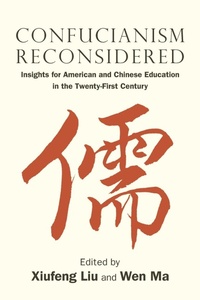
Confucianism Reconsidered
Insights for American and Chinese Education in the Twenty-First Century
Published on 2. January 2019
Book
Paperback/Softback
256 pages
978-1-4384-7002-3 (ISBN)
Description
Explores the rich potential of Confucianism in American and Chinese classrooms of the twenty-first century.
This is one of the first books to explicitly address twenty-first-century education from a Confucian perspective. The contributors focus on why Confucianism is relevant to both American and Chinese education, how Confucian pedagogical principles can be applied to diverse sociocultural settings, and what the social and moral functions of a Confucianism-based education are. Prominent scholars explore a wide-range of research areas and methods, such as K-12 and college teaching; conceptual comparisons; case studies; and discourse analysis, that reflect the depth and breadth of Confucian ideas, and the divergent contexts in which Confucian principles and practices may be applied. This book not only enriches the research literature on Confucianism from an interdisciplinary perspective, but also offers fresh insights into Confucianism's continuing relevance and its compatibility with the latest research-based pedagogical practices.
This is one of the first books to explicitly address twenty-first-century education from a Confucian perspective. The contributors focus on why Confucianism is relevant to both American and Chinese education, how Confucian pedagogical principles can be applied to diverse sociocultural settings, and what the social and moral functions of a Confucianism-based education are. Prominent scholars explore a wide-range of research areas and methods, such as K-12 and college teaching; conceptual comparisons; case studies; and discourse analysis, that reflect the depth and breadth of Confucian ideas, and the divergent contexts in which Confucian principles and practices may be applied. This book not only enriches the research literature on Confucianism from an interdisciplinary perspective, but also offers fresh insights into Confucianism's continuing relevance and its compatibility with the latest research-based pedagogical practices.
More details
Series
Language
English
Place of publication
Albany, NY
United States
Target group
Professional and scholarly
US School Grade: College Graduate Student and over
Product notice
Paperback (trade)
Illustrations
7 Figures
Dimensions
Height: 229 mm
Width: 152 mm
Thickness: 15 mm
Weight
424 gr
ISBN-13
978-1-4384-7002-3 (9781438470023)
Copyright in bibliographic data and cover images is held by Nielsen Book Services Limited or by the publishers or by their respective licensors: all rights reserved.
Schweitzer Classification
Other editions
Additional editions
Xiufeng Liu | Wen Ma
Confucianism Reconsidered
Insights for American and Chinese Education in the Twenty-First Century
E-Book
06/2018
1st Edition
State University of New York Press
€36.49
Available for download
Persons
Xiufeng Liu is Director of the Center for Educational Innovation and Professor of Learning and Instruction at the University at Buffalo, State University of New York. He is the author of several books, including Linking Competence to Opportunities to Learn: Models of Competence and Data Mining. Wen Ma is Associate Professor of Education at Le Moyne College. He is the editor of East Meets West in Teacher Preparation: Crossing Chinese and American Borders and the coeditor (with Guofang Li) of Chinese-Heritage Students in North American Schools: Understanding Hearts and Minds Beyond Test Scores.
Content
Foreword
Guofang Li
Acknowledgments
Introduction: Why Is Confucianism Still Relevant in the Globalized Twenty-First Century?
Xiufeng Liu and Wen Ma
Part I. Relevance of Confucianism to American and Chinese Education
1. Becoming Confucian in America Today
Pamela G. Herron
2. Teaching Deliberation: Abandoning Aristotelian Persuasion and Embracing Confucian Remonstration
Arabella Lyon
3. Confucian Educational Thought: Enlightenment and Value for Contemporary Education in China
Fangping Cheng
4. Confucian Rituals and Science in Modern Chinese Education
Xiaoqing Diana Lin
Part II. Confucian Insights on Teaching and Learning
5. Neo-Confucianism as a Guide for Contemporary Confucian Education
Yair Lior
6. Learning as Public Reasoning (gongyi): A Paradigmatic Shift of the Late-Imperial Confucian Educational Tradition in 17th-Century China
Yang Wei
7. The Confucian Philosophy of Education in Hexagram Meng (Shrouded) of the Yijing
Bin Song
8. Facilitating Critical Thinking of Chinese Students: A Confucian Perspective
Yin Wu
Part III. Confucianism and the Social and Moral Functions of Education
9. From Self-Cultivation to Social Transformation: The Confucian Embodied Pathway and Educational Implications
Jing Lin
10. Confucian Selfhood and the Idea of Multicultural Education
Chenyu Wang
11. Confucian Philosophical Foundations for Moral Education in an Era of Advanced Technology
Vincent Shen
12. Rethinking Confucian Values in a Global Age
Huey-Li Li
List of Contributors
Index
Guofang Li
Acknowledgments
Introduction: Why Is Confucianism Still Relevant in the Globalized Twenty-First Century?
Xiufeng Liu and Wen Ma
Part I. Relevance of Confucianism to American and Chinese Education
1. Becoming Confucian in America Today
Pamela G. Herron
2. Teaching Deliberation: Abandoning Aristotelian Persuasion and Embracing Confucian Remonstration
Arabella Lyon
3. Confucian Educational Thought: Enlightenment and Value for Contemporary Education in China
Fangping Cheng
4. Confucian Rituals and Science in Modern Chinese Education
Xiaoqing Diana Lin
Part II. Confucian Insights on Teaching and Learning
5. Neo-Confucianism as a Guide for Contemporary Confucian Education
Yair Lior
6. Learning as Public Reasoning (gongyi): A Paradigmatic Shift of the Late-Imperial Confucian Educational Tradition in 17th-Century China
Yang Wei
7. The Confucian Philosophy of Education in Hexagram Meng (Shrouded) of the Yijing
Bin Song
8. Facilitating Critical Thinking of Chinese Students: A Confucian Perspective
Yin Wu
Part III. Confucianism and the Social and Moral Functions of Education
9. From Self-Cultivation to Social Transformation: The Confucian Embodied Pathway and Educational Implications
Jing Lin
10. Confucian Selfhood and the Idea of Multicultural Education
Chenyu Wang
11. Confucian Philosophical Foundations for Moral Education in an Era of Advanced Technology
Vincent Shen
12. Rethinking Confucian Values in a Global Age
Huey-Li Li
List of Contributors
Index