

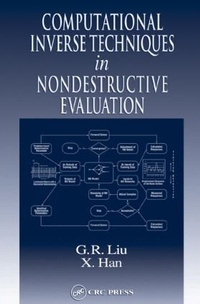
Computational Inverse Techniques in Nondestructive Evaluation
1st Edition
Published on 27. June 2003
Book
Hardback
592 pages
978-0-8493-1523-7 (ISBN)
Description
Ill-posedness. Regularization. Stability. Uniqueness. To many engineers, the language of inverse analysis projects a mysterious and frightening image, an image made even more intimidating by the highly mathematical nature of most texts on the subject. But the truth is that given a sound experimental strategy, most inverse engineering problems can be well-posed and not difficult to deal with.
Computational Inverse Techniques in Nondestructive Evaluation sets forth in clear, easy-to-understand terms the principles, computational methods, and algorithms of inverse analyses based on elastic waves or the dynamic responses of solids and structures. After describing the features of inverse problems, the authors discuss the regularization methods useful in handling ill-posed problems. The book also presents practical optimization algorithms, including some developed and successfully tested by his research group.
Inverse analyses are fast becoming one of the engineer's most powerful tools in nondestructive evaluation and testing. With straightforward examples, a wealth of specific applications, and clear exposition written by engineers for engineers, this book offers an outstanding opportunity to overcome any trepidation and begin using inverse analysis in practice.
Computational Inverse Techniques in Nondestructive Evaluation sets forth in clear, easy-to-understand terms the principles, computational methods, and algorithms of inverse analyses based on elastic waves or the dynamic responses of solids and structures. After describing the features of inverse problems, the authors discuss the regularization methods useful in handling ill-posed problems. The book also presents practical optimization algorithms, including some developed and successfully tested by his research group.
Inverse analyses are fast becoming one of the engineer's most powerful tools in nondestructive evaluation and testing. With straightforward examples, a wealth of specific applications, and clear exposition written by engineers for engineers, this book offers an outstanding opportunity to overcome any trepidation and begin using inverse analysis in practice.
More details
Language
English
Place of publication
Bosa Roca
United States
Publishing group
Taylor & Francis Inc
Target group
Professional and scholarly
Professional
Illustrations
144 s/w Tabellen, 284 s/w Abbildungen
144 Tables, black and white; 284 Illustrations, black and white
Dimensions
Height: 234 mm
Width: 156 mm
Weight
1006 gr
ISBN-13
978-0-8493-1523-7 (9780849315237)
Copyright in bibliographic data and cover images is held by Nielsen Book Services Limited or by the publishers or by their respective licensors: all rights reserved.
Schweitzer Classification
Other editions
Additional editions
G.R. Liu | X. Han
Computational Inverse Techniques in Nondestructive Evaluation
E-Book
06/2003
CRC Press
€45.99
Available for download
G.R. Liu | X. Han
Computational Inverse Techniques in Nondestructive Evaluation
E-Book
06/2003
CRC Press
€45.99
Available for download
Content
Introduction. Fundamentals of Inverse Problems. Computational Optimization Techniques. Neural Networks. Inverse Identification of Impact Loads on the Surface of Beams. Inverse Identification of Impact Loads on the Surface of Composite Laminates. Inverse Determination of Material Constants of Composites. Inverse Determination of Material Property Variation in Functionally Graded. Inverse Determination of Cracks in Beams Using Flexural Waves. Inverse Characterization of Cracks in Composite laminates. Inverse Detection of Flaws in Sandwich Plates. Total Solution for Engineering Systems: Future Direction. Application to Electronic system, MEMS, Interatomic Potential and Protein Structure Prediction. Index.