

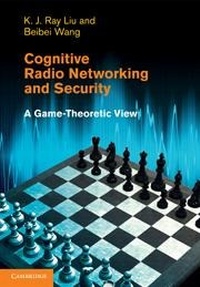
Cognitive Radio Networking and Security
A Game-Theoretic View
Published on 31. October 2010
Book
Hardback
618 pages
978-0-521-76231-1 (ISBN)
Description
With the rapid growth of new wireless devices and applications over the past decade, the demand for wireless radio spectrum is increasing relentlessly. The development of cognitive radio networking provides a framework for making the best possible use of limited spectrum resources, and it is revolutionising the telecommunications industry. This book presents the fundamentals of designing, implementing, and deploying cognitive radio communication and networking systems. Uniquely, it focuses on game theory and its applications to various aspects of cognitive networking. It covers in detail the core aspects of cognitive radio, including cooperation, situational awareness, learning, and security mechanisms and strategies. In addition, it provides novel, state-of-the-art concepts and recent results. This is an ideal reference for researchers, students and professionals in industry who need to learn the applications of game theory to cognitive networking.
More details
Language
English
Place of publication
Cambridge
United Kingdom
Target group
Professional and scholarly
Product notice
sewn/stitched
Paper over boards
Illustrations
34 Tables, black and white; 178 Line drawings, black and white
Dimensions
Height: 251 mm
Width: 170 mm
Thickness: 33 mm
Weight
1361 gr
ISBN-13
978-0-521-76231-1 (9780521762311)
Copyright in bibliographic data and cover images is held by Nielsen Book Services Limited or by the publishers or by their respective licensors: all rights reserved.
Schweitzer Classification
Other editions
Additional editions
E-Book
11/2010
Cambridge University Press
€146.99
Available for download
Persons
K. J. Ray Liu is a Distinguished Scholar-Teacher at the University of Maryland, College Park. He is the recipient of numerous honors and awards including the 2009 IEEE Signal Processing Society Technical Achievement Award, IEEE Signal Processing Society Distinguished Lecturer, National Science Foundation Presidential Young Investigator, and various best paper awards. Beibei Wang is currently a Research Associate at the University of Maryland, College Park, from where she received her Ph.D. in 2009. Her research interests include dynamic spectrum allocation and management in cognitive radio systems, cooperative communications, multimedia communications, game theory and learning, and network security.
Content
Part I. Cognitive Radio Communications and Cooperation: 1. Introduction to cognitive radios; 2. Game theory for cognitive radio networks; 3. Markov models for dynamic spectrum allocation; 4. Repeated open spectrum sharing game; 5. Pricing game for dynamic spectrum allocation; 6. A multi-winner cognitive spectrum auction game; 7. Evolutionary cooperative spectrum sensing game; 8. Anti-jamming stochastic game; 9. Opportunistic multiple access for cognitive networks; Part II. Resource Awareness and Learning: 10. Reinforcement learning for energy-aware communications; 11. Repeated game and learning for packet forwarding; 12. Dynamic pricing games for routing; 13. Connectivity-aware network lifetime optimization; 14. Connectivity-aware network maintenance and repair; Part III. Securing Mechanism and Strategies: 15. Trust modeling and evaluation; 16. Defense against routing disruptions; 17. Defense against injecting traffic attacks; 18. Attack-resistant cooperation stimulation; 19. Optimal strategies for cooperation stimulation; 20. Belief evaluation for cooperation enforcement; 21. Defense against insider attacks; 22. Secure cooperation stimulation under noise and imperfect monitoring.