

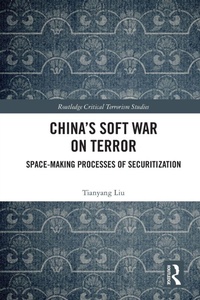
China's Soft War on Terror
Space-Making Processes of Securitization
1st Edition
Published on 25. September 2023
Book
Paperback/Softback
194 pages
978-0-367-76482-1 (ISBN)
Description
This book explores how the Chinese government reasserts its control and management of public spaces as part of its overall counter-terrorism strategy.
The work focuses primarily on the banal and alternative forms that China's 'war on terror' takes: the everyday, non-military, socio-economic and spatio-material. It presents three different cases of control associated with the state's effort to manage material, social and digital public spaces as remedies to terrorism and ethnic unrest in China: the redevelopment project of Kashgar-the 'home' of Uyghur culture-from 2001 to 2017; the forging of local partnerships with potential agents (i.e. the local cadres and imams in Xinjiang) as part of the process of implementing counter-terrorism policies; and an online campaign about international terrorism that appeared on Sina Weibo. Using securitization theory as a theoretical framework, the book establishes links between human geography and critical security studies and advances the understanding of non-confrontational forms of resistance in China. It also focuses attention on the binary relationship between the securitizing agency of the state and the counter-securitization agency of 'terrorists', while also exploring the manner in which other societal forces interact with these processes.
This book will be of interest to students of critical terrorism studies, Chinese studies, human geography, and security studies.
The work focuses primarily on the banal and alternative forms that China's 'war on terror' takes: the everyday, non-military, socio-economic and spatio-material. It presents three different cases of control associated with the state's effort to manage material, social and digital public spaces as remedies to terrorism and ethnic unrest in China: the redevelopment project of Kashgar-the 'home' of Uyghur culture-from 2001 to 2017; the forging of local partnerships with potential agents (i.e. the local cadres and imams in Xinjiang) as part of the process of implementing counter-terrorism policies; and an online campaign about international terrorism that appeared on Sina Weibo. Using securitization theory as a theoretical framework, the book establishes links between human geography and critical security studies and advances the understanding of non-confrontational forms of resistance in China. It also focuses attention on the binary relationship between the securitizing agency of the state and the counter-securitization agency of 'terrorists', while also exploring the manner in which other societal forces interact with these processes.
This book will be of interest to students of critical terrorism studies, Chinese studies, human geography, and security studies.
More details
Series
Language
English
Place of publication
London
United Kingdom
Publishing group
Taylor & Francis Ltd
Target group
College/higher education
Professional and scholarly
Postgraduate, Professional, and Undergraduate Advanced
Illustrations
25 s/w Abbildungen, 23 s/w Photographien bzw. Rasterbilder, 2 s/w Zeichnungen, 2 s/w Tabellen
2 Tables, black and white; 2 Line drawings, black and white; 23 Halftones, black and white; 25 Illustrations, black and white
Dimensions
Height: 234 mm
Width: 156 mm
Thickness: 11 mm
Weight
316 gr
ISBN-13
978-0-367-76482-1 (9780367764821)
Copyright in bibliographic data and cover images is held by Nielsen Book Services Limited or by the publishers or by their respective licensors: all rights reserved.
Schweitzer Classification
Other editions
Additional editions
Book
11/2021
1st Edition
Routledge
€206.10
Shipment within 15-20 days
E-Book
11/2021
1st Edition
Routledge
€59.49
Available for download
E-Book
11/2021
1st Edition
Routledge
€59.49
Available for download
Person
Tianyang Liu is an associate professor in the School of Politics and Public Administration at Wuhan University, China.
Content
1. Introduction: A study on non-terrorists 2. Between a counter-terrorist and a novelist 3. The home front 4. The ambiguous spaces of bureaucracy, worship and de-radicalization 5. The digital spaces of learning to fear 6. Conclusions