

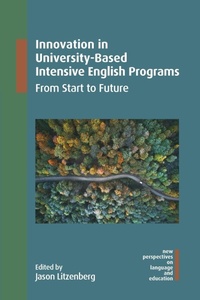
Innovation in University-Based Intensive English Programs
From Start to Future
Published on 12. December 2023
Book
Paperback/Softback
228 pages
978-1-80041-443-3 (ISBN)
Description
This book considers the past, present and future directions of innovation in US-based Intensive English Programs (IEPs), which provide international students with an immersion-style environment for learning academic English, prior to matriculating into a full-time college or university degree program. IEPs frequently serve as sites for pre-service teacher preparation, curricular experimentation and research, and yet little published work takes a critical look at the advantages and shortcomings of such programs. The chapters in this book provide a nuanced view of this microcosm of the English language teaching industry, demonstrating the various ways that IEPs have impacted and continue to influence the wider fields of Applied Linguistics and TESOL. They emphasize the unique positioning of IEPs within higher education and describe the various ways IEP practitioners can influence their host institutions and beyond.
Reviews / Votes
A one-of-a-kind volume on innovation in the context of Intensive English Programs (IEPs). Chapter authors chronicle the past, explore important contemporary issues and consider future trajectories. This is a must-read for IEP teachers, administrators and scholars, as well as other ELT professionals in the US and elsewhere. A stellar contribution to the professional literature. * Fredricka L. Stoller, Professor Emerita, Northern Arizona University, USA * The ever-changing profile of our students' backgrounds and needs requires innovation, and Intensive English Programs (IEPs) deliver. This volume articulates the history of constant innovation that permeates the field, and many chapters close with suggestions for future innovative work. I strongly recommend this book to IEP and international education leaders alike to understand what IEPs are and how they support the international education aims of their institutions. * Mark Algren, University of Missouri, USA * With contributions from experts, this book provides a nuanced view of Intensive English Programs (IEPs) at US universities and is sure to be an immensely valuable read. It is the first attempt to go beyond discussing the administrative aspects of IEPs to delve into their innovations, which are of great interest in the fields of TESOL and applied linguistics. * Yumi Matsumoto, University of Pennsylvania, USA * ...a well-written and thorough exploration of what IEP innovation means at US universities. Although the IEPs discussed here are US-centered, this volume could be relevant for many language programs, program administrators, researchers, and applied linguists around the world. This book will be of great interest to IEP educators who are looking to innovate in their programs, but also to applied linguists and ESL/EFL teachers who are interested in reflecting on their own working environments because the issues covered can address particular needs and challenges that may arise in varied contexts. * Dong Wang, Shandong Normal University, China, TESL-EJ 29.2, August 2025 *More details
Series
Language
English
Place of publication
Bristol
United Kingdom
Target group
College/higher education
Dimensions
Height: 234 mm
Width: 156 mm
Thickness: 13 mm
Weight
380 gr
ISBN-13
978-1-80041-443-3 (9781800414433)
DOI
10.21832/LITZEN4440
Copyright in bibliographic data and cover images is held by Nielsen Book Services Limited or by the publishers or by their respective licensors: all rights reserved.
Schweitzer Classification
Other editions
Additional editions
Book
12/2023
Multilingual Matters
€185.10
Shipment within 10-20 days
E-Book
10/2023
Multilingual Matters
€24.49
Available for download
Person
Jason Litzenberg is Teaching Professor of Applied Linguistics and Director of the Intensive English Communication Program at Pennsylvania State University, USA. His research interests are in the areas of sociolinguistics, English as a Lingua Franca, World Englishes, Linguistic Landscapes, Language Program Administration and Decolonial Scholarship.
Content
Contributors
Jason Litzenberg: Introduction: Understanding Innovation in University-Based Intensive English Programs
Chapter 1. Diane Larsen-Freeman: The First IEP: The English Language Institute at the University of Michigan
Chapter 2 Jason Litzenberg and Minjin Kim: ELI, ELP or IEP? Tracing the Growth of an Industry
Chapter 3. Sharon Cavusgil, Martyn J. Miller, Rebecca Smith-Murdock and Betty Soppelsa: Founding the Modern Era: A Conversation Among Former IEP Directors
Chapter 4. Jeremy D. Slagoski: Employment Trends in English Language Programs
Chapter 5. Sarah Arva Grosik: Beyond Revenue: IEP Service to the University and Community
Chapter 6. Michael E. Anderson and LeeAnne Berger Godfrey: Multilingualism, Multiculturalism and Advocacy: How Intensive English Language Programs can Impact Campus Culture
Chapter 7. Nikki Mattson and Jacqueline M. Gianico: Behold-Remold: Navigating and Innovating Liminal Spaces as an IEP Practitioner-Administrator-Scholar (PAS)
Chapter 8. JPB Gerald: The Missing Puzzle Piece: Racism and Native-Speakerism Scholarship
Chapter 9. James M. Perren: The Other Side of Community Engagement Projects: Benefits to the Community?
Chapter 10. Kleber Aparecido da Silva, Lauro Sergio Machado Pereira, Dllubia Santclair, Silvia Penna and Oseas Bezerra Viana-Jr: Mind the Gap! Voices of Brazilian English Language Teachers in a Continuing Education Intensive English Program in the United States
Chapter 11. Carter A. Winkle: Over a Decade of Third-Party Pathway Programs in the United States
Chapter 12. Ekaterina Arshavskaya and Marta Halaczkiewicz: Brave New Classrooms: On the Role of Technology in IEPs
Chapter 13. Crystal Bock Thiessen: Where to From Here? Continuing to Innovate, Respond and Reform in IEPs
Index
Jason Litzenberg: Introduction: Understanding Innovation in University-Based Intensive English Programs
Chapter 1. Diane Larsen-Freeman: The First IEP: The English Language Institute at the University of Michigan
Chapter 2 Jason Litzenberg and Minjin Kim: ELI, ELP or IEP? Tracing the Growth of an Industry
Chapter 3. Sharon Cavusgil, Martyn J. Miller, Rebecca Smith-Murdock and Betty Soppelsa: Founding the Modern Era: A Conversation Among Former IEP Directors
Chapter 4. Jeremy D. Slagoski: Employment Trends in English Language Programs
Chapter 5. Sarah Arva Grosik: Beyond Revenue: IEP Service to the University and Community
Chapter 6. Michael E. Anderson and LeeAnne Berger Godfrey: Multilingualism, Multiculturalism and Advocacy: How Intensive English Language Programs can Impact Campus Culture
Chapter 7. Nikki Mattson and Jacqueline M. Gianico: Behold-Remold: Navigating and Innovating Liminal Spaces as an IEP Practitioner-Administrator-Scholar (PAS)
Chapter 8. JPB Gerald: The Missing Puzzle Piece: Racism and Native-Speakerism Scholarship
Chapter 9. James M. Perren: The Other Side of Community Engagement Projects: Benefits to the Community?
Chapter 10. Kleber Aparecido da Silva, Lauro Sergio Machado Pereira, Dllubia Santclair, Silvia Penna and Oseas Bezerra Viana-Jr: Mind the Gap! Voices of Brazilian English Language Teachers in a Continuing Education Intensive English Program in the United States
Chapter 11. Carter A. Winkle: Over a Decade of Third-Party Pathway Programs in the United States
Chapter 12. Ekaterina Arshavskaya and Marta Halaczkiewicz: Brave New Classrooms: On the Role of Technology in IEPs
Chapter 13. Crystal Bock Thiessen: Where to From Here? Continuing to Innovate, Respond and Reform in IEPs
Index