

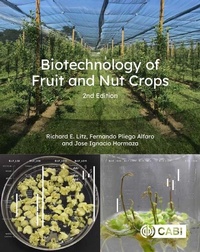
Biotechnology of Fruit and Nut Crops
2nd Edition
Published on 31. January 2020
Book
Hardback
704 pages
978-1-78064-827-9 (ISBN)
Description
This book covers the biotechnology of all the major perennial fruit and nut species. Since the publication of the first edition of this book in 2005, there has been significant progress in cell culture, genomics and genetic transformation for many of these species. This book covers these biotechnologies and also traditional ones, such as regeneration pathways, protoplast culture, in vitro mutagenesis, and ploidy manipulation that have been applied to many of these species. Three species, Diospyros kaki (persimmon), Punica granatum (pomegranate) and Eriobotrya japonica (loquat) are included for the first time, and several Prunus species now receive separate coverage. The species are organized by plant family to facilitate comparisons among related ones. Each species is discussed in relation to its family and its related wild forms, and most are accompanied by full colour illustrations. This book is a vital resource for those working on the improvement of perennial fruit, nut and plantation crops. The book features: Detailed coverage of major perennial fruit and crop species. Coverage of traditional and new biotechnologies. Full colour illustrations to aid identification This book is an essential resource for scientists and postgraduate students who are engaged in the improvement of perennial fruit, nut and plantation crops and will also be an important accession for university and agricultural research libraries.
More details
Edition
2nd edition
Language
English
Place of publication
Wallingford
United Kingdom
Dimensions
Height: 285 mm
Width: 227 mm
Thickness: 41 mm
Weight
2704 gr
ISBN-13
978-1-78064-827-9 (9781780648279)
Copyright in bibliographic data and cover images is held by Nielsen Book Services Limited or by the publishers or by their respective licensors: all rights reserved.
Schweitzer Classification
Other editions
Additional editions
Richard Litz | Fernando Pliego-Alfaro | Jose Ignacio Hormaza
Biotechnology of Fruit and Nut Crops
E-Book
01/2020
2nd Edition
CABI Publishing
€339.99
Available for download
Persons
Richard E Litz (Edited By)
Richard Litz is a professor emeritus in the Department of Horticultural Sciences of the University of Florida. From 1976 until his retirement in 2011, he was at the Tropical Research and Education Center in Homestead, where he developed and led a research programme that focused on biotechnology of tropical fruit crops, e.g., avocado, carambola, litchi, longan, mango and papaya. His laboratory hosted postgraduate students, postdoctoral fellows and visiting scientists from 16 countries in the tropics and subtropics of the Americas, Africa and Asia. He has edited seven books about biotechnology of fruit crops and also about mango and has authored more than 150 refereed publications and book chapters. In retirement, Richard lives in a village on the coast of Maine.
Fernando Pliego-Alfaro (Edited By)
Fernando Pliego-Alfaro is Professor of Plant Physiology at the the Botany and Plant Physiology Department, Faculty of Sciences (University of Malaga) and researcher of the Subtropical Fruit Crops Department at Instituto de Hortofruticultura Subtropical y Mediterranea La Mayora (IHSM). His research has focused on the development of regeneration and transformation protocols of subtropical and temperate fruit crops such as avocado, olive and strawberry, contributing to establish the bases for biotechnological breeding. His current interests focus on improving tolerance of these crops to soil borne pathogens. He has been involved in numerous research projects and has authored more than 150 refereed publications and book chapters; his postgraduate training activities include supervision of 20 Ph.D. and numerous M. Sc. thesis, of students from different countries.
Jose Ignacio Hormaza (Edited By)
Jose I. Hormaza is a Research Professor and Head of the Subtropical Fruit Crops Department at the Instituto de Hortofruticultura Subtropical y Mediterranea La Mayora (IHSM), a joint Research Institute between the Spanish Council of Scientific Research (CSIC) and the University of Malaga. His research program focuses on genetic diversity, germplasm characterization, conservation and utilization, and reproductive biology in tropical, subtropical and temperate fruit tree crops. During his scientific career, he has been involved in numerous national and international research projects. He has authored more than 150 refereed publications and book chapters, supervised more than 15 Ph.D. students and several postdocs and exchange students with other countries from the Americas, Africa and Asia.
Richard Litz is a professor emeritus in the Department of Horticultural Sciences of the University of Florida. From 1976 until his retirement in 2011, he was at the Tropical Research and Education Center in Homestead, where he developed and led a research programme that focused on biotechnology of tropical fruit crops, e.g., avocado, carambola, litchi, longan, mango and papaya. His laboratory hosted postgraduate students, postdoctoral fellows and visiting scientists from 16 countries in the tropics and subtropics of the Americas, Africa and Asia. He has edited seven books about biotechnology of fruit crops and also about mango and has authored more than 150 refereed publications and book chapters. In retirement, Richard lives in a village on the coast of Maine.
Fernando Pliego-Alfaro (Edited By)
Fernando Pliego-Alfaro is Professor of Plant Physiology at the the Botany and Plant Physiology Department, Faculty of Sciences (University of Malaga) and researcher of the Subtropical Fruit Crops Department at Instituto de Hortofruticultura Subtropical y Mediterranea La Mayora (IHSM). His research has focused on the development of regeneration and transformation protocols of subtropical and temperate fruit crops such as avocado, olive and strawberry, contributing to establish the bases for biotechnological breeding. His current interests focus on improving tolerance of these crops to soil borne pathogens. He has been involved in numerous research projects and has authored more than 150 refereed publications and book chapters; his postgraduate training activities include supervision of 20 Ph.D. and numerous M. Sc. thesis, of students from different countries.
Jose Ignacio Hormaza (Edited By)
Jose I. Hormaza is a Research Professor and Head of the Subtropical Fruit Crops Department at the Instituto de Hortofruticultura Subtropical y Mediterranea La Mayora (IHSM), a joint Research Institute between the Spanish Council of Scientific Research (CSIC) and the University of Malaga. His research program focuses on genetic diversity, germplasm characterization, conservation and utilization, and reproductive biology in tropical, subtropical and temperate fruit tree crops. During his scientific career, he has been involved in numerous national and international research projects. He has authored more than 150 refereed publications and book chapters, supervised more than 15 Ph.D. students and several postdocs and exchange students with other countries from the Americas, Africa and Asia.
Editor
Professor EmeritusUniversity of Florida, USA
Universidad de Malaga, Spain
IHSM la Mayora, Spain
Contributions
The University of Queensland, Australia
Campus Universitario de Espinardo, Spain
Instituto Valenciano de Investigaciones Agrarias (IVIA), Spain
CNR - Istituto di Bioscienze e Biorisorse, Perugia, Italy
IFAPA, Spain
Universidade Nova de Lisboa, Portugal
University of Wyoming
Content
1: Actinidiaceae 1.1: Actinidia deliciosa Kiwifruit 2: Anacardiaceae 2.1: Anacardium occidentale Cashew 2.2: Mangifera indica L. Mango 2.3: Pistacia vera L. Pistachio 3: Annonaceae 3.1: Annona squamosa Sugar Apple, Annona cherimola Cherimoya and Annona muricata Soursop 4: Arecaceae 4.1: Cocos nucifera L. Coconut 4.2: Elaeis guineensis Oil Palm 4.3: Phoenix dactylifera L. Date Palm 5: Bromeliaceae 5.1: Ananas comosus Pineapple 6: Caricaceae 6.1: Carica papaya L. Papaya 7: Clusiaceae 7.1: Garcinia mangostana Mangosteen 8: Ebenaceae 8.1: Diospyros kaki Persimmon 9: Ericaceae 9.1: Vaccinium spp. Blueberry and Cranberry 10: Fagaceae 10.1: Castanea spp. Chestnut 11: Juglandaceae 11.1: Carya illinoensis Pecan 11.2: Juglans regia L. Walnut 12: Lauraceae 12.1: Persea americana Avocado 13: Malvaceae 13.1: Theobroma cacao L. Cacao 14: Musaceae 14.1: Musa Banana and Plantain 15: Myrtaceae 15.1: Psidium guajaba L. Guava 16: Oleaceae 16.1: Olea europaea Olive 17: Oxalidaceae 17.1: Averrhoa carambola L. Carambola 18: Passifloraceae 18.1: Passiflora edulis Passionfruit 19: Rosaceae 19.1: Eriobotrya japonica Loquat 19.2: Fragaria x ananassa Strawberry 19.3: Malus x domestica Apple 19.4: Prunus sp. Peach and Nectarine 19.5: Prunus sp. Apricot 19.6: Prunus sp. Plum 19.7: Prunus Cherry 19.8: Prunus sp. Almond 19.9: Pyrus Pear and Quince 19.10: Rubus spp. Cane Fruit 20: Rutaceae 20.1: Citrus 21: Sapindaceae 21.1: Dimocarpus longan Longan and Litchi chinensis Litchi 22: Vitaceae 22.1: Vitis spp. Grape