

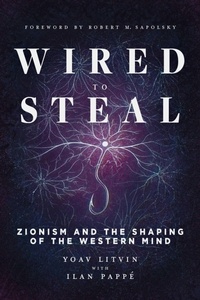
Wired to Steal
Zionism and the Shaping of the Western Mind
Will be published approx. on 3. November 2026
Book
Paperback/Softback
248 pages
978-1-62371-535-9 (ISBN)
Description
From the bestselling author of Ten Myths About Israel and a renowned neuroscientist comes a groundbreaking new book that delves into the psyche of settler colonialism and its far-reaching repercussions on history, identity, and global politics.
Since the Hamas assault of October 7, 2023, and for more than two years, Israel has been engaged in what has been described by a consensus of international experts as a genocide.
Can Israel’s actions be explained by retribution, “self-defense,” revenge, or the quest to free hostages, or are these narratives masking something deeper? How has Israel’s decades-long occupation of Palestine shaped the violence we are witnessing today?
Wired to Steal is a powerful blend of investigative narrative, history, and behavioral neuroscience. Cutting through and dismantling propaganda, it
exposes how the ruling classes of settler colonial projects hijack the human brain’s fear circuitry, systems of addiction, empathy pathways, and identity
mechanisms to make oppression feel normal, even righteous. At its core, the book is about psychological hacking: how political systems are designed to exploit human vulnerability to fear and social belonging in order to turn communities against others, justify mass violence, and conceal theft as self-defense. Zionism is presented here as the most urgent, real-time case study, yet the book’s framework applies to settler colonialism worldwide.
Drawing on decades of research in neuroscience and extensive historical scholarship, Wired to Steal combines vivid storytelling, clear science, and deep moral urgency to reveal the playbook of settler colonialism, and to offer a roadmap for dismantling it.
Since the Hamas assault of October 7, 2023, and for more than two years, Israel has been engaged in what has been described by a consensus of international experts as a genocide.
Can Israel’s actions be explained by retribution, “self-defense,” revenge, or the quest to free hostages, or are these narratives masking something deeper? How has Israel’s decades-long occupation of Palestine shaped the violence we are witnessing today?
Wired to Steal is a powerful blend of investigative narrative, history, and behavioral neuroscience. Cutting through and dismantling propaganda, it
exposes how the ruling classes of settler colonial projects hijack the human brain’s fear circuitry, systems of addiction, empathy pathways, and identity
mechanisms to make oppression feel normal, even righteous. At its core, the book is about psychological hacking: how political systems are designed to exploit human vulnerability to fear and social belonging in order to turn communities against others, justify mass violence, and conceal theft as self-defense. Zionism is presented here as the most urgent, real-time case study, yet the book’s framework applies to settler colonialism worldwide.
Drawing on decades of research in neuroscience and extensive historical scholarship, Wired to Steal combines vivid storytelling, clear science, and deep moral urgency to reveal the playbook of settler colonialism, and to offer a roadmap for dismantling it.
More details
Language
English
Place of publication
United States
Publishing group
Interlink Publishing Group, Inc
Product notice
Paperback (trade)
Unsewn / adhesive bound
Dimensions
Height: 229 mm
Width: 152 mm
Weight
231 gr
ISBN-13
978-1-62371-535-9 (9781623715359)
Copyright in bibliographic data and cover images is held by Nielsen Book Services Limited or by the publishers or by their respective licensors: all rights reserved.
Schweitzer Classification
Persons
Yoav Litvin is a doctor of neuroscience, award-winning photographer, and writer. Known for incisive political analyses and interviews, he brings a unique perspective to social movements, urban culture, and the arts. Litvin has published scientific research articles and reviews on the neuroscience of emotion in a host of academic publications in the US and Europe. His books Outdoor Gallery: New York City and 2Create: Art Collaborations in New York City are iconic documents of ephemeral art.