

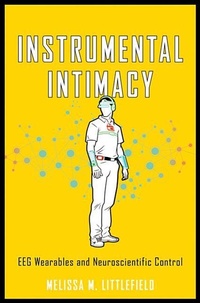
Instrumental Intimacy
EEG Wearables and Neuroscientific Control
Published on 26. April 2018
Book
Hardback
176 pages
978-1-4214-2465-1 (ISBN)
Description
A critical examination of the rise of wearable EEG monitors.
From Fitbits to GPS trackers, wearables promise to help us understand and improve ourselves in quantified ways. We count our steps, track our location, and even monitor our brain waves as we strive to achieve better fitness, clearer direction, or a more focused mind. But why do we rely on wearables to learn about ourselves? In Instrumental Intimacy, Melissa M. Littlefield questions our desire for mechanistic guidance by examining brain-based EEG wearables that promise to improve sleep, relationships, self-knowledge, and learning.
Littlefield focuses specifically on EEGs' transition out of the laboratory and into the hands of consumers. While other brain-imaging technologies (such as MRI, PET, and MEG) are used only in specialized laboratories, human electroencephalography (a.k.a. EEG) is embedded in portable, user-friendly devices. These direct-to-consumer wearables visualize brain activity as accessible data, and many offer the promise of self-optimization.
Littlefield's illuminating book brings the histories of EEG to bear on the contemporary development of EEG wearables via case studies of EEG-based sleep aids, bio-mapping instruments, fashionable surveillance tools, and athletic training devices. The author argues that, over the past century, applied uses of EEG helped to create new states of mind to be monitored and manipulated, as well as discourses about the existence of brain waves and their viability as a tool for brain optimization. By contextualizing and analyzing EEG wearables, Instrumental Intimacy provides a crucial intervention in an emergent consumer market and in the scholarly fields of STS, critical neuroscience, and the history of technology.
From Fitbits to GPS trackers, wearables promise to help us understand and improve ourselves in quantified ways. We count our steps, track our location, and even monitor our brain waves as we strive to achieve better fitness, clearer direction, or a more focused mind. But why do we rely on wearables to learn about ourselves? In Instrumental Intimacy, Melissa M. Littlefield questions our desire for mechanistic guidance by examining brain-based EEG wearables that promise to improve sleep, relationships, self-knowledge, and learning.
Littlefield focuses specifically on EEGs' transition out of the laboratory and into the hands of consumers. While other brain-imaging technologies (such as MRI, PET, and MEG) are used only in specialized laboratories, human electroencephalography (a.k.a. EEG) is embedded in portable, user-friendly devices. These direct-to-consumer wearables visualize brain activity as accessible data, and many offer the promise of self-optimization.
Littlefield's illuminating book brings the histories of EEG to bear on the contemporary development of EEG wearables via case studies of EEG-based sleep aids, bio-mapping instruments, fashionable surveillance tools, and athletic training devices. The author argues that, over the past century, applied uses of EEG helped to create new states of mind to be monitored and manipulated, as well as discourses about the existence of brain waves and their viability as a tool for brain optimization. By contextualizing and analyzing EEG wearables, Instrumental Intimacy provides a crucial intervention in an emergent consumer market and in the scholarly fields of STS, critical neuroscience, and the history of technology.
More details
Language
English
Place of publication
Baltimore, MD
United States
Target group
Professional and scholarly
Product notice
sewn/stitched
Cloth over boards
Illustrations
12 s/w Photographien bzw. Rasterbilder
12 Halftones, black and white
Dimensions
Height: 236 mm
Width: 159 mm
Thickness: 17 mm
Weight
367 gr
ISBN-13
978-1-4214-2465-1 (9781421424651)
DOI
10.1353/book.57783
Copyright in bibliographic data and cover images is held by Nielsen Book Services Limited or by the publishers or by their respective licensors: all rights reserved.
Schweitzer Classification
Other editions
Additional editions
E-Book
04/2018
Johns Hopkins University Press
€34.49
Available for download
Person
Melissa M. Littlefield is an associate professor of English and an associate professor of kinesiology and community health at the University of Illinois, Urbana-Champaign. She is the author of The Lying Brain: Lie Detection in Science and Science Fiction and the coeditor of The Neuroscientific Turn: Transdisciplinarity in the Age of the Brain.
Content
List of Figures
Acknowledgments
Introduction
1. Public Displays of Arousal
2. In the Zone
3. 'Sleeping seems to be such a natural thing'
4. Neurogeography and the City
Conclusion
Notes
References
Index
Acknowledgments
Introduction
1. Public Displays of Arousal
2. In the Zone
3. 'Sleeping seems to be such a natural thing'
4. Neurogeography and the City
Conclusion
Notes
References
Index